反思与自我纠错机制
优秀的 Agent 不仅能完成任务,还能评估自己的输出质量,发现问题并自我改进。这种能力来自反思(Reflection)机制。
📄 学术背景:反思机制是 Agent 研究中增长最快的方向之一。其核心问题是:LLM 能否意识到自己的错误,并自我修正? 以下三篇论文从不同角度给出了肯定的回答,并提出了不同的反思框架:
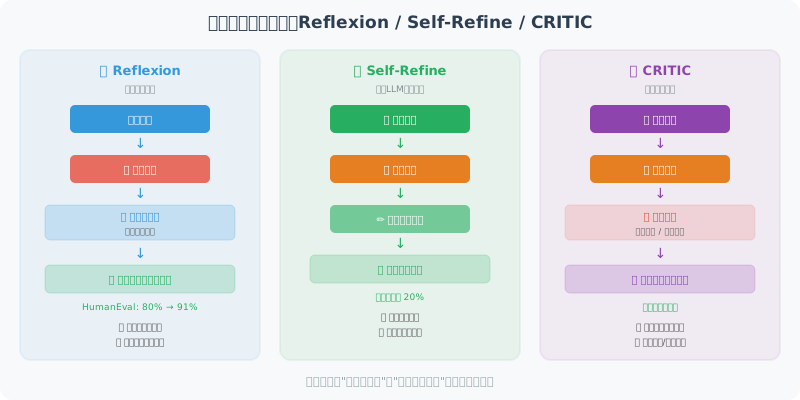
Reflexion(Reflexion: Language Agents with Verbal Reinforcement Learning,Shinn et al., 2023):提出了"语言强化学习"——Agent 在任务失败后不更新模型权重,而是将失败经验写成自然语言"反思笔记",存入长期记忆。下次遇到类似任务时,这些反思笔记会被检索出来指导行为。在 HumanEval 编程任务上,Reflexion Agent 的通过率从 80% 提升到了 91%。
Self-Refine(Self-Refine: Iterative Refinement with Self-Feedback,Madaan et al., CMU, 2023):更简洁的方案——让同一个 LLM 扮演"生成者"和"批评者"两个角色。先生成初稿,然后自我批评,再根据批评修改,如此循环直到满意。在代码生成、数学推理、对话摘要等任务上平均提升了约 20%。
CRITIC(CRITIC: Large Language Models Can Self-Correct with Tool-Interactive Critiquing,Gou et al., 2023):在自我批评的基础上引入工具验证——Agent 写完代码后运行单元测试,写完事实陈述后用搜索引擎核实。工具提供的客观反馈比纯自我批评更可靠。
基础反思循环
from openai import OpenAI

client = OpenAI()

class ReflectiveAgent:
    """具备反思能力的 Agent"""

    def __init__(self, max_reflection_rounds: int = 3):
        self.max_rounds = max_reflection_rounds

    def generate(self, task: str, context: str = "") -> str:
        """生成初始答案"""
        response = client.chat.completions.create(
            model="gpt-4o",
            messages=[
                {"role": "system", "content": context or "你是一个专业助手"},
                {"role": "user", "content": task}
            ]
        )
        return response.choices[0].message.content

    def reflect(self, task: str, output: str, criteria: list[str]) -> dict:
        """
        反思评估:检查输出是否满足标准

        Returns:
            {"score": 0-10, "passed": bool, "feedback": str, "improvements": []}
        """
        criteria_text = "\n".join([f"- {c}" for c in criteria])

        response = client.chat.completions.create(
            model="gpt-4o",
            messages=[
                {
                    "role": "user",
                    "content": f"""请评估以下输出是否满足要求,并给出改进建议。

【原始任务】
{task}

【生成输出】
{output}

【评估标准】
{criteria_text}

请返回JSON格式的评估:
{{
  "score": 0-10的评分,
  "passed": true/false(是否通过所有标准),
  "feedback": "整体反馈",
  "failed_criteria": ["未满足的标准1", "未满足的标准2"],
  "improvements": ["改进建议1", "改进建议2"]
}}"""
                }
            ],
            response_format={"type": "json_object"}
        )

        import json
        return json.loads(response.choices[0].message.content)

    def revise(self, task: str, output: str, feedback: dict) -> str:
        """基于反思反馈修改输出"""
        improvements = "\n".join([f"- {i}" for i in feedback.get("improvements", [])])
        failed = "\n".join([f"- {c}" for c in feedback.get("failed_criteria", [])])

        response = client.chat.completions.create(
            model="gpt-4o",
            messages=[
                {
                    "role": "user",
                    "content": f"""请改进以下输出,解决指出的问题。

【原始任务】
{task}

【当前输出】
{output}

【未满足的标准】
{failed}

【改进建议】
{improvements}

请给出改进后的版本:"""
                }
            ]
        )
        return response.choices[0].message.content

    def run_with_reflection(self, task: str, criteria: list[str]) -> dict:
        """
        运行反思循环:生成 → 反思 → 改进 → 循环

        Returns:
            {"final_output": str, "rounds": int, "history": list}
        """
        history = []
        current_output = self.generate(task)

        print(f"\n任务:{task}")

        for round_num in range(self.max_rounds):
            print(f"\n=== 第 {round_num + 1} 轮反思 ===")

            # 评估
            evaluation = self.reflect(task, current_output, criteria)
            score = evaluation.get("score", 0)
            passed = evaluation.get("passed", False)

            print(f"评分:{score}/10 | 通过:{passed}")
            if evaluation.get("feedback"):
                print(f"反馈:{evaluation['feedback'][:100]}")

            history.append({
                "round": round_num + 1,
                "output": current_output,
                "score": score,
                "passed": passed
            })

            # 如果通过,停止
            if passed or score >= 8:
                print(f"✅ 输出质量满足要求,停止反思")
                break

            # 改进
            if round_num < self.max_rounds - 1:
                print("🔄 正在改进...")
                current_output = self.revise(task, current_output, evaluation)

        return {
            "final_output": current_output,
            "rounds": len(history),
            "history": history
        }


# 测试
agent = ReflectiveAgent(max_reflection_rounds=3)

result = agent.run_with_reflection(
    task="写一段Python代码,实现二分查找算法",
    criteria=[
        "代码能正确运行",
        "包含详细注释",
        "有类型注解",
        "有边界情况处理",
        "代码简洁易读"
    ]
)

print(f"\n最终输出(第{result['rounds']}轮):")
print(result["final_output"])
自我纠错:发现并修复错误
def self_correcting_code_generator(requirement: str) -> str:
    """
    自我纠错的代码生成器
    生成代码 → 自动测试 → 发现错误 → 修复 → 循环
    """
    import subprocess
    import tempfile
    import os

    max_attempts = 3

    for attempt in range(max_attempts):
        print(f"\n[尝试 {attempt + 1}]")

        # 生成代码
        response = client.chat.completions.create(
            model="gpt-4o",
            messages=[
                {
                    "role": "user",
                    "content": f"""
编写Python代码完成以下需求:
{requirement}

要求:
1. 代码必须能够直接运行(包含完整的测试用例)
2. 在文件末尾添加 if __name__ == '__main__': 测试代码
3. 只返回纯Python代码,不要Markdown格式
"""
                }
            ]
        )

        code = response.choices[0].message.content

        # 清理代码(移除可能的markdown标记)
        if "```python" in code:
            code = code.split("```python")[1].split("```")[0].strip()
        elif "```" in code:
            code = code.split("```")[1].split("```")[0].strip()

        # 测试代码
        with tempfile.NamedTemporaryFile(mode='w', suffix='.py',
                                          delete=False, encoding='utf-8') as f:
            f.write(code)
            tmp_file = f.name

        try:
            result = subprocess.run(
                ["python", tmp_file],
                capture_output=True,
                text=True,
                timeout=10
            )

            if result.returncode == 0:
                print(f"✅ 代码运行成功!")
                os.unlink(tmp_file)
                return code
            else:
                error = result.stderr
                print(f"❌ 运行错误:{error[:200]}")

                # 修复错误
                fix_response = client.chat.completions.create(
                    model="gpt-4o",
                    messages=[
                        {
                            "role": "user",
                            "content": f"""以下代码有错误,请修复:

代码:
```python
{code}
错误信息: {error}
请返回修复后的完整Python代码(不要Markdown格式):"""
}
]
)
code = fix_response.choices[0].message.content
if "python" in code: code = code.split("python")[1].split("```")[0].strip()
    except subprocess.TimeoutExpired:
        print("❌ 代码执行超时")
    finally:
        try:
            os.unlink(tmp_file)
        except:
            pass

return f"# 无法生成满足要求的代码({max_attempts}次尝试后)\n" + code
测试
code = self_correcting_code_generator( "实现一个函数,计算列表中所有偶数的平均值,如果没有偶数返回0" ) print(code)
---

## 小结

反思机制的价值:
- **质量保证**:多轮评估确保输出满足标准
- **自动纠错**:发现并修复错误,无需人工干预
- **持续改进**:每轮反思都让输出更接近目标
- **适用场景**:代码生成、内容写作、复杂分析

> 📖 **想深入了解反思与自我纠错的学术前沿?** 请阅读 [6.6 论文解读:规划与推理前沿研究](./06_paper_readings.md),涵盖 Reflexion、Self-Refine、CRITIC 等论文的深度解读,以及自我纠错的边界与局限。
>
> 💡 **实践建议**:在实际 Agent 中实现反思时,**永远要设置最大迭代次数**(通常 2-3 轮就足够了),并优先使用有工具反馈的反思方式(如运行测试、查询数据库)。纯自我批评适合主观任务(如写作风格改进),而需要客观正确性的任务(如代码、数据分析)必须有外部验证。

---

*下一节:[6.5 实战:自动化研究助手 Agent](./05_practice_research_agent.md)*