10.6 实战:完整 Agentic-RL 训练 Pipeline
项目概述与实验设计
本节将从零构建一个完整的 Agentic-RL 训练项目,验证前四节介绍的所有理论与方法。
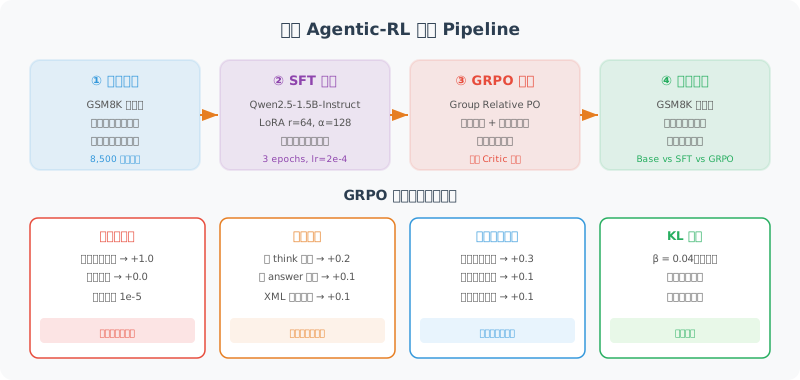
实验目标:训练一个能够使用计算器工具解决数学推理问题的 Agent 模型
基座模型:
Qwen/Qwen2.5-1.5B-Instruct(消费级 GPU 可训练)数据集:GSM8K [1](8,500 条小学数学应用题,含标准答案)
训练流程:数据准备 → SFT(格式学习)→ GRPO(推理优化)→ 评估对比
为什么选择 GSM8K?
GSM8K 是验证 Agentic-RL 效果的理想基准数据集,具备以下关键特性:
| 特性 | 说明 | 对训练的意义 |
|---|---|---|
| 客观可验证 | 每题有唯一正确的数值答案 | 可自动计算准确率,无需人工标注奖励 |
| 多步推理 | 平均需要 3–5 个推理步骤 | 能充分测试 Agent 的链式推理能力 |
| 规模适中 | 7,473 训练题 + 1,319 测试题 | 训练成本可控,结果具有统计显著性 |
| 社区基准 | 广泛用于 LLM 评估 | 有大量公开基准数据可供对比 |
硬件需求与预期训练时间
| 配置 | SFT 阶段 | GRPO 阶段 | 备注 |
|---|---|---|---|
| 最低配置 | 1× RTX 3090 24GB | 1× RTX 3090 24GB | 需开启 QLoRA 4-bit 量化 |
| 推荐配置 | 1× A100 40GB | 1× A100 40GB | 全精度 bfloat16 训练 |
| 训练时间(最低配置) | 约 2–4 小时 | 约 4–8 小时 | 1.5B 模型,3 个 epoch |
Step 1:环境搭建
# 创建项目目录与虚拟环境
mkdir -p agent-rl-training && cd agent-rl-training
python -m venv venv && source venv/bin/activate

# 安装核心依赖(版本经过兼容性验证)
pip install torch>=2.1.0
pip install transformers>=4.40.0
pip install peft>=0.10.0
pip install trl>=0.12.0
pip install datasets accelerate bitsandbytes
pip install wandb tensorboard          # 实验追踪(强烈推荐)
Step 2:数据准备
"""
step2_prepare_data.py

将 GSM8K 原始数据转换为 Agent 格式的 SFT 训练数据。

GSM8K 原始格式:
  question: "Natalia sold clips to 48 of her friends..."
  answer:   "Natalia sold 48/2 = <<48/2=24>>24 clips... #### 72"

目标格式(Agent 轨迹):
  <think>推理过程</think>
  <tool_call>calculator(expression="...")</tool_call>
"""

import re
from datasets import load_dataset, Dataset


def extract_final_answer(solution: str) -> str:
    """从 GSM8K 解答中提取 '#### 数字' 格式的最终答案"""
    match = re.search(r'####\s*(.+)', solution)
    return match.group(1).strip().replace(",", "") if match else ""


def extract_calculations(solution: str) -> list[str]:
    """提取 GSM8K 解答中的计算表达式(格式:<<expr=result>>)"""
    return re.findall(r'<<(.+?)=.+?>>', solution)


def convert_to_agent_format(example: dict) -> dict:
    """
    将 GSM8K 样本转换为 Agent SFT 训练格式

    转换策略:
    1. 提取推理步骤作为 <think> 内容
    2. 提取最后一个计算表达式作为 <tool_call> 参数
    3. 构建完整的 ChatML 格式对话
    """
    question = example["question"]
    solution = example["answer"]
    final_answer = extract_final_answer(solution)
    calculations = extract_calculations(solution)

    # 提取推理步骤(去除 #### 行和计算标注)
    steps = [
        re.sub(r'<<.+?>>', '', line).strip()
        for line in solution.split("\n")
        if line.strip() and "####" not in line
    ]
    think_content = "\n".join(steps)

    # 构建 Agent 格式回答
    if calculations:
        # 使用最后一个计算表达式(通常是最终计算步骤)
        final_expr = calculations[-1]
        agent_response = (
            f"<think>\n{think_content}\n"
            f"最终需要计算:{final_expr}\n</think>\n\n"
            f"<tool_call>\ncalculator(expression=\"{final_expr}\")\n</tool_call>"
        )
    else:
        agent_response = (
            f"<think>\n{think_content}\n</think>\n\n"
            f"最终答案是 **{final_answer}**。"
        )

    # 构建 ChatML 格式对话
    conversation = (
        "<|im_start|>system\n"
        "你是一个数学助手。解题时请先在 <think> 标签中写出完整的推理过程,"
        "需要精确计算时使用 calculator 工具。\n"
        "<|im_end|>\n"
        f"<|im_start|>user\n{question}\n<|im_end|>\n"
        f"<|im_start|>assistant\n{agent_response}\n<|im_end|>"
    )

    return {
        "text": conversation,
        "question": question,
        "answer": final_answer,
    }


# ── 加载并转换数据集 ──────────────────────────────────────────────────────
print("📦 加载 GSM8K 数据集...")
dataset = load_dataset("openai/gsm8k", "main")

print("🔄 转换为 Agent 格式...")
sft_train = dataset["train"].map(convert_to_agent_format, remove_columns=dataset["train"].column_names)
sft_test  = dataset["test"].map(convert_to_agent_format, remove_columns=dataset["test"].column_names)

print(f"✅ 训练集:{len(sft_train)} 条 | 测试集:{len(sft_test)} 条")

# 数据质量验证
valid_train = sft_train.filter(lambda x: "<think>" in x["text"] and x["answer"] != "")
print(f"📊 格式验证通过率:{len(valid_train) / len(sft_train):.1%}")

sft_train.save_to_disk("./data/sft_train")
sft_test.save_to_disk("./data/sft_test")
Step 3:SFT 训练
"""
step3_sft_training.py

SFT 阶段:通过模仿学习让模型习得 Agent 行为格式。
目标:将基座模型的格式符合率从 ~5% 提升至 ~85%+。
"""

import torch
from transformers import AutoModelForCausalLM, AutoTokenizer, BitsAndBytesConfig
from peft import LoraConfig, TaskType
from trl import SFTConfig, SFTTrainer
from datasets import load_from_disk

# ── 数据加载 ──────────────────────────────────────────────────────────────
train_dataset = load_from_disk("./data/sft_train")
eval_dataset  = load_from_disk("./data/sft_test")

# ── 模型加载(QLoRA 配置)────────────────────────────────────────────────
model_name = "Qwen/Qwen2.5-1.5B-Instruct"

bnb_config = BitsAndBytesConfig(
    load_in_4bit=True,
    bnb_4bit_quant_type="nf4",
    bnb_4bit_compute_dtype=torch.bfloat16,
    bnb_4bit_use_double_quant=True,
)

model = AutoModelForCausalLM.from_pretrained(
    model_name,
    quantization_config=bnb_config,
    device_map="auto",
    trust_remote_code=True,
)
tokenizer = AutoTokenizer.from_pretrained(model_name)
tokenizer.pad_token = tokenizer.eos_token

# ── LoRA 配置 ─────────────────────────────────────────────────────────────
# 1.5B 模型使用 r=16 即可,参数量约 8M(占总参数量 ~0.5%)
lora_config = LoraConfig(
    task_type=TaskType.CAUSAL_LM,
    r=16,
    lora_alpha=32,
    lora_dropout=0.05,
    target_modules=["q_proj", "k_proj", "v_proj", "o_proj"],
)

# ── 训练配置 ──────────────────────────────────────────────────────────────
sft_config = SFTConfig(
    output_dir="./checkpoints/sft",

    num_train_epochs=3,
    per_device_train_batch_size=4,
    gradient_accumulation_steps=4,      # 有效 batch size = 16
    learning_rate=2e-4,
    warmup_ratio=0.1,
    weight_decay=0.01,
    lr_scheduler_type="cosine",

    bf16=True,
    gradient_checkpointing=True,

    logging_steps=10,
    eval_strategy="steps",
    eval_steps=200,
    save_strategy="steps",
    save_steps=200,
    save_total_limit=3,
    load_best_model_at_end=True,        # 自动加载验证集最优检查点

    max_seq_length=1024,
    dataset_text_field="text",
    report_to="tensorboard",
)

# ── 训练执行 ──────────────────────────────────────────────────────────────
trainer = SFTTrainer(
    model=model,
    args=sft_config,
    train_dataset=train_dataset,
    eval_dataset=eval_dataset.select(range(200)),
    peft_config=lora_config,
    processing_class=tokenizer,
)

print("🚀 开始 SFT 训练...")
print(f"   模型:{model_name} | LoRA r={lora_config.r} | 训练数据:{len(train_dataset)} 条")
trainer.train()

trainer.save_model("./checkpoints/sft-final")
tokenizer.save_pretrained("./checkpoints/sft-final")
print("✅ SFT 训练完成!")
Step 4:GRPO 强化学习训练
"""
step4_grpo_training.py

GRPO 阶段:通过强化学习信号引导模型探索超越 SFT 数据质量的推理策略。
目标:在 SFT 基础上,将准确率进一步提升 10–20 个百分点。
"""

import re
import torch
from transformers import AutoModelForCausalLM, AutoTokenizer
from peft import PeftModel
from trl import GRPOConfig, GRPOTrainer
from datasets import load_from_disk

# ── 加载 SFT 模型(合并 LoRA 权重)──────────────────────────────────────
model_name = "Qwen/Qwen2.5-1.5B-Instruct"

base_model = AutoModelForCausalLM.from_pretrained(
    model_name,
    torch_dtype=torch.bfloat16,
    device_map="auto",
    trust_remote_code=True,
)
model = PeftModel.from_pretrained(base_model, "./checkpoints/sft-final")
model = model.merge_and_unload()   # 合并 LoRA 权重,恢复标准模型结构

tokenizer = AutoTokenizer.from_pretrained(model_name)
tokenizer.pad_token = tokenizer.eos_token

# ── 准备 GRPO 训练数据(需要 "prompt" 字段)──────────────────────────────
train_dataset = load_from_disk("./data/sft_train")

def prepare_grpo_prompt(example: dict) -> dict:
    """将训练样本转换为 GRPO 所需的 prompt 格式"""
    return {
        "prompt": (
            "<|im_start|>system\n"
            "你是一个数学助手。解题时请先在 <think> 标签中写出完整的推理过程,"
            "需要精确计算时使用 calculator 工具。\n"
            "<|im_end|>\n"
            f"<|im_start|>user\n{example['question']}\n<|im_end|>\n"
            "<|im_start|>assistant\n"
        ),
        "answer": example["answer"],
    }

grpo_dataset = train_dataset.map(prepare_grpo_prompt)

# ── 奖励函数:数学 Agent 综合评估 ────────────────────────────────────────
def math_agent_reward(completions: list[str], **kwargs) -> list[float]:
    """
    数学 Agent 综合奖励函数

    奖励维度及权重:
    - 准确率(0.50):最终数值是否正确(允许 1% 相对误差)
    - 格式(0.20):<think>/<tool_call> 标签是否规范
    - 推理质量(0.20):推理步骤是否充分、包含计算过程
    - 简洁性(0.10):输出长度是否合理
    """
    rewards = []
    answers = kwargs.get("answer", [""] * len(completions))

    for completion, answer in zip(completions, answers):
        reward = 0.0

        # ── 维度 1:准确率(权重 0.50)────────────────────────────────────
        try:
            numbers = re.findall(r'-?[\d,]+\.?\d*', completion)
            if numbers:
                pred = float(numbers[-1].replace(",", ""))
                true_val = float(str(answer).replace(",", ""))
                if abs(pred - true_val) / (abs(true_val) + 1e-8) < 0.01:
                    reward += 0.50
        except (ValueError, TypeError, ZeroDivisionError):
            pass

        # ── 维度 2:格式正确性(权重 0.20)───────────────────────────────
        has_think = "<think>" in completion and "</think>" in completion
        if has_think:
            reward += 0.10
            think = completion.split("<think>")[1].split("</think>")[0].strip()
            if len(think) > 20:
                reward += 0.10   # 有实质性推理内容

        # ── 维度 3:推理质量(权重 0.20)─────────────────────────────────
        if has_think:
            think = completion.split("<think>")[1].split("</think>")[0]
            lines = [l.strip() for l in think.split("\n") if l.strip()]
            if len(lines) >= 2:
                reward += 0.10   # 多步推理
            if re.search(r'[\d+\-*/=]', think):
                reward += 0.10   # 包含数学计算过程

        # ── 维度 4:简洁性(权重 0.10)───────────────────────────────────
        token_count = len(completion.split())
        if token_count <= 300:
            reward += 0.10
        elif token_count > 800:
            reward -= 0.05   # 过长惩罚

        rewards.append(max(0.0, reward))

    return rewards

# ── GRPO 训练配置 ─────────────────────────────────────────────────────────
grpo_config = GRPOConfig(
    output_dir="./checkpoints/grpo",

    num_generations=8,               # G=8:每题生成 8 个回答用于组内比较
    num_train_epochs=1,              # GRPO 通常 1–2 个 epoch
    per_device_train_batch_size=1,
    gradient_accumulation_steps=8,
    learning_rate=5e-6,              # RL 学习率 ≈ SFT 学习率的 1/40
    warmup_ratio=0.1,
    max_grad_norm=0.5,               # 梯度裁剪,防止 RL 训练中的梯度爆炸

    max_new_tokens=512,
    temperature=0.7,                 # 保证 G 个回答的多样性

    kl_coef=0.05,                    # KL 散度惩罚系数

    bf16=True,
    logging_steps=1,
    save_strategy="steps",
    save_steps=100,
    save_total_limit=3,
    report_to="tensorboard",
)

# ── 训练执行 ──────────────────────────────────────────────────────────────
trainer = GRPOTrainer(
    model=model,
    config=grpo_config,
    train_dataset=grpo_dataset,
    processing_class=tokenizer,
    reward_funcs=math_agent_reward,
)

print("🚀 开始 GRPO 训练...")
print(f"   组大小 G={grpo_config.num_generations} | 学习率={grpo_config.learning_rate} | KL 系数={grpo_config.kl_coef}")
trainer.train()
trainer.save_model("./checkpoints/grpo-final")
print("✅ GRPO 训练完成!")
Step 5:系统性评估与对比分析
"""
step5_evaluation.py

对比评估三个阶段的模型性能:
  基座模型(Baseline)→ SFT 模型 → GRPO 模型

评估指标:
  - 准确率(Accuracy):最终答案正确率
  - 格式符合率(Format Compliance):<think> 标签使用率
  - 平均输出长度(Avg. Length):Token 数
"""

import re
import torch
from transformers import AutoModelForCausalLM, AutoTokenizer
from datasets import load_from_disk


def evaluate_model(
    model_path: str,
    test_data,
    num_samples: int = 200,
    device: str = "cuda",
) -> dict:
    """
    在 GSM8K 测试集上评估模型性能

    Args:
        model_path:  模型路径(HuggingFace 格式)
        test_data:   测试数据集
        num_samples: 评估样本数(完整评估用 1319)

    Returns:
        包含各项指标的评估结果字典
    """
    model = AutoModelForCausalLM.from_pretrained(
        model_path, torch_dtype=torch.bfloat16, device_map="auto"
    )
    tokenizer = AutoTokenizer.from_pretrained(model_path)

    correct = 0
    format_ok = 0
    total_tokens = 0
    total = 0

    for example in test_data.select(range(num_samples)):
        prompt = (
            "<|im_start|>system\n"
            "你是一个数学助手。解题时请先在 <think> 标签中写出完整的推理过程,"
            "需要精确计算时使用 calculator 工具。\n"
            "<|im_end|>\n"
            f"<|im_start|>user\n{example['question']}\n<|im_end|>\n"
            "<|im_start|>assistant\n"
        )

        inputs = tokenizer(prompt, return_tensors="pt").to(model.device)
        with torch.no_grad():
            outputs = model.generate(
                **inputs,
                max_new_tokens=512,
                temperature=0.1,
                do_sample=True,
            )

        response = tokenizer.decode(
            outputs[0][inputs["input_ids"].shape[1]:],
            skip_special_tokens=True,
        )

        # 准确率评估
        try:
            true_val = float(example["answer"].replace(",", ""))
            numbers = re.findall(r'-?[\d,]+\.?\d*', response)
            if numbers:
                pred = float(numbers[-1].replace(",", ""))
                if abs(pred - true_val) / (abs(true_val) + 1e-8) < 0.01:
                    correct += 1
        except (ValueError, ZeroDivisionError):
            pass

        # 格式符合率
        if "<think>" in response and "</think>" in response:
            format_ok += 1

        total_tokens += len(response.split())
        total += 1

    del model   # 释放显存,为下一个模型腾出空间

    return {
        "accuracy":          correct / total,
        "format_compliance": format_ok / total,
        "avg_length":        total_tokens / total,
        "total_samples":     total,
    }


# ── 评估三个阶段的模型 ────────────────────────────────────────────────────
test_data = load_from_disk("./data/sft_test")

models_to_eval = [
    ("🔵 基座模型",  "Qwen/Qwen2.5-1.5B-Instruct"),
    ("🟡 SFT 模型",  "./checkpoints/sft-merged"),
    ("🟢 GRPO 模型", "./checkpoints/grpo-final"),
]

results = {}
for name, path in models_to_eval:
    print(f"\n{name} 评估中...")
    results[name] = evaluate_model(path, test_data, num_samples=200)

# ── 结果展示 ──────────────────────────────────────────────────────────────
print("\n" + "=" * 65)
print("📈 Agentic-RL 训练效果对比(GSM8K 测试集,n=200)")
print("=" * 65)
print(f"{'指标':<20} {'基座模型':>12} {'SFT':>12} {'GRPO':>12}")
print("-" * 65)

metrics = [
    ("准确率",     "accuracy",          ".1%"),
    ("格式符合率", "format_compliance", ".1%"),
    ("平均输出长度", "avg_length",      ".0f"),
]

for label, key, fmt in metrics:
    row = f"{label:<20}"
    for name, _ in models_to_eval:
        val = results[name][key]
        row += f" {val:>11{fmt}}"
    print(row)

print("=" * 65)
print("\n📌 预期结果参考(Qwen2.5-1.5B):")
print("   基座模型:准确率 ~35–45%,格式符合率 ~5%")
print("   SFT 后:  准确率 ~45–55%,格式符合率 ~85%")
print("   GRPO 后: 准确率 ~55–65%,格式符合率 ~90%")
Step 6:模型导出与部署
"""
step6_export.py

将训练好的模型导出为生产可用的格式。
支持 HuggingFace 格式(用于 vLLM/TGI 部署)和 GGUF 格式(用于本地部署)。
"""

import torch
from transformers import AutoModelForCausalLM, AutoTokenizer

# ── 加载最终模型 ──────────────────────────────────────────────────────────
model = AutoModelForCausalLM.from_pretrained(
    "./checkpoints/grpo-final",
    torch_dtype=torch.bfloat16,
)
tokenizer = AutoTokenizer.from_pretrained("./checkpoints/grpo-final")

# ── 方式 1:HuggingFace 格式(推荐用于服务端部署)────────────────────────
# 兼容 vLLM、Text Generation Inference (TGI)、Ollama 等推理框架
model.save_pretrained("./export/hf-model", safe_serialization=True)
tokenizer.save_pretrained("./export/hf-model")
print("✅ HuggingFace 格式已导出至 ./export/hf-model")

# ── 方式 2:GGUF 格式(用于 llama.cpp / Ollama 本地部署)────────────────
# 需要安装 llama.cpp 并使用其转换脚本
# python llama.cpp/convert_hf_to_gguf.py ./export/hf-model \
#     --outtype q4_k_m \
#     --outfile ./export/model-q4_k_m.gguf
print("💡 GGUF 格式转换命令:")
print("   python llama.cpp/convert_hf_to_gguf.py ./export/hf-model \\")
print("       --outtype q4_k_m --outfile ./export/model-q4_k_m.gguf")
完整项目结构
agent-rl-training/
├── data/
│   ├── sft_train/              # SFT 训练数据(7,473 条 Agent 格式轨迹)
│   └── sft_test/               # 评估数据(1,319 条)
├── checkpoints/
│   ├── sft/                    # SFT 训练检查点(含 TensorBoard 日志)
│   ├── sft-final/              # SFT 最终 LoRA 适配器权重
│   ├── sft-merged/             # SFT 合并后的完整模型(用于 GRPO 初始化)
│   ├── grpo/                   # GRPO 训练检查点
│   └── grpo-final/             # GRPO 最终模型(用于评估和部署)
├── export/
│   ├── hf-model/               # HuggingFace 格式(服务端部署)
│   └── model-q4_k_m.gguf       # GGUF 格式(本地部署,可选)
├── step2_prepare_data.py
├── step3_sft_training.py
├── step4_grpo_training.py
├── step5_evaluation.py
├── step6_export.py
└── requirements.txt
📌 工程实践要点
- 实验追踪:强烈建议使用 wandb 或 MLflow 记录每次训练的超参数、损失曲线和评估指标,便于复现和对比
- 数据增强:可用 GPT-4 对 GSM8K 题目进行改写,生成更多样化的训练数据,通常能带来 2–5% 的准确率提升
- 课程学习(Curriculum Learning):先用简单题(1–2 步推理)训练,再逐步引入复杂题(4–5 步推理),收敛速度通常更快
- 模型规模效应:本教程使用 1.5B 模型作为教学演示;实际生产中,7B–14B 模型的 GRPO 提升幅度更显著(通常 15–25%)
- 成本估算:A100 40GB 上,1.5B 模型完整训练约需 6–12 小时;7B 模型约需 24–48 小时;14B 模型约需 48–96 小时
本章总结
通过本章的系统学习,你已掌握了 Agentic-RL 训练的完整知识体系:
| 章节 | 核心知识点 | 关键结论 |
|---|---|---|
| 10.1 概述 | MDP 建模、两阶段范式 | RL 训练可涌现出超越训练数据的推理策略 |
| 10.2 SFT + LoRA | 监督微调、参数高效训练 | LoRA 以 <1% 的参数量实现接近全参数微调的效果 |
| 10.3 PPO | 策略梯度、重要性采样、优势函数、Clip 机制 | PPO 是 RLHF 的经典算法,但 Critic 导致显存占用 ≈ 3× |
| 10.4 DPO | 隐式奖励、Bradley-Terry 模型、闭式解 | DPO 将 RL 转化为监督学习,极简但无法在线探索 |
| 10.5 GRPO + 奖励设计 | 组内比较、多维度奖励、奖励黑客防御 | GRPO 将显存需求从 3× 降至 1.5×;奖励函数是 RL 训练效果的决定性因素 |
| 10.6 实战 | 完整 Pipeline、评估对比 | GSM8K 上:基座 ~40% → SFT ~50% → GRPO ~60% |
Agentic-RL 代表了 LLM 应用的一个重要发展方向:从"提示工程"到"训练优化"的范式转变。随着算法的持续演进和计算成本的降低,这一技术将在越来越多的高价值 Agent 场景中发挥关键作用。
参考文献
[1] COBBE K, KOSARAJU V, BAVARIAN M, et al. Training verifiers to solve math word problems[R]. arXiv preprint arXiv:2110.14168, 2021.
[2] DEEPSEEK AI. DeepSeek-R1: Incentivizing reasoning capability in LLMs via reinforcement learning[R]. arXiv preprint arXiv:2501.12948, 2025.
[3] HU E J, SHEN Y, WALLIS P, et al. LoRA: Low-rank adaptation of large language models[C]//International Conference on Learning Representations (ICLR). 2022.
[4] SHAO Z, WANG P, ZHU Q, et al. DeepSeekMath: Pushing the limits of mathematical reasoning in open language models[R]. arXiv preprint arXiv:2402.03300, 2024.
[5] BENGIO Y, LOURADOUR J, COLLOBERT R, et al. Curriculum learning[C]//International Conference on Machine Learning (ICML). 2009.