Feature Augmentation and Diversity Optimization
📝 Before You Continue: Finish 10.1 and 10.2 first — this section's AsymDiffRec and DMSG take the denoising capability beyond "augmenting data" into "augmenting features" and "optimizing outputs."
10.2 used diffusion to generate pseudo-interactions, easing data sparsity and cold start. This section explores the practical value of diffusion from two other angles: feature augmentation and diversity optimization.
In industrial recommendation, missing features are pervasive — incomplete user profiles and absent item attributes directly degrade prediction quality. Meanwhile, traditional deterministic recommendation tends to suggest similar content, and insufficient diversity hurts the experience. Diffusion models offer new approaches to both: denoising is naturally suited to incomplete inputs, and the random sampling mechanism intrinsically supports diversity. This section covers two deployed methods: AsymDiffRec, which uses asymmetric diffusion for feature completion, and DMSG, which uses conditional diffusion to generate diverse recommendation lists.
After reading this section, you will be able to:
- Describe AsymDiffRec's asymmetric design of "discrete forward + latent reverse" and its two losses
- Explain why dropout on discrete features fits real recommendation missingness better than Gaussian noise
- Recount DMSG's slate generation pipeline and its v-prediction parameterization
- Critically assess the applicability boundaries of diffusion in recommendation (latency, supporting infrastructure)
- Complete 4 tiered practice problems
10.3.0 From "Augmenting Data" to "Augmenting Features and Outputs"
Existing diffusion recommenders (such as DiffRec) follow the standard CV recipe: symmetric forward/reverse processes, both using Gaussian noise. But recommendation input features are mostly discrete (user ID, gender, item category); adding continuous Gaussian noise to latent representations of discrete features produces noised representations that do not correspond to any real sample — robustness to Gaussian noise ≠ robustness to the real noise in recommendation. Moreover, the symmetric process may make the model over-attend to noise reconstruction while neglecting personalization information.
💡 Key Insight: Copying diffusion wholesale into recommendation causes a mismatch. Both methods in this section reshape the diffusion process for real recommendation pain points — rather than naively applying the image paradigm. This is the general wisdom for bringing diffusion to recommendation.
🧠 Mental Model: Missing Puzzle Pieces vs a Blurry Photo
Standard diffusion is like adding fog (Gaussian noise) to a "clear photo" — just remove the fog. But missing features in recommendation are more like a puzzle missing a few pieces — not blur, but structural gaps. AsymDiffRec's discrete dropout simulates exactly those "missing pieces," which is closer to reality than adding fog.
10.3.1 Feature Augmentation: AsymDiffRec
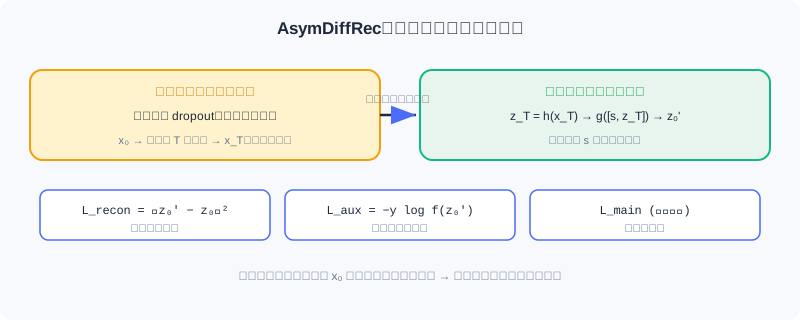
AsymDiffRec proposes asymmetric diffusion for two pain points: discrete data-space mismatch (Gaussian noise does not represent real samples) and personalization loss (the symmetric process prioritizes noise over personalization). Its core: the forward process replaces Gaussian noise with discrete feature dropout, the reverse process switches from the raw feature space to the latent representation space, and a task-oriented auxiliary loss preserves personalization.
Discrete Forward Process
Given a sample with features , the forward process performs steps of feature dropout, each randomly dropping one feature, producing the noised sequence . The number of diffusion steps .
The key: after steps, is a sample missing features — highly consistent with online feature missingness (incomplete collection, privacy settings, service failures). So dropout as "noise" matches reality better than Gaussians.
Asymmetric Reverse Process
AsymDiffRec's key innovation: the reverse and forward processes are not in the same space. The forward runs in the raw feature space (dropout); the reverse completes directly in the latent representation space. Let the feature extractor be ; for the noised sample , first extract , and the denoising function takes and the step embedding as input to produce the denoised representation:
The step embedding is a binary vector where marks the corresponding feature as missing, giving the denoiser information about missing positions. Training is driven by a reconstruction loss:
The asymmetry advantage: running the reverse in the raw space (reconstructing missing features, then feeding the extractor) would incur information loss twice (reverse reconstruction + feature extraction); reversing directly in the latent space avoids this — and the latent representation is exactly what recommendation ultimately consumes.
Task-Oriented Auxiliary Loss
Reconstruction loss alone cannot guarantee that personalization is preserved. AsymDiffRec introduces an auxiliary task loss that predicts directly from the denoised representation:
where is a prediction head and is the ground-truth label. This ensures the denoised representation is not only close to the complete representation in L2, but also performs well on downstream prediction.
Training pipeline: ① sample ; ② run the discrete forward to get ; ③ run the asymmetric reverse to get ; ④ jointly optimize .
Inference pipeline: unlike most diffusion recommenders, AsymDiffRec also uses the diffusion module at inference. Online inputs often have missing features; treat them directly as "noised samples," mark the missing positions with the step embedding , and denoise to produce the completed representation . Since the denoising function is a simple two-layer network, the latency impact is minimal.
📊 Data Point: In industrial offline experiments, AsymDiffRec achieved a relative AUC gain of +0.1% and UAUC +1.68%, outperforming CDAE, MultiVAE, self-supervised learning, DiffRec, and others. Ablations show the reconstruction loss and auxiliary task loss are both indispensable — removing the auxiliary loss drops AUC below baseline, showing how critical preserving personalization information is.
10.3.2 Diversity Optimization: DMSG
Scenarios such as music playlists and e-commerce bundles require generating a group of items (a slate) for consumption as a whole, considering coordination among items and overall quality — a combinatorial optimization problem (candidate combinations grow exponentially). Traditional methods assume the user interacts with only one item in the slate (reducing it to single-item recommendation), and deterministic retrieval always returns the same results for the same input, lacking diversity.
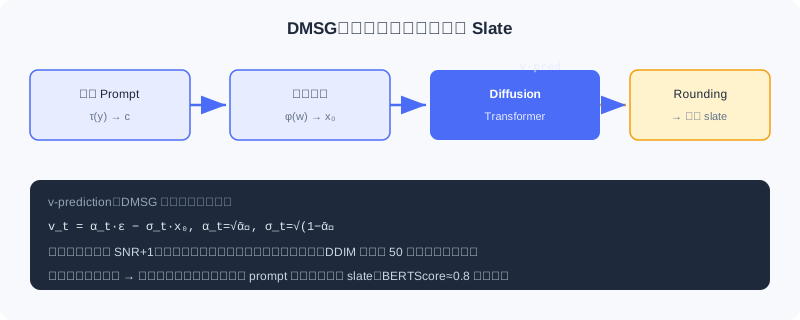
DMSG (Diffusion Model for Slate Generation) models slate generation as a conditional generation problem, using diffusion to generate a complete item slate directly from a text prompt. It has three core components:
- Encoding module — converts the discrete item sequence via an embedding function into a continuous representation . It uses a pretrained, frozen encoder that is not jointly trained with the diffusion model, improving stability — and when the catalog updates, only the encoder needs updating.
- Condition module — maps the text prompt to the condition using a Transformer encoding layer, injected into the diffusion via cross-attention.
- Diffusion process module — the core generative module: the forward noises the slate's latent representation, and the reverse recovers it guided by the condition ; the denoising network is a Diffusion Transformer that fuses the condition via cross-attention.
v-prediction Parameterization
10.1 introduced ε-prediction and x₀-prediction; DMSG adopts a third option: v-prediction — predicting the "velocity" , where . From we can recover and . Its advantage: the loss weight is "SNR+1," giving reasonable gradients in both high- and low-SNR regions for more stable training. The loss:
Generation and Decoding
At inference: ① encode the prompt ; ② sample ; ③ iterate conditional denoising; ④ convert the final continuous representation back to a discrete item sequence via rounding (nearest item at each position). To meet latency requirements, DMSG uses DDIM acceleration, cutting inference steps from over a thousand during training down to 50, reaching millisecond-level generation.
Diversity Analysis
DMSG has a natural advantage in diversity, rooted in its random sampling mechanism:
- Item popularity distribution — unlike deterministic retrieval such as BM25, which biases toward high-frequency items, random sampling in the continuous latent space gives low-popularity but semantically relevant items a chance of being selected.
- Freshness of generated results — the same prompt yields different slates on each generation, with comparable quality (BERTScore stable around 0.8) and plenty of new items each time. Users repeatedly requesting the same topic still get different lists, aiding content discovery and retention.
Analysis: AsymDiffRec and DMSG share a common core — reshaping the diffusion process for real recommendation needs instead of applying the image paradigm. The former's asymmetric design solves missing features; the latter's random sampling solves diversity. Both are validated online. Still, diffusion remains some distance from directly replacing discriminative online serving: the latency of multi-step denoising and the supporting infrastructure required for end-to-end generation (e.g., semantic IDs) remain practical constraints on large-scale deployment. The complementarity of diffusion with Transformers, and its fusion with RL / multimodality, remain open directions.
⚠️ Common Mistakes in 10.3
| # | Mistake | Example | Why It's Wrong | Fix |
|---|---|---|---|---|
| 1 | Copying symmetric Gaussian diffusion into recommendation | "Add Gaussian noise and denoise just like images" | Recommendation features are discrete; Gaussians don't represent real missingness | Use AsymDiffRec's discrete dropout |
| 2 | Ignoring personalization loss | Train the diffusion with reconstruction loss only | The model prioritizes noise over personalization; AUC drops | Add the task-oriented auxiliary loss L_aux |
| 3 | Assuming DMSG only uses ε/x₀ prediction | "DMSG just applies DDPM's ε-pred" | DMSG's v-prediction is more stable | Recognize v-pred (SNR+1 weighting) |
| 4 | Overestimating diffusion as a discriminative replacement | "Fully replace ranking with diffusion" | Multi-step denoising latency is high; semantic IDs and other infrastructure required | Treat diffusion as an augmentation tool, not an end-to-end replacement |
Chapter Summary
📌 Key Takeaways
| Concept | Key Points | Why It Matters |
|---|---|---|
| AsymDiffRec | Discrete forward (dropout) + latent reverse + auxiliary loss | Solves industrial missing features; deployed online |
| Asymmetric design | Forward in raw space, reverse in latent space | Avoids double information loss |
| DMSG | Conditional diffusion + v-pred + DDIM | Generates diverse slates; deployed online |
| Source of diversity | Random sampling → long-tail / freshness | Breaks the homogenization of deterministic retrieval |
| Applicability boundary | Latency / supporting infrastructure constrain large-scale deployment | Diffusion is a tool, not an end-to-end replacement |
❓ FAQ
Q1: Why does AsymDiffRec use discrete dropout instead of Gaussian noise?
A: Recommendation features are discrete; Gaussian-noised representations don't correspond to any real sample. Online feature missingness is a "structural gap," and dropout simulates exactly this real missingness — denoising is then completion.
Q2: What's good about DMSG's v-prediction?
A: v = αₜε − σₜx₀; its loss weight is SNR+1, giving reasonable gradients in both high- and low-SNR regions — more stable training than ε/x₀-pred.
Q3: Can diffusion directly replace discriminative ranking?
A: Not yet — multi-step iterative denoising brings latency, and end-to-end generative recommendation requires supporting infrastructure such as semantic IDs. The methods in this part are augmentation tools for data / features / diversity, complementary to Transformers.
🔗 Connections to Later Chapters
- 10.1 (basics) AsymDiffRec's asymmetry and DMSG's v-pred and DDIM all build on 10.1's mechanisms.
- 10.2 (data augmentation) belongs to the same "diffusion as a generative tool" through-line, moving from data → features / outputs.
- 5.3 / 9.x (generative through-line) Diffusion is the continuous-space branch of the generative family, advancing in tandem with autoregressive generation and explicit reasoning.
Practice Problems
Work through all problems in order — they get progressively harder. Each has a complete solution you can reveal after trying yourself.
Problem 10.3.1 — Judging the Asymmetric Design 🟢 Easy
Determine whether each description below belongs to AsymDiffRec's "forward" or "reverse" space:
- (a) Randomly dropping features in the raw feature space
- (b) Denoising in the latent representation space with g([s, z_T])
- (c) The step embedding s marking which features are missing
💡 Solution (click to reveal)
Approach: Check against the asymmetric design.
- (a) Forward (raw feature space, discrete dropout)
- (b) Reverse (latent representation space)
- (c) Reverse (the step embedding is used for denoising in the latent space)
Key points:
- Forward = dropout in raw space; reverse = denoising in latent space.
- Asymmetry means "two stages, two different spaces."
Problem 10.3.2 — The Role of the Auxiliary Loss 🟢 Easy
After removing , AsymDiffRec's AUC even falls below baseline. Explain why.
💡 Solution (click to reveal)
Approach: Analyze from the personalization perspective.
With only the reconstruction loss , the denoised representation is close to the complete representation in L2 distance but may not preserve the personalization information useful for downstream prediction — the model may favor noise reconstruction over personalization. The auxiliary loss forces the denoised representation to also perform well on the prediction task; removing it lets personalization information drain away, and AUC drops below baseline.
Key points:
- Reconstruction ≠ good task performance.
- The auxiliary loss preserves personalization; both losses are indispensable.
Problem 10.3.3 — v-prediction Derivation 🟡 Medium
Given and a predicted , write the formulas recovering and from , and explain the source of v-pred's stability compared to ε-pred.
💡 Solution (click to reveal)
Approach: Apply the v-pred recovery formulas.
Source of stability: v-pred's loss weight is "SNR+1," giving reasonable gradients in both high-SNR (small t) and low-SNR (large t) regions, unlike ε-pred whose gradients become unstable in high-noise regions.
Key points:
- v is a linear combination of ε and x₀ and can be inverted both ways.
- The SNR+1 weighting is the key to its more stable training.
Problem 10.3.4 — Designing Diversity-Oriented Generation 🔴 Hard
You are designing DMSG-style slate generation for a music app. Write down: ① the inputs and outputs of each of the three components (encoding / condition / diffusion); ② why v-prediction and DDIM are used; ③ how to verify the "diversity" improvement (two metrics).
💡 Solution (click to reveal)
Approach: Apply the DMSG design.
- Three components:
- Encoding: item sequence → (frozen pretrained encoder).
- Condition: text prompt → (Transformer encoding).
- Diffusion: guided by condition , a Diffusion Transformer denoises to generate the slate's latent representation.
- Why v-pred: the loss weight is SNR+1, stable across high and low SNR; why DDIM: cuts inference steps from over a thousand to 50, with millisecond-level latency meeting online requirements.
- Diversity verification: ① popularity distribution — compare with BM25 and check whether the share of low-frequency long-tail items rises; ② freshness — generate multiple times from the same prompt and measure the differences across slates (proportion of new items) while quality (BERTScore ≈ 0.8) stays stable.
Key points:
- Random sampling is the intrinsic source of diversity.
- v-pred + DDIM balance stability and latency.
🏆 Challenge: Arguing the Applicability Boundary
This part notes that diffusion "remains some distance from directly replacing discriminative online serving." In 200 words or fewer, list two practical factors constraining large-scale diffusion deployment in recommendation, and propose the fusion direction you find most promising (connecting to the generative through-line of 5.3 / 9.x).
💡 Hint
Constraints: ① the latency cost of multi-step iterative denoising (even DDIM is higher than single-step discriminative models); ② the supporting infrastructure for end-to-end generative recommendation — semantic IDs / quantization — is not yet widespread. Fusion direction: diffusion's denoising generation + Transformer sequence modeling (e.g., DreamRec's conditional diffusion) + reinforcement-learning alignment (echoing GRPO in 9.2), forming a "generation-augmented + controllably aligned" hybrid architecture; or combine with the semantic indexing of 9.x so that diffusion denoises in the semantic ID space.