13.4 Conditional Routing and Loop Control
LangGraph's power lies in its flexible conditional routing and loop control — enabling it to express workflows far more complex than a simple "call a tool."
In the previous section, we used tools_condition, a built-in condition function, to determine "whether a tool is needed." But real-world Agents often require more complex decision logic: deciding whether to pass or reject code based on review results, routing to different processing flows based on user intent, deciding whether to iterate and optimize based on a quality score...
All of these can be implemented with conditional routing — you define a condition function that inspects the current state and returns a string identifying which path to take. Then use add_conditional_edges to map those strings to different target nodes.
The Power and Risk of Loops
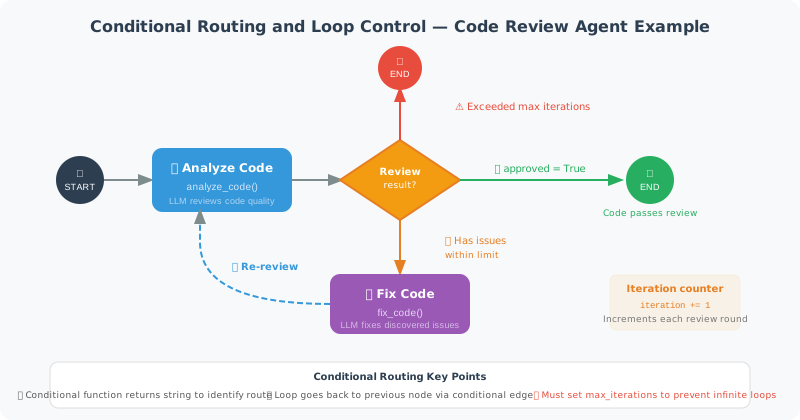
The most powerful use of conditional routing is constructing loops — allowing a node's output to point back to a previous node. For example, an iterative flow like "code review → fix → re-review → re-fix." But loops also introduce the risk of infinite loops: if the condition logic has a bug, the Agent might loop forever. Therefore, setting a maximum iteration count is a mandatory safety measure.
Below, we use a "Code Review Agent" to demonstrate conditional routing and loop control. This Agent analyzes code, finds issues, fixes the code, and then re-reviews — until the code passes review or the maximum iteration count is reached.
from langgraph.graph import StateGraph, END, START
from typing import TypedDict, Optional, Literal
from langchain_openai import ChatOpenAI
from langchain_core.messages import HumanMessage
import json

llm = ChatOpenAI(model="gpt-4o-mini")

# ============================
# Code Review Agent with Loops
# ============================

class CodeReviewState(TypedDict):
    code: str
    review_result: Optional[str]
    issues: list
    iteration: int
    max_iterations: int
    approved: bool

def analyze_code(state: CodeReviewState) -> CodeReviewState:
    """Analyze code quality"""
    response = llm.invoke([
        HumanMessage(content=f"""Review the following code and identify all issues (JSON format):
```python
{state['code']}
Return: {{"issues": ["issue1", "issue2"], "severity": "high/medium/low"}}""") ])
try:
    import re
    json_match = re.search(r'\{.*\}', response.content, re.DOTALL)
    if json_match:
        result = json.loads(json_match.group())
        issues = result.get("issues", [])
    else:
        issues = []
except:
    issues = []

return {
    "issues": issues,
    "review_result": response.content,
    "iteration": state.get("iteration", 0) + 1
}
def fix_code(state: CodeReviewState) -> CodeReviewState: """Fix code issues""" issues_text = "\n".join([f"- {issue}" for issue in state["issues"]])
response = llm.invoke([
    HumanMessage(content=f"""Fix the issues in the following code:
Code:
{state['code']}
Issues: {issues_text}
Return only the fixed Python code:""") ])
fixed_code = response.content
if "```python" in fixed_code:
    fixed_code = fixed_code.split("```python")[1].split("```")[0].strip()
elif "```" in fixed_code:
    fixed_code = fixed_code.split("```")[1].split("```")[0].strip()

return {"code": fixed_code}
def should_fix_or_approve(state: CodeReviewState) -> Literal["fix", "approve", "max_reached"]: """Conditional routing: decide whether to continue fixing or approve
This function is the core control logic of the entire loop:
- Check the iteration count limit (safety valve to prevent infinite loops)
- If no issues, approve directly
- Only trigger the fix loop for critical issues (e.g., bugs, security vulnerabilities)
"""

if state["iteration"] >= state["max_iterations"]:
    return "max_reached"

if not state["issues"]:
    return "approve"

# Only continue fixing for critical issues
critical_keywords = ["bug", "error", "security vulnerability", "performance issue", "syntax error"]
has_critical = any(
    any(kw in issue.lower() for kw in critical_keywords)
    for issue in state["issues"]
)

return "fix" if has_critical else "approve"
def mark_approved(state: CodeReviewState) -> CodeReviewState: """Mark code as approved""" return {"approved": True}
Build the graph
graph = StateGraph(CodeReviewState) graph.add_node("analyze", analyze_code) graph.add_node("fix", fix_code) graph.add_node("approve", mark_approved)
graph.add_edge(START, "analyze") graph.add_conditional_edges( "analyze", should_fix_or_approve, { "fix": "fix", "approve": "approve", "max_reached": "approve" } ) graph.add_edge("fix", "analyze") # After fixing, re-analyze (loop!) graph.add_edge("approve", END)
app = graph.compile()
Test
initial_code = """ def divide(a, b): return a / b
result = divide(10, 0) print(result) """
result = app.invoke({ "code": initial_code, "review_result": None, "issues": [], "iteration": 0, "max_iterations": 3, "approved": False })
print(f"Final code:\n{result['code']}") print(f"Approved: {result['approved']}") print(f"Iterations: {result['iteration']}")
## Advanced Routing Patterns

The code review example above demonstrates basic conditional routing. In real Agent systems, you may need more complex routing logic:

**Pattern 1: Fan-out**

Route requests to different specialized processing flows based on user intent:

```python
def intent_router(state: dict) -> str:
    """Route to different processing nodes based on user intent"""
    intent = state.get("detected_intent", "unknown")

    routing_map = {
        "code_review": "code_analyzer",
        "bug_fix": "debugger",
        "feature_request": "planner",
        "documentation": "doc_writer",
    }

    return routing_map.get(intent, "general_handler")

graph.add_conditional_edges("intent_detector", intent_router, {
    "code_analyzer": "code_analyzer",
    "debugger": "debugger",
    "planner": "planner",
    "doc_writer": "doc_writer",
    "general_handler": "general_handler",
})
Pattern 2: Quality Gate
Add a quality check before Agent output; if it doesn't pass, send it back for rework:
def quality_gate(state: dict) -> str:
    """Check output quality, decide whether to pass or redo"""
    score = state.get("quality_score", 0)
    retries = state.get("retry_count", 0)

    if score >= 0.8:
        return "publish"       # Quality acceptable, publish
    elif retries >= 3:
        return "manual_review" # Retries exhausted, hand off to human
    else:
        return "regenerate"    # Regenerate
Pattern 3: Map-Reduce (Parallel Merge)
LangGraph 2.0 introduced the Send() API, supporting dynamic creation of parallel branches:
from langgraph.constants import Send

def route_to_parallel(state: dict) -> list[Send]:
    """Dynamically distribute tasks to multiple parallel nodes"""
    subtasks = state.get("subtasks", [])

    # Create an independent Send for each subtask
    return [
        Send("worker", {"task": subtask, "task_id": i})
        for i, subtask in enumerate(subtasks)
    ]

graph.add_conditional_edges("planner", route_to_parallel)
Debugging Conditional Routing
When conditional routing behavior doesn't match expectations, the most effective debugging method is tracing each routing decision:
# Method 1: Add logging to the condition function
import logging
logger = logging.getLogger("agent.routing")

def route_with_logging(state: dict) -> str:
    """Conditional routing with logging"""
    decision = state.get("review_result")
    iteration = state.get("iteration", 0)

    if decision == "pass":
        result = "approve"
    elif iteration >= state.get("max_iterations", 3):
        result = "approve"  # Force approve when max iterations exceeded
    else:
        result = "fix"

    logger.info(f"Routing decision: iteration={iteration}, decision={decision} → {result}")
    return result

# Method 2: Use stream to trace the complete execution path
for event in app.stream(initial_state):
    for node_name, output in event.items():
        print(f"  Node [{node_name}] → iteration={output.get('iteration', '?')}")
💡 Best practice: Complex condition routing functions should be unit tested first to verify that every input combination returns the correct routing target, before integrating into the graph.
Summary
Key techniques for conditional routing:
- Condition function: returns a string identifying the next node
- Loop control: must set a maximum iteration count to prevent infinite loops
- State tracking: record iteration count and completion flags in State
Next section: 13.5 Human-in-the-Loop: Human-AI Collaboration