13.1 Why Graph Structures?
Section Goal: Understand the limitations of linear chains and master the core advantages of graph structures for solving complex Agent scenarios.
LangChain's LCEL chains are excellent for linear processing flows, but real-world Agents need to handle more complex scenarios: looping execution, conditional branching, and backtracking retries. Graph structures were designed precisely for this.
Theoretical Background: Finite State Machines and Graph Computing
LangGraph's design is directly inspired by two classic concepts in computer science.
Finite State Machines (FSM)
Agent behavior is fundamentally a finite state machine — transitioning between a finite number of states based on inputs and conditions [1]:
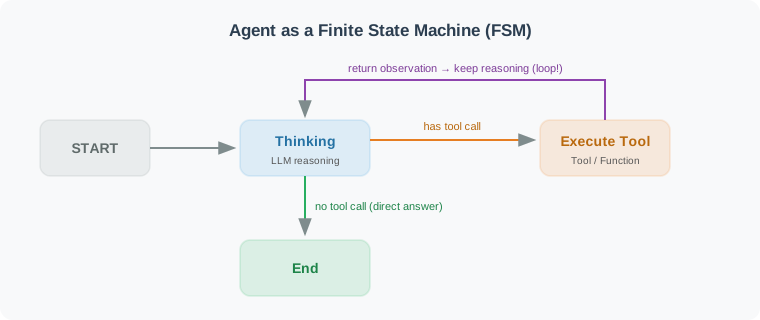
In the FSM model:
- State: the current phase the Agent is in (e.g., "thinking," "executing tool," "waiting for human approval")
- Transition: a conditional jump from one state to another
- Action: the operation performed during a state transition (e.g., calling LLM, executing a tool)
LangGraph maps the FSM concept directly to its API: State corresponds to TypedDict, states correspond to Nodes, and transitions correspond to Edges. This makes complex Agent behavior modelable, testable, and debuggable.
Academic Roots of Graph Computing in AI Agents
Graph structures have deep academic foundations in the AI Agent field:
| Academic Field | Graph Application | Connection to LangGraph |
|---|---|---|
| Behavior Trees (Robotics) [2] | Game AI and robots use behavior trees for decision control | LangGraph's conditional edges = behavior tree selector nodes |
| Dataflow Programming | TensorFlow and similar frameworks use computation graphs to express data flow | LangGraph's State transitions = dataflow graph tensor passing |
| Workflow Engines (BPM) | Airflow/Temporal use DAGs to orchestrate tasks | LangGraph supports cycles, more flexible than DAGs |
| Cognitive Architectures | SOAR, ACT-R use production rules to control reasoning | LangGraph's conditional routing = production rule condition matching |
💡 LangGraph's innovation is: it is not a simple DAG (Directed Acyclic Graph), but a directed graph that supports cycles. This distinction is crucial — because the core behavioral pattern of Agents (the ReAct loop: think → act → observe → think again) is inherently a cycle. Traditional workflow engines (like Airflow) don't support cycles, so they cannot natively express an Agent's iterative reasoning.
Real-World Business Scenario Analysis
Before diving into code, let's look at a few real business scenarios to understand why "graph structures" are not an optional advanced feature, but a hard requirement for building production-grade Agents.
Scenario 1: Multi-Turn Dialogue for Intelligent Customer Service
User: "I want to return an item"
  → Identify intent: return
  → Query order status
    → If shipped → follow return process
    → If not shipped → cancel directly
    → If past return window → escalate to human agent
  → Execute operation
  → Confirm result
  → If user is unsatisfied → back to "understand intent" for reprocessing
This scenario requires: conditional branching (3 paths), loops (retry when unsatisfied), and human interaction (escalate to human). LCEL chains cannot elegantly express this logic.
Scenario 2: Code Review Agent
Submit code → Static analysis → LLM review
  → If security issue found → Deep security analysis → Generate fix suggestions
  → If performance issue found → Performance analysis → Optimization suggestions
  → If no issues → Pass review
  → All analysis results → Summary report
  → Human review → Approve/Reject
This scenario requires: parallel branching (security and performance analyzed simultaneously), dynamic routing (different paths by issue type), and merging (combining analysis results).
Scenario 3: Data Analysis Agent (Chapter 23 of this book)
Natural language question → Understand intent → Generate SQL
  → SQL safety check
    → If unsafe → Regenerate SQL (loop)
    → If safe → Execute query
  → Analyze data → Generate charts → Generate insights → Output report
  → If user asks follow-up → Back to "understand intent"
The common characteristic of these scenarios is: the execution path is not predetermined, but dynamically decided based on intermediate results. Graph structures are naturally suited to express this kind of "runtime decision-making."
Limitations of Linear Chains
# LCEL chain: linear, A → B → C
chain = step_a | step_b | step_c

# Cannot handle:
# 1. Loops: "Step B's result is unsatisfactory, re-execute Step B"
# 2. Conditional branching: "Based on Step A's result, take path B or path C"
# 3. Parallel then merge: "Execute B and C simultaneously, then merge at Step D"
# 4. Persistent state: "Step B needs to access data saved long ago by Step A"
A concrete example: suppose you're building a code review Agent:
# LCEL approach: linear execution, cannot handle complex situations
review_chain = analyze_code | find_issues | suggest_fix

# Problem scenarios:
# 1. If analyze_code finds the code file is too large → need to split first, then analyze in segments
#    LCEL cannot go back to a previous step
# 2. If find_issues discovers a security vulnerability → need an extra security analysis step
#    LCEL cannot dynamically insert steps
# 3. If suggest_fix's fix suggestions introduce new problems → need to re-review
#    LCEL cannot implement loops
Advantages of Graph Structures
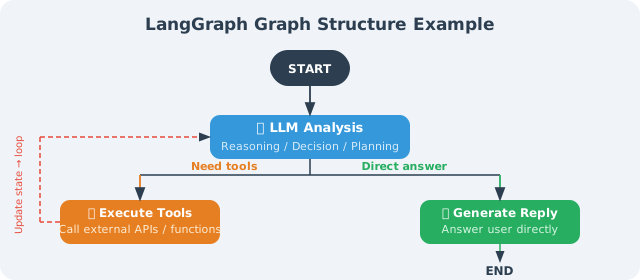
Graph structures fundamentally change the Agent's execution model:
| Feature | Linear Chain (LCEL) | Graph Structure (LangGraph) |
|---|---|---|
| Execution flow | A → B → C (fixed) | Arbitrary topology (dynamic) |
| Loop support | ❌ Not supported | ✅ Nodes can point back |
| Conditional branching | ⚠️ Limited support | ✅ Conditional edges |
| State management | ❌ No persistent state | ✅ Global State |
| Human interaction | ❌ Not supported | ✅ Human-in-the-Loop |
| Checkpoint recovery | ❌ Not supported | ✅ Checkpoint persistence |
| Parallel execution | ⚠️ Simple parallel | ✅ Complex parallel + merge |
LangGraph's Core Design
LangGraph's design revolves around three core concepts: State, Node, and Edge.
# pip install langgraph

from langgraph.graph import StateGraph, END, START
from typing import TypedDict, Annotated
import operator

# 1. Define State: data shared by all nodes in the graph
class AgentState(TypedDict):
    messages: list        # Message history
    current_task: str     # Current task
    iterations: int       # Loop count (prevent infinite loops)
    final_answer: str     # Final answer

# 2. Define Nodes: each node is a function that receives state and returns updates
def process_input(state: AgentState) -> AgentState:
    """Node function: process input"""
    print(f"Processing: {state['current_task']}")
    return {"iterations": state.get("iterations", 0) + 1}

# 3. Define Edges: connections between nodes (can be conditional edges)
def should_continue(state: AgentState) -> str:
    """Conditional edge: returns the name of the next node"""
    if state.get("final_answer"):
        return "end"
    elif state.get("iterations", 0) >= 5:
        return "end"  # Prevent infinite loops
    else:
        return "continue"

# 4. Build the graph
graph = StateGraph(AgentState)
graph.add_node("process", process_input)
graph.add_edge(START, "process")
graph.add_conditional_edges(
    "process",
    should_continue,
    {"end": END, "continue": "process"}  # Can loop back to itself!
)

app = graph.compile()
When Should You Choose LangGraph?
# ✅ Signals to choose LangGraph:
should_use_langgraph = [
    "Agent needs multi-step loops (e.g., ReAct loop)",
    "Needs conditional routing (e.g., different branches based on user intent)",
    "Needs Human-in-the-Loop (approval/confirmation nodes)",
    "Needs long-running tasks (with checkpoint recovery)",
    "Multiple Agents collaborating (Supervisor pattern)",
]

# ❌ Scenarios where LangGraph is not needed:
use_lcel_instead = [
    "Simple Prompt → LLM → output",
    "Fixed-step processing pipelines",
    "Workflows that don't need loops or conditional branching",
]
Summary
The core value of graph structures:
- Loop support: nodes can point to themselves or previous nodes
- Persistent state: State is shared across all nodes throughout execution
- Conditional routing: dynamically decide the next step based on state
- Visualization: graph structures can intuitively display Agent execution logic
- Checkpoint recovery: through the Checkpoint mechanism, supports resuming tasks after interruption
- Human-AI collaboration: built-in Human-in-the-Loop support, suitable for scenarios requiring human approval
Next section: 13.2 LangGraph Core Concepts: Nodes, Edges, State
References
[1] HOPCROFT J E, MOTWANI R, ULLMAN J D. Introduction to automata theory, languages, and computation[M]. 3rd ed. Pearson, 2006.
[2] COLLEDANCHISE M, ÖGREN P. Behavior trees in robotics and AI: an introduction[M]. CRC Press, 2018.