15.4 Core: Self-Evolving Skills Loop
☤ "Hermes' sharpest knife: let the Agent write its own skills and iterate them itself."
The Problem
Traditional Agent skills are hand-written (OpenClaw / Claude Code's SKILL.md). Two ceilings: incomplete coverage (humans can't pre-write everything) and no adaptation (skills don't follow a user's workflow change).
Hermes' answer is Self-Evolving Skills — after a task, the Agent itself distills the trajectory into a skill, then improves it in use.
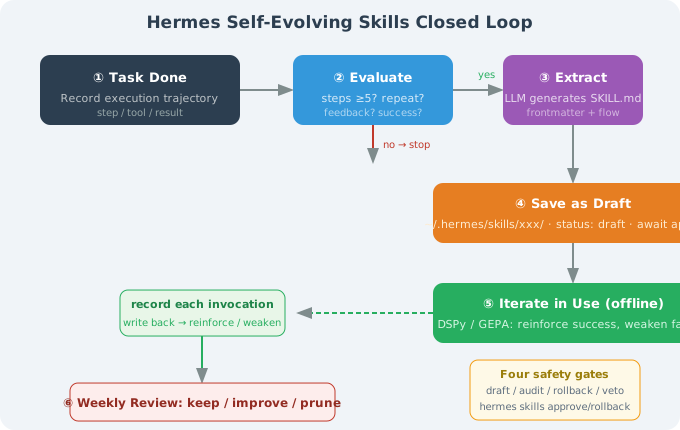
The 5-Stage Loop
task done → ① evaluate → ② extract → ③ save draft → ④ iterate in use → ⑤ prune/reinforce
① Evaluate (should I extract?)
| Signal | Threshold | Meaning |
|---|---|---|
| Task steps | ≥ 5 | complex enough to persist |
| Repetition | same task ≥ 2 times | repetitive = automate |
| Explicit feedback | "remember this flow" | strong signal |
| Success | task succeeded | don't distill failures |
② Extract (SKILL.md)
Feed the trajectory to an LLM to produce structured SKILL.md (frontmatter + trigger + flow + constraints).
③ Save as Draft
~/.hermes/skills/summarize-inbox/
├── SKILL.md      # frontmatter status: draft
└── meta.json     # source trajectory, created time, confidence
Drafts are not immediately active — user approves first.
④ Iterate in Use (offline self-improve)
Each invocation records results; offline, DSPy/GEPA-style tuning reinforces successful steps and weakens failing ones.
⑤ Prune / Reinforce
Weekly review classifies skills: healthy (keep) / needs-improvement (self-improve) / dying (prompt user).
A Concrete Example
User: "organize my inbox, categorize by topic, and summarize."
- Execute: Agent does it in 8 steps;
- Evaluate: 8 ≥ 5 → worth distilling;
- Extract: generates
summarize-inboxskill (read→categorize→summarize→report); - Save draft;
- Next time: "organize email" triggers the skill instead of re-planning;
- Iterate: a mis-categorization is recorded and the rule corrected.
📌 A normal Agent re-plans from scratch on the 6th run; Hermes' 6th run uses its own skill, refined through 5 iterations.
vs a Human-Maintained Skill Library
| Dimension | Hand-written (OpenClaw) | Self-evolving (Hermes) |
|---|---|---|
| Source | human | human + Agent |
| Iteration | human releases | Agent offline auto |
| Coverage | human imagination | actual task trajectories |
| Personalization | generic | user-specific |
| Audit | easy | needs draft + audit |
Safety Boundary (Why It's Not "Out of Control")
- Draft mechanism — new skills are
status: draftuntil approved; - Security audit — distilled SKILL.md passes permission checks (
tools/permissions); - Rollback — skills keep versions;
- User veto —
hermes skills disable <name>anytime.
hermes skills list              # active/draft/disabled with versions
hermes skills approve summarize-inbox
hermes skills rollback summarize-inbox v2
Section Summary
| Topic | Key point |
|---|---|
| 5 stages | evaluate → extract → save draft → iterate → prune |
| Signals | steps / repetition / feedback / success |
| Iteration | DSPy/GEPA offline |
| Safety | draft + audit + rollback + veto |
| Essence | from "human writes skills" to "Agent writes + iterates" |
Next section: 15.5 Three-Layer Memory