15.3 Three-Layer Architecture: Gateway / Engine / Plugin
☤ "Three layers aren't a classification — they're three ways of looking at the same system."
Why Hermes' Architecture Matters
Hermes layers a Plugin subsystem on top of the traditional channel+loop+tool structure. Memory, tool-execution backend, self-evolving loop, and voice transcriber are all plugins — giving Hermes the same "swappable kernel" flexibility as DeepSeek Harness (Ch.17), just earlier and more Pythonic.
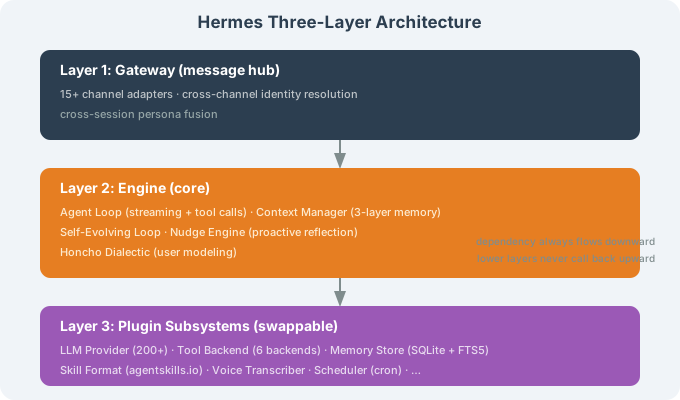
Layer 1: Gateway
Same shape as OpenClaw but Python + more channels (15+). Cross-channel persona blending merges one human's channels into a single session, and Honcho user modeling is injected explicitly (not implicitly).
Layer 2: Engine — 5 Subsystems
async def agent_loop(session, user_message):
    context = await context_manager.assemble(session, user_message)
    for step in range(MAX_STEPS):
        parsed = parse(await llm.stream(context))
        if parsed.kind == "final_answer": return parsed.text
        if parsed.kind == "tool_call":
            decision = await permissions.check(parsed.tool_call, session)
            if not decision.allowed: ...
            result = await tools.run(parsed.tool_call)
            context.append_tool_result(parsed.tool_call.id, result)
            # ⭐ Hermes-only hook: self-evolving evaluation
            await self_evolving.on_tool_use(session, parsed.tool_call, result, context)
The self_evolving.on_tool_use hook is Hermes' unique addition — every completed task may trigger skill creation/update.
Context Manager — pulls from plugin Memory Store
async def assemble(session, user_message):
    long_term = await memory_store.recall_relevant(user_message.text, top_k=10)
    working   = await memory_store.get_session(session.id)
    episodic  = await memory_store.get_recent_episodes(session.id, k=5)
    persona   = await honcho.user_model(user_message.from_)
    return build_prompt(...)
Layer 3: Plugin Subsystems
| Subsystem | Default | Replaceable with |
|---|---|---|
| LLM Provider | OpenAI/Anthropic | any of 200+ models |
| Tool backend | local | Docker/SSH/Singularity/Modal/Daytona |
| Memory store | SQLite + FTS5 | Redis/Postgres/MongoDB |
| Skill format | agentskills.io | custom |
| Voice | OpenAI Whisper | Paraformer/whisper.cpp |
hermes runtime set modal    # switch execution backend
hermes runtime set local
Memory: FTS5 + BM25
CREATE VIRTUAL TABLE memory USING fts5(
  content, created_at UNINDEXED, source UNINDEXED, tags,
  tokenize = 'unicode61 remove_diacritics 2'
);
-- search:
SELECT content, bm25(memory) AS score FROM memory
WHERE memory MATCH ? ORDER BY score ASC LIMIT 10;
BM25 weights term frequency but down-weights common words (IDF) — precise keyword recall without a vector database.
Mapping to Chapter 8's Pillars
Hermes implements all six pillars plus two new ones: Self-Evolution and Honcho User Modeling.
Section Summary
| Topic | Key point |
|---|---|
| 3 layers | Gateway / Engine / Plugin |
| Engine | Agent Loop + Context + Self-Evolving + Nudge + Honcho |
| Plugins | LLM / Tool backend / Memory / Skill / Voice all swappable |
| 6 backends | local/Docker/SSH/Singularity/Modal/Daytona |
| Search | SQLite FTS5 + BM25 |
Next section: 15.4 Core: Self-Evolving Skills Loop