18.4 Supervisor Mode vs. Decentralized Mode
Multi-Agent systems face a fundamental architectural decision: who coordinates? Should you set up a "project manager" to centrally schedule all Agents (Supervisor mode), or let Agents negotiate freely with each other (decentralized mode)?
Both modes have their pros and cons. Most real-world projects choose Supervisor mode because it's easier to control and debug. This section compares the two approaches with complete code examples.
The Big Picture First: Six Collaboration Patterns
Supervisor vs decentralized is really only two of the six multi-Agent collaboration patterns. The six that have settled out of production practice by 2026 are below; this section focuses on two of them, with the rest covered elsewhere in the book:
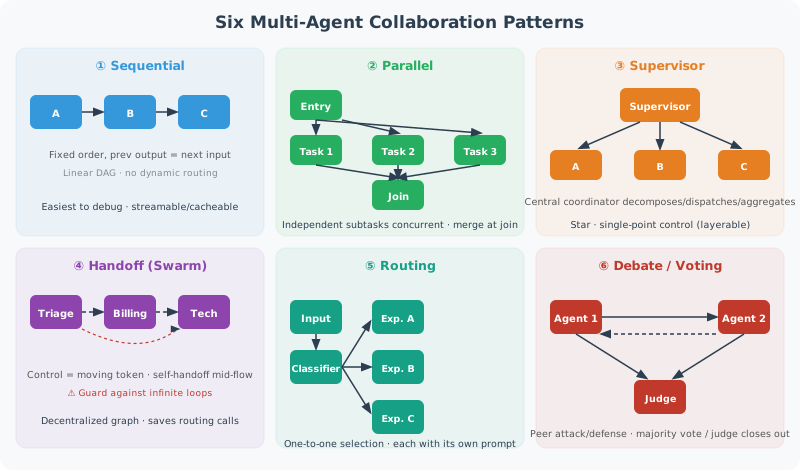
| Pattern | Topology | Who coordinates | One-line scenario | Book location |
|---|---|---|---|---|
| Sequential pipeline | Linear DAG | None (fixed order) | Fixed stages, previous output feeds next input | 18.5 Practice |
| Parallel | Fan-out / fan-in | A join point merges results | N independent subtasks run at once | 18.1 |
| Supervisor hierarchy | Star | Central coordinator | Decomposable tasks needing unified scheduling | This section |
| Handoff (Swarm) | Decentralized graph | Moving token (whoever holds the conversation decides) | Experts dynamically decide "switch to someone else" mid-flow | This section |
| Routing | One-to-one | Classifier (rules / small model) | Inputs fall into distinct categories, each with its own prompt | 18.3 Dynamic assignment |
| Debate / Voting | Peer-to-peer | Judge / majority | Decisions needing disagreement convergence | 18.2 |
💡 Core mental model: these six patterns are not mutually exclusive — they are nestable, composable building blocks. A Supervisor can fan out in Parallel internally; a link in a Handoff chain can hang another Supervisor. The architect's job is "pick the building block by the task's true structure," not "pick one pattern and use it everywhere."
Supervisor (Centralized) Mode
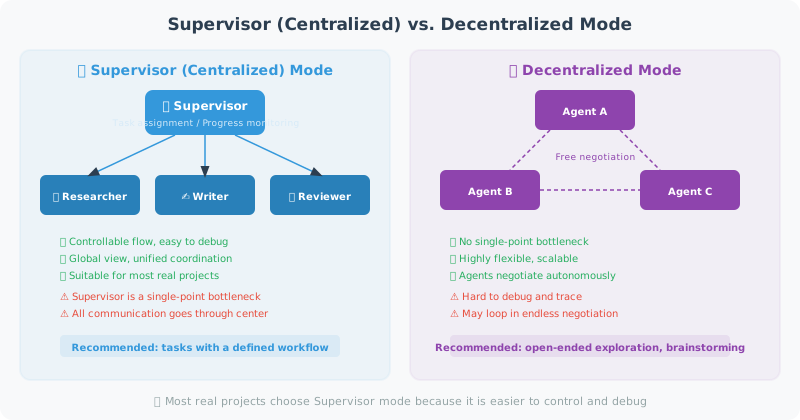
The Supervisor mode works like project management: a Supervisor Agent is responsible for analyzing tasks, assigning subtasks, monitoring progress, and aggregating results. All decisions are coordinated through the Supervisor.
The following example builds a "content creation team" — the Supervisor coordinates three sub-Agents: a researcher, a writer, and a reviewer:
from langgraph.graph import StateGraph, END, START
from langgraph.prebuilt import create_react_agent
from langchain_openai import ChatOpenAI
from langchain_core.tools import tool
from typing import TypedDict, Annotated, Literal
import operator

llm = ChatOpenAI(model="gpt-4o")

# ============================
# Define tools for each sub-Agent
# ============================

@tool
def do_research(topic: str) -> str:
    """Research specialist: in-depth research on a specified topic"""
    from openai import OpenAI
    client = OpenAI()
    response = client.chat.completions.create(
        model="gpt-4o-mini",
        messages=[{"role": "user", "content": f"Research {topic} and provide 3 core insights"}],
        max_tokens=200
    )
    return response.choices[0].message.content

@tool
def write_content(outline: str) -> str:
    """Writing specialist: write content based on an outline"""
    from openai import OpenAI
    client = OpenAI()
    response = client.chat.completions.create(
        model="gpt-4o-mini",
        messages=[{"role": "user", "content": f"Write a 300-word article based on this outline: {outline}"}],
        max_tokens=400
    )
    return response.choices[0].message.content

@tool
def review_content(content: str) -> str:
    """Review specialist: check content quality"""
    from openai import OpenAI
    client = OpenAI()
    response = client.chat.completions.create(
        model="gpt-4o-mini",
        messages=[{"role": "user", "content": f"Review the following content (score + suggestions): {content[:200]}"}],
        max_tokens=150
    )
    return response.choices[0].message.content

# Supervisor Agent has access to all tools
supervisor_tools = [do_research, write_content, review_content]
supervisor_agent = create_react_agent(llm, supervisor_tools)

# ============================
# Supervisor decision logic
# ============================

class SupervisorState(TypedDict):
    messages: Annotated[list, operator.add]
    task: str
    research_done: bool
    content_written: bool
    review_done: bool

def supervisor(state: SupervisorState) -> dict:
    """Supervisor: centrally coordinates all subtasks"""
    from langchain_core.messages import HumanMessage, SystemMessage

    context = f"""
You are a task coordinator managing a content creation team.
Available tools: do_research, write_content, review_content

Task: {state['task']}
Research complete: {state.get('research_done', False)}
Writing complete: {state.get('content_written', False)}
Review complete: {state.get('review_done', False)}

Analyze the current progress and decide the next step:
1. If research is not done → use do_research
2. If research is done but writing is not → use write_content
3. If writing is done but review is not → use review_content
4. If everything is done → summarize and finish

Current message history (to get previous outputs):
{[m.content if hasattr(m, 'content') else str(m) for m in state.get('messages', [])[-3:]]}
"""

    result = supervisor_agent.invoke({
        "messages": [HumanMessage(content=context)]
    })

    last_msg = result["messages"][-1]
    content = last_msg.content if hasattr(last_msg, 'content') else ""

    # Update state
    updates = {"messages": [last_msg]}
    if "research" in content.lower():
        updates["research_done"] = True
    if "write" in content.lower() or "article" in content.lower():
        updates["content_written"] = True
    if "review" in content.lower():
        updates["review_done"] = True

    return updates

def should_continue(state: SupervisorState) -> str:
    if state.get("review_done"):
        return "end"
    return "continue"

# Build Supervisor graph
graph = StateGraph(SupervisorState)
graph.add_node("supervisor", supervisor)
graph.add_edge(START, "supervisor")
graph.add_conditional_edges(
    "supervisor",
    should_continue,
    {"end": END, "continue": "supervisor"}
)

supervisor_app = graph.compile()

# Run
result = supervisor_app.invoke({
    "messages": [],
    "task": "Write a technical article about Python asynchronous programming",
    "research_done": False,
    "content_written": False,
    "review_done": False
})

print("Final state:")
print(f"  Research complete: {result['research_done']}")
print(f"  Writing complete: {result['content_written']}")
print(f"  Review complete: {result['review_done']}")
Decentralized Mode
Unlike Supervisor mode, decentralized mode has no central coordinator. Each Agent has its own inbox and communicates directly with other Agents via broadcast or point-to-point messages. This mode is more like a self-organizing team — members discuss freely and decide among themselves who does what.
The advantage is no single point of failure and high flexibility; the disadvantage is high coordination costs and the potential for conflicts or deadlocks.
# Decentralized: Agents negotiate directly with each other, no central coordinator

class PeerToPeerNetwork:
    """Peer-to-peer Agent network"""

    def __init__(self):
        self.agents = {}
        self.message_board = {}  # Shared message board

    def add_agent(self, name: str, specialization: str):
        self.agents[name] = {
            "name": name,
            "specialization": specialization,
            "inbox": [],
        }

    def broadcast(self, sender: str, message: str, target: str = "all"):
        """Broadcast a message"""
        if target == "all":
            for name, agent in self.agents.items():
                if name != sender:
                    agent["inbox"].append({
                        "from": sender,
                        "message": message
                    })
        else:
            if target in self.agents:
                self.agents[target]["inbox"].append({
                    "from": sender,
                    "message": message
                })

    def process_inbox(self, agent_name: str) -> list[str]:
        """Process inbox"""
        agent = self.agents[agent_name]
        messages = agent["inbox"].copy()
        agent["inbox"].clear()
        return [m["message"] for m in messages]

# Usage example
network = PeerToPeerNetwork()
network.add_agent("research", "Information research")
network.add_agent("writing", "Content writing")
network.add_agent("editing", "Article editing")

# Agents communicate directly with each other, self-organizing to complete tasks
# This mode is more flexible but also harder to control
Handoff Mode: The Modern Practice of Decentralization
Pure "broadcast + inbox" decentralization has a fatal flaw: who decides the next step? After a broadcast, every Agent receives the message, but no one leads the closure — easy to fall into "everyone watching, no one acting." OpenAI's Swarm experiment (late 2024, later upgraded to the production-grade OpenAI Agents SDK) introduced a more practical decentralized form — Handoff: treat "control" as a moving token; the Agent currently holding the conversation decides "time to switch," and hands the whole conversation (with accumulated context) to the next Agent via a tool call.
def handoff(target_agent):
    """Handoff tool: the current Agent calls it to transfer control and context.

    Why make handoff a tool rather than framework scheduling: letting the Agent
    decide when to hand off avoids the Supervisor's per-step routing call, and
    allows an Agent to self-correct mid-task when it realizes it's the wrong
    specialist — something a Supervisor can't do (a Supervisor only decides at
    node boundaries).
    """
    def transfer(context: str) -> str:
        # Key: pass accumulated context along so the conversation stays coherent
        return target_agent(context)
    transfer.__name__ = f"handoff_to_{target_agent}"
    transfer.__doc__ = f"Hand the current conversation over to {target_agent}"
    return transfer

# Customer-service scenario: triage Agent -> billing / technical / refunds
def triage_agent(context):
    """Triage: judge which category the question falls into, then hand off"""
    if "billing" in context or "refund" in context:
        return handoff(billing_agent)(context)
    elif "technical" in context or "error" in context:
        return handoff(tech_agent)(context)
    return "Please describe whether your issue is billing, technical, or other."
The essential difference between Handoff and Supervisor:
| Dimension | Supervisor | Handoff |
|---|---|---|
| Decision point | Central coordinator decides at node boundaries | Current Agent self-decides mid-conversation |
| Routing cost | Pays a supervisor routing call every step | Handoff is one tool call in the active loop, cheaper |
| Traceability | Single thread, easy to trace | Becomes a directed handoff graph, harder to trace |
| Typical risk | Supervisor misroutes -> global failure | Infinite handoff loop (A→B→A→B) or ambiguous ownership of the final answer |
⚠️ Handoff's #1 trap: infinite handoff loops. A hands to B, B hands back to A, looping and burning tokens. In engineering you must set a handoff count cap (e.g.
max_handoffs=5) and force closure beyond it. This echoes the "bounded retry" idea from 18.3: every loop needs an upper bound.
Hierarchical Supervision (Supervisor-of-Supervisors)
When specialist Agents exceed roughly 10, a single Supervisor's tool list becomes too bloated to route well. At that point you need layering: the top-level Supervisor only routes to "sub-supervisors" (billing, technical, engineering sub-domains), each managing its own specialist pool.
Top-level Supervisor (ops)
├── Billing Supervisor ── refund / invoice / ...
├── Technical Supervisor ── triage / consult / ...
└── Engineering Supervisor ── review / deploy / ...
💡 Use sparingly: hierarchical supervision is rarely the right starting point — every layer doubles the "routing-overhead tax" and makes failure attribution harder. Only consider it when specialists truly exceed 10, or different sub-domains need different routing policies. Otherwise a flat Supervisor with router-style tool selection is simpler.
Split-Brain and Consistency: The Hidden Cost of Decentralization
The subtlest problem of decentralized mode is split-brain — two Agents write the same shared state (a shared document, a shared task queue, a shared scratchpad) simultaneously, each believing it is the "single source of truth," overwriting each other's results. This is the same disease as split-brain in distributed databases.
# Split-brain example: two Agents update "current progress" simultaneously,
# later write overwrites earlier write
# Agent A writes progress="step 1 done"  ->  overwritten by Agent B's
# progress="step 2 done"
# Result: step 1's work is lost, and nobody notices (no conflict detection)
Three solutions (a continuation of 18.2's shared-state conflict resolution):
| Solution | Idea | Cost |
|---|---|---|
| Single writer | Only one Agent can write a field at a time (Supervisor mode has this naturally) | Sacrifices parallelism |
| CRDT | Conflict-free replicated data types (counters, OR-Sets) auto-merge concurrent writes | Only for commutative operations |
| Explicit conflict rules | Writes carry versions; on conflict, adjudicate by predefined rule (e.g. "newest timestamp wins") | Must design the adjudication logic |
🔑 Core conclusion: decentralization's "flexibility" has a price — it pushes "who has the final say" from the architecture layer down to the state-consistency layer. If shared state is designed poorly, decentralization loses data silently more easily than Supervisor. Production advice: unless you have explicit CRDTs or conflict rules, critical shared-state fields should fall back to single-writer (Supervisor or locking).
Comparison of the Two Modes
Supervisor (Centralized):
✅ Easy to coordinate and control
✅ Global view, avoids duplicate work
✅ Easy to debug and monitor
❌ Supervisor becomes a bottleneck
❌ If Supervisor fails, everything fails

Decentralized:
✅ No single point of failure
✅ Highly flexible, adaptive
✅ Closer to real team collaboration
❌ High coordination costs
❌ May produce conflicts or deadlocks
❌ Difficult to debug

Recommendations:
- Most production scenarios → Supervisor mode
- High fault tolerance required → Decentralized
- Clear task boundaries → Supervisor is more suitable
Summary
In the global view of the six collaboration patterns (Sequential / Parallel / Supervisor / Handoff / Routing / Debate), this section compared two orchestration paradigms in depth:
- Supervisor (Centralized) Mode: a central coordinator schedules everything, with a global view, easy to coordinate and monitor, suited to clear task boundaries and strict control. The cost: the Supervisor becomes a single-point bottleneck, and too many specialists require hierarchical supervision (use sparingly — routing tax doubles).
- Handoff (Decentralized, modern form): control as a moving token; the current Agent self-decides mid-conversation, avoiding per-step routing calls. The cost: control flow becomes a hard-to-trace directed graph, prone to infinite handoff loops — a handoff cap is mandatory.
Two engineering iron rules:
- Every loop needs an upper bound — Supervisor state checks, Handoff counts, decentralized message rounds, all need caps.
- Decentralization pushes "who has the final say" to the state-consistency layer — critical shared-state fields need single-writer, CRDT, or explicit conflict rules; otherwise you silently lose data (split-brain).
Practical recommendation: most production projects prefer Supervisor (controllable, debuggable); only introduce Handoff/decentralization when you need high fault tolerance, a very large Agent count, or specialists that must switch mid-task.
Next section: 18.5 Practice: Multi-Agent Software Development Team