18.3 Role Assignment and Task Allocation
Goal of this section: Master the principles of role design in multi-Agent systems, the strategies for task allocation, and how to implement dynamic role assignment.
An efficient multi-Agent system requires a sensible division of roles. Good role design lets every Agent deliver its maximum value.
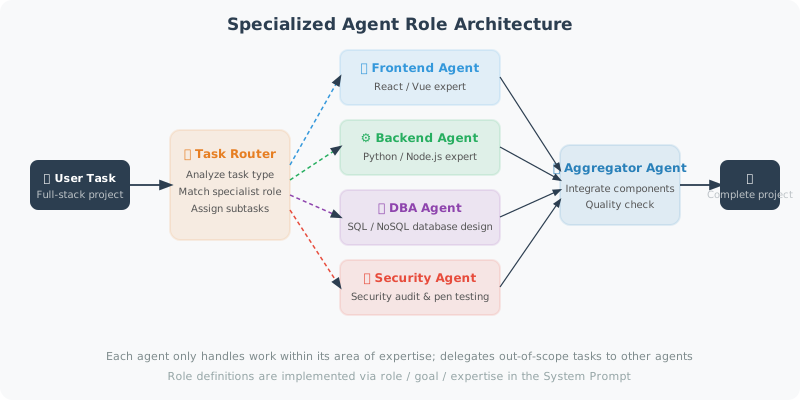
Designing Specialized Agents
from openai import OpenAI
from typing import Optional

client = OpenAI()

class SpecializedAgent:
    """Base class for specialized Agents"""

    def __init__(self, name: str, role: str, expertise: str):
        self.name = name
        self.role = role
        self.expertise = expertise
        self.system_prompt = f"""You are {name}, serving as a {role}.

Your area of expertise: {expertise}

Work requirements:
- Only handle work directly related to your area of expertise
- If a task falls outside your area of expertise, say so clearly and ask other Agents for help
- Produce professional, precise output
"""

    def process(self, task: str, context: str = "") -> str:
        """Process a task"""
        messages = [
            {"role": "system", "content": self.system_prompt}
        ]

        if context:
            messages.append({
                "role": "user",
                "content": f"Background information: {context}\n\nTask: {task}"
            })
        else:
            messages.append({"role": "user", "content": task})

        response = client.chat.completions.create(
            model="gpt-4.1",
            messages=messages,
            max_tokens=800
        )

        return response.choices[0].message.content


# ============================
# Software development team example
# ============================

class DevTeam:
    """Multi-Agent software development team"""

    def __init__(self):
        # Define the Agent for each role
        self.product_manager = SpecializedAgent(
            name="Alice",
            role="Product Manager",
            expertise="Requirements analysis, feature planning, user story writing, prioritization"
        )

        self.architect = SpecializedAgent(
            name="Bob",
            role="System Architect",
            expertise="System design, technology selection, architecture decisions, database design, API design"
        )

        self.developer = SpecializedAgent(
            name="Charlie",
            role="Full-Stack Developer",
            expertise="Python backend development, FastAPI, Django, database operations, code implementation"
        )

        self.tester = SpecializedAgent(
            name="Diana",
            role="QA Engineer",
            expertise="Test case design, pytest authoring, boundary condition testing, security testing"
        )

        self.devops = SpecializedAgent(
            name="Eve",
            role="DevOps Engineer",
            expertise="Docker, CI/CD, deployment scripts, monitoring configuration"
        )

    def develop_feature(self, requirement: str) -> dict:
        """The full feature development workflow"""

        results = {}

        print(f"\n{'='*60}")
        print(f"Requirement to build: {requirement}")
        print('='*60)

        # 1. Product Manager: requirements analysis
        print("\n[Alice - Product Manager] Analyzing the requirement...")
        user_stories = self.product_manager.process(
            f"Write user stories and acceptance criteria for the following requirement: {requirement}"
        )
        results["user_stories"] = user_stories

        # 2. Architect: system design
        print("\n[Bob - Architect] Designing the system...")
        architecture = self.architect.process(
            "Design an implementation plan covering: technology stack selection, data structures, API design",
            context=f"Requirements document: {user_stories}"
        )
        results["architecture"] = architecture

        # 3. Developer: code implementation
        print("\n[Charlie - Developer] Writing code...")
        code = self.developer.process(
            "Write the Python implementation based on the design plan, with complete functions and classes",
            context=f"Design plan: {architecture}"
        )
        results["code"] = code

        # 4. QA Engineer: write tests
        print("\n[Diana - QA] Writing tests...")
        tests = self.tester.process(
            "Write pytest test cases for the following code, covering both normal and boundary cases",
            context=f"Code under test: {code[:500]}"
        )
        results["tests"] = tests

        # 5. DevOps: deployment configuration
        print("\n[Eve - DevOps] Preparing deployment...")
        deployment = self.devops.process(
            "Create a Dockerfile and a docker-compose.yml",
            context=f"Code: {code[:300]}"
        )
        results["deployment"] = deployment

        return results


# Test
team = DevTeam()
result = team.develop_feature("A user login API that supports email + password login and returns a JWT token")

print("\n\n=== Development output summary ===")
for key, value in result.items():
    print(f"\n[{key}]")
    print(value[:200] + "..." if len(value) > 200 else value)
Dynamic Role Assignment
class DynamicTaskAllocator:
    """Dynamic task allocator: automatically routes a task to the right Agent"""

    def __init__(self, agents: dict[str, SpecializedAgent]):
        self.agents = agents

    def allocate(self, task: str) -> str:
        """Analyze the task and pick the most suitable Agent"""
        agent_descriptions = "\n".join([
            f"- {name}: specializes in {agent.expertise}"
            for name, agent in self.agents.items()
        ])

        response = client.chat.completions.create(
            model="gpt-4.1-mini",
            messages=[{
                "role": "user",
                "content": f"""Based on the task description, pick the most suitable Agent.

Available Agents:
{agent_descriptions}

Task: {task}

Return only the Agent name (a single word):"""
            }],
            max_tokens=20
        )

        agent_name = response.choices[0].message.content.strip().lower()
        return agent_name

    def process(self, task: str) -> str:
        """Automatically allocate and execute the task"""
        agent_name = self.allocate(task)
        agent = self.agents.get(agent_name)

        if agent:
            print(f"Assigned to: {agent.name} ({agent.role})")
            return agent.process(task)
        else:
            # No exact match found; fall back to the first Agent
            agent = list(self.agents.values())[0]
            return agent.process(task)
Load Balancing Strategies
The DynamicTaskAllocator above only solves "who can do it" (capability matching), not "who is free right now." When multiple homogeneous Agents can all handle the same kind of task (say 5 "code reviewers"), always assigning to the first one creates "some Agents overworked, others idle." Load balancing solves exactly this — spreading tasks evenly across available Agents.
Three Allocation Strategies
import itertools
from collections import deque

class LoadBalancer:
    """Multi-Agent load balancer: pick the least-busy Agent from a homogeneous pool"""

    def __init__(self, agents: list[str]):
        # Each Agent has a pending queue; queue length = current load
        self.queues: dict[str, deque] = {a: deque() for a in agents}
        self._rr = itertools.cycle(agents)   # round-robin cursor

    # Strategy 1: Round-Robin — assign in turn, the simplest
    def round_robin(self, task) -> str:
        agent = next(self._rr)
        self.queues[agent].append(task)
        return agent

    # Strategy 2: Least-Load — assign to the Agent with the shortest queue
    def least_load(self, task) -> str:
        agent = min(self.queues, key=lambda a: len(self.queues[a]))
        self.queues[agent].append(task)
        return agent

    # Strategy 3: Capability-Aware — combine "bidding" (contract net, see 18.2):
    # Agents self-report "current load + completion confidence", pick the best
    def capability_aware(self, task, bids: dict[str, tuple[float, float]]) -> str:
        # bids: {agent: (estimated_cost, confidence)}; low-confidence agents dropped
        valid = {a: c for a, (c, conf) in bids.items() if conf > 0.5}
        if not valid:
            return self.least_load(task)     # no bidders -> degrade to least-load
        # score = estimated cost + current queue length penalty, take the minimum
        agent = min(valid, key=lambda a: valid[a] + len(self.queues[a]))
        self.queues[agent].append(task)
        return agent

    def finish(self, agent: str):
        """An Agent finished a task, dequeue (load decreases)"""
        if self.queues[agent]:
            self.queues[agent].popleft()
💡 Selection intuition: homogeneous Agents with equal speed → round-robin is simplest; large speed variance → least-load; Agents differ in capability and self-report dynamically → capability-aware (closest to real production, but also the most complex).
Backpressure: Preventing Avalanches
Load balancing only "spreads evenly," it can't "accept unlimited work." When every Agent's queue is full, pushing more tasks in only collapses the whole system — this is backpressure from distributed systems: upstream must sense downstream saturation and proactively slow down or reject.
MAX_QUEUE = 10   # per-Agent queue cap

def enqueue_with_backpressure(lb: LoadBalancer, task) -> str:
    """Enqueue with backpressure: reject when all full, instead of forcing in"""
    if all(len(q) >= MAX_QUEUE for q in lb.queues.values()):
        # All full: reject and let upstream retry later (rather than queueing
        # unboundedly and draining memory/latency)
        raise RuntimeError("All Agent queues are full, please retry later")
    return lb.least_load(task)
🔴 Most common incident: a Supervisor fans out sub-agents without limit (e.g. "search 500 web pages" spawns 500), instantly blowing up LLM rate limits and memory — this is the so-called fork-bomb. In engineering you must put a hard cap on "concurrent sub-agent count" (e.g.
Semaphore(8)), queueing excess tasks instead of unbounded spawning.
Five Principles of Role Design
1. The MECE Principle: Mutually Exclusive, Collectively Exhaustive
"""
The MECE (Mutually Exclusive, Collectively Exhaustive) principle
ensures roles do not overlap and together cover every responsibility you need
"""

# ❌ Bad example: overlapping roles
bad_roles = {
    "coder": "Write code and tests",        # coding and testing mixed together
    "developer": "Implement features and debug",  # overlaps with coder
    "tester": "Test code and write docs",   # testing and documentation mixed together
}

# ✅ Good example: roles are mutually exclusive and collectively exhaustive
good_roles = {
    "product_manager": {
        "expertise": "Requirements analysis, user stories, prioritization",
        "excludes": "Does not write code, does not make architecture decisions",
    },
    "architect": {
        "expertise": "System design, technology selection, API design",
        "excludes": "Does not write concrete implementation code",
    },
    "developer": {
        "expertise": "Code implementation, unit tests, code review",
        "excludes": "Does not make architecture decisions, does not handle deployment",
    },
    "devops": {
        "expertise": "CI/CD, containerization, deployment, monitoring",
        "excludes": "Does not write business code",
    },
}
2. The Minimum-Roles Principle
def optimize_roles(task: dict, candidate_roles: list[dict]) -> list[dict]:
    """Minimum-roles principle: cover every responsibility with as few roles as possible

    Every extra role adds:
    - Communication overhead (N roles = N(N-1)/2 communication links)
    - Coordination cost (the Supervisor has more Agents to manage)
    - Debugging complexity
    """
    # Step 1: identify the skills the task requires
    required_skills = set(task.get("required_skills", []))

    # Step 2: greedy selection — at each step pick the role covering the most unmet skills
    selected = []
    covered = set()

    while covered != required_skills:
        # Find the role that covers the most currently unmet skills
        best_role = max(
            candidate_roles,
            key=lambda r: len(set(r["skills"]) & (required_skills - covered))
        )
        new_coverage = set(best_role["skills"]) & (required_skills - covered)

        if not new_coverage:
            break  # cannot cover anything more

        selected.append(best_role)
        covered |= new_coverage

    return selected

# Example
task = {
    "required_skills": [
        "Requirements analysis", "System design", "Backend development",
        "Frontend development", "Testing", "Deployment"
    ]
}

candidates = [
    {"name": "Full-Stack Developer", "skills": ["Backend development", "Frontend development", "Testing"]},
    {"name": "Product Architect", "skills": ["Requirements analysis", "System design"]},
    {"name": "DevOps", "skills": ["Deployment", "Testing"]},
    {"name": "Project Manager", "skills": ["Requirements analysis"]},
]

optimal = optimize_roles(task, candidates)
print(f"Minimum number of roles needed: {len(optimal)}")
for role in optimal:
    print(f"  - {role['name']}")
3. Explicit Input/Output Contracts
@dataclass
class RoleContract:
    """Role contract: an explicit definition of inputs, outputs and quality standards"""
    role_name: str
    inputs: list[str]       # what it expects to receive
    outputs: list[str]      # what it must produce
    quality_gates: list[str]  # quality gates

# Example: role contracts for a software team
contracts = [
    RoleContract(
        role_name="Product Manager",
        inputs=["User requirement description", "Business background"],
        outputs=["User stories", "Acceptance criteria", "Prioritization"],
        quality_gates=["User stories are testable", "Acceptance criteria are unambiguous"],
    ),
    RoleContract(
        role_name="Architect",
        inputs=["User stories", "Non-functional requirements"],
        outputs=["System design document", "API interface definitions", "Data model"],
        quality_gates=["The design satisfies every user story", "API definitions are complete"],
    ),
    RoleContract(
        role_name="Developer",
        inputs=["System design document", "API interface definitions"],
        outputs=["Source code", "Unit tests", "Code comments"],
        quality_gates=["Test coverage > 80%", "Code passes lint checks"],
    ),
]
4. Fault Tolerance and Degradation Strategies
class ResilientTeam:
    """A fault-tolerant multi-Agent team"""

    def __init__(self, primary_roles: dict, backup_roles: dict = None):
        self.primary = primary_roles
        self.backup = backup_roles or {}

    def assign_task(self, task: str, role: str) -> str:
        """Assign a task, with degradation support"""
        agent = self.primary.get(role)

        try:
            result = agent.process(task)
            # Quality check
            if self._quality_check(result, role):
                return result
            else:
                print(f"⚠️ Output from {role} did not meet the quality bar, trying degradation...")
                return self._fallback(task, role)
        except Exception as e:
            print(f"❌ {role} failed to execute: {e}")
            return self._fallback(task, role)

    def _fallback(self, task: str, role: str) -> str:
        """Degradation strategy"""
        # Strategy 1: use the backup Agent
        if role in self.backup:
            print(f"🔄 Switching to the backup {role}")
            return self.backup[role].process(task)

        # Strategy 2: merge into another role
        # For example: if the architect is down, a senior developer takes over
        merge_map = {
            "architect": "senior_developer",
            "tester": "developer",
        }
        if role in merge_map:
            alt_role = merge_map[role]
            if alt_role in self.primary:
                print(f"🔄 Merging the {role} responsibilities into {alt_role}")
                return self.primary[alt_role].process(
                    f"[also acting as {role}] {task}"
                )

        # Strategy 3: let the Supervisor handle it directly
        return self.primary.get("supervisor", list(self.primary.values())[0]).process(task)

    def _quality_check(self, result: str, role: str) -> bool:
        """A simple quality check"""
        if not result or len(result) < 50:
            return False
        return True
The ResilientTeam above handles "degradation after a task fails" (switching to a backup Agent). But in multi-Agent distributed execution, five categories of "system-level" faults must be handled separately — they are not "business failures" but "Agent process/call-level" anomalies:
| Mechanism | Solves | Core approach |
|---|---|---|
| Timeout | Agent hangs (LLM unresponsive) | Set a timeout per call; interrupt and degrade on expiry |
| Bounded retry | Transient failures (network jitter, rate limits) | Retry on failure, but with a cap + backoff to avoid retry storms |
| Circuit breaker | One Agent failing continuously drags down the whole | After N consecutive failures → temporarily break that Agent, fail fast |
| Heartbeat/watchdog | Agent goes silent (process froze without erroring) | Periodic heartbeat; no response past timeout → mark dead and restart |
| Idempotency | Retries cause duplicate side effects | Tasks carry an idempotency key; repeated submission executes once |
import time

class SystemResilientAgent:
    """Agent wrapper with system-level resilience: timeout + bounded retry + circuit breaker + idempotency"""

    def __init__(self, agent, timeout: float = 30.0, max_retries: int = 3,
                 breaker_threshold: int = 5):
        self.agent = agent
        self.timeout = timeout
        self.max_retries = max_retries
        self.breaker_threshold = breaker_threshold
        self._fail_streak = 0            # consecutive failure count (for breaker)
        self._seen_ids: set[str] = set() # idempotency key set

    def call(self, task_id: str, task: str) -> str:
        # Idempotency: same task_id re-submitted returns cached, no duplicate side effects
        if task_id in self._seen_ids:
            return "[idempotent hit] task already executed, skipped"

        if self._fail_streak >= self.breaker_threshold:
            # Circuit breaker: too many consecutive failures, fail fast instead of
            # hammering a known-broken Agent
            return "[circuit open] Agent failing repeatedly, temporarily paused"

        for attempt in range(self.max_retries):
            try:
                # Timeout: use a thread pool to "give up at deadline", preventing a
                # hung Agent from stalling the whole pipeline
                import concurrent.futures
                with concurrent.futures.ThreadPoolExecutor(max_workers=1) as ex:
                    result = ex.submit(self.agent.process, task).result(timeout=self.timeout)
                self._fail_streak = 0          # success resets the streak
                self._seen_ids.add(task_id)     # record idempotency key
                return result
            except Exception:
                self._fail_streak += 1
                # Bounded retry + exponential backoff: wait 2^N seconds after the Nth
                # failure, avoiding retry storms
                if attempt < self.max_retries - 1:
                    time.sleep(2 ** attempt)
        return "[failed] retries exhausted, task failed"
🔑 Key principle: retries must be idempotent — if a "send email" Agent fails and retrying sends a second email, the retry itself becomes the disaster. The four system-level mechanisms (timeout/retry/breaker/heartbeat) are "infrastructure"; idempotency is a "business contract" — both are indispensable.
5. Context Isolation and Sharing
class ContextManager:
    """Multi-Agent context management: isolate private context, share only what is necessary"""

    def __init__(self):
        self.shared_context = {}    # shared by all Agents
        self.private_context = {}   # private to each Agent

    def update_shared(self, key: str, value: str):
        """Update the shared context (e.g. project requirements, architecture decisions)"""
        self.shared_context[key] = value

    def update_private(self, agent_name: str, key: str, value: str):
        """Update the private context (e.g. an Agent's intermediate state)"""
        if agent_name not in self.private_context:
            self.private_context[agent_name] = {}
        self.private_context[agent_name][key] = value

    def get_context_for(self, agent_name: str) -> dict:
        """Get the context visible to an Agent (shared + private)"""
        return {
            **self.shared_context,
            **self.private_context.get(agent_name, {}),
        }

    def get_handoff_context(self, from_agent: str, to_agent: str,
                            task: str) -> str:
        """Build the context handoff summary between two Agents"""
        from_ctx = self.private_context.get(from_agent, {})
        shared = self.shared_context

        # Pass along only the context relevant to the target Agent, not everything
        summary = f"Work handoff from {from_agent}:\n"
        summary += f"Task: {task}\n"
        summary += f"Key decisions: {from_ctx.get('decisions', 'none')}\n"
        summary += f"Completed so far: {from_ctx.get('completed', 'none')}\n"
        summary += f"Still pending: {from_ctx.get('pending', 'none')}"

        return summary
Summary
The key principles of role design:
- MECE: roles are mutually exclusive and collectively exhaustive — no overlap, no gaps
- Minimum roles: cover every responsibility with as few roles as possible (N roles = N(N-1)/2 communication links)
- Explicit contracts: each role's inputs / outputs / quality standards must be verifiable
- Fault tolerance and degradation: design backup plans to avoid single points of failure
- Context isolation: private context never leaks, shared context is passed on in a trimmed form
Two levels of task allocation:
- By capability (
DynamicTaskAllocator): the LLM judges "who can do it" - By load balancing (
LoadBalancer): spread evenly across a homogeneous pool — round-robin / least-load / capability-aware, plus backpressure to prevent avalanches
System-level fault tolerance (distinct from business degradation):
- Timeout prevents hangs, bounded retry prevents retry storms, circuit breaker prevents dragging down the whole, heartbeat prevents silent death, idempotency keeps retries safe
- Especially guard against fork-bombs: hard-cap the concurrent sub-agent count
💡 Further reading: For an in-depth comparison of the Supervisor pattern and the decentralized pattern, see 18.4 Supervisor Mode vs. Decentralized Mode.
Next section: 18.4 Supervisor Mode vs. Decentralized Mode