12.4 LCEL:LangChain 表达式语言
LCEL(LangChain Expression Language)是 LangChain 的核心构建语言,用 | 符号将组件连接成处理管道。如果你用过 Unix 管道(cat file.txt | grep "error" | wc -l),LCEL 的思路完全相同:数据从左到右流过一系列处理组件,每个组件接收上一个的输出作为自己的输入。
LCEL 的核心抽象是 Runnable 协议——所有组件都实现了统一接口(invoke、stream、batch 等),因此任何组件都可以自由组合。你写好一条链之后,自动获得了流式输出、异步调用和批处理能力,不需要额外编码。
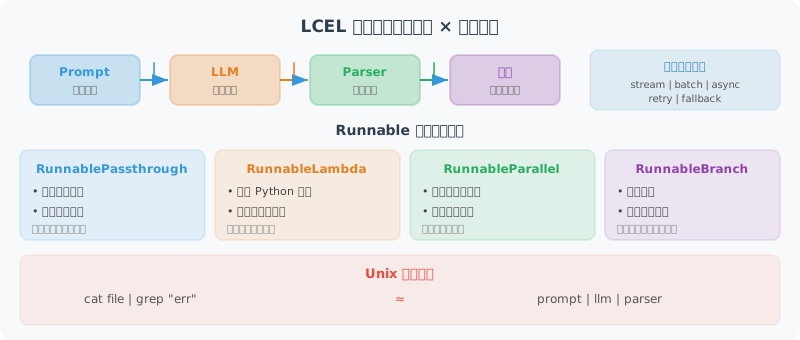
四个最常用原语
| 原语 | 作用 | 使用场景 |
|---|---|---|
| 操作符 | 把两个 Runnable 串联(背后是 __or__ 方法) | 所有链的基础 |
RunnablePassthrough | 原样传递输入,常用于保留原始数据 | 同时需要"检索上下文"和"原问题"时 |
RunnableLambda | 把普通 Python 函数包装成 Runnable | 在管道中插入自定义逻辑 |
RunnableParallel | 并行执行多个 Runnable,结果合并为字典 | RAG 同时检索 + 传问题;多路分析 |
from langchain_core.runnables import RunnablePassthrough, RunnableParallel, RunnableLambda
from langchain_core.prompts import ChatPromptTemplate
from langchain_core.output_parsers import StrOutputParser

llm = ChatOpenAI(model="gpt-4.1-mini")

# 基础链:提示 → 模型 → 解析
chain = ChatPromptTemplate.from_messages([("human", "{question}")]) | llm | StrOutputParser()

# RunnableParallel:同时保留"检索到的上下文"和"原问题"
rag_chain = (
    RunnableParallel({"context": lambda x: retrieve(x["question"]),
                      "question": lambda x: x["question"]})
    | ChatPromptTemplate.from_messages([("system", "基于上下文回答:{context}"),
                                        ("human", "{question}")])
    | llm | StrOutputParser()
)

# RunnableLambda:把普通函数嵌入管道
json_chain = (ChatPromptTemplate.from_messages([("system", "转JSON,含title和priority"),
                                                ("human", "{description}")])
              | llm | StrOutputParser()
              | RunnableLambda(lambda text: json.loads(text[text.find("{"):text.rfind("}")+1])))
💡 直觉理解:
RunnablePassthrough像是管道中的"三通接头"——它不改变水流,只是把主流复制一份送到旁路(比如把原问题也发给模型)。RunnableLambda则是你往流水线上"加一个手工工位"的标准接口。把原语组合好,复杂的 RAG、多路分析都能用声明式表达。
错误处理与重试:生产级韧性
生产环境中,LLM API 可能因网络抖动、速率限制偶尔失败。LCEL 内置两种恢复机制:
with_retry:自动重试,支持指数退避(避免限流时雪崩)with_fallbacks:主链失败后切到备用链(如主模型 GPT-4.1 → 备用 gpt-4.1-mini),保证可用性
resilient = (ChatPromptTemplate.from_messages([("human", "{input}")])
             | llm.with_retry(stop_after_attempt=3, wait_exponential_jitter=True)
             | StrOutputParser())

fallback = (ChatPromptTemplate.from_messages([("human", "{input}")])
            | ChatOpenAI(model="gpt-4.1-mini") | StrOutputParser())
chain_with_fallback = resilient.with_fallbacks([fallback])
链的组合与复用
子链可以像积木一样复用:定义一次 summarize_chain,就能在"先摘要再翻译""先摘要再分类"等多处复用。
summarize = ChatPromptTemplate.from_messages([("system", "压缩为50字摘要"), ("human", "{text}")]) | llm | StrOutputParser()
translate = ChatPromptTemplate.from_messages([("system", "翻译成英文"), ("human", "{text}")]) | llm | StrOutputParser()

summarize_then_translate = summarize | RunnableLambda(lambda x: {"text": x}) | translate
小结
LCEL 的核心优势:
- 统一接口:所有组件都是 Runnable,支持相同调用方式
- 声明式:代码即文档,清晰表达数据流向
- 内置支持:自动支持流式、异步、批处理
- 可组合性:子链自由组合复用
📌 LCEL 解决了"线性管道"的组合问题。但循环、条件分支、持久状态、人工介入这些 Agent 真正复杂的需求,依然超出 LCEL 的表达力——这正是 LangGraph 的舞台(第 13 章)。