9.8 The Skills Bible: Superpowers Engineering Practice Guide
🎯 "Tools give Agents the ability to act; Skills give Agents engineering discipline. What Superpowers does is turn the best practices in software development that are hardest to maintain into non-negotiable execution standards for AI."
1. What Is Superpowers
Project Positioning
obra/superpowers is a collection of Agent Skills designed specifically for Claude Code, with 70k+ Stars on GitHub. Its goal is not to add new capabilities to AI, but to add engineering discipline to AI's behavioral patterns — covering the complete software development lifecycle, from requirements exploration to branch completion.
Core Design Philosophy: On-Demand SKILL.md Loading
Each Skill in Superpowers is essentially a SKILL.md file. This file is not an ordinary README, but a structured expert knowledge document containing:
- Precise operational workflows (Checklists)
- Non-negotiable mandatory constraints (MUST / NEVER / FORBIDDEN)
- Common anti-patterns and Red Flags
- Collaborative relationships with other Skills
When Claude Code determines that the current task requires a certain capability, it loads the corresponding Skill's context on demand. This design solves a core contradiction:
❌ Traditional approach: stuff all specifications into the main System Prompt
   → Context too long → Model degradation → AI forgets to follow specifications

✅ Superpowers approach: SKILL.md injected on demand
   → Only load the Skill needed for the current task → Focused context → Specifications effectively executed
Installation
npx skills add obra/superpowers -g -y
Complete Skills Overview
| Skill Name | Phase | Core Function |
|---|---|---|
brainstorming | Requirements exploration | Structured thinking, generate design specification documents |
writing-plans | Design planning | Output executable plan.md |
test-driven-development | Development implementation | Red-green-refactor cycle, TDD constraints |
using-git-worktrees | Pre-implementation | Create isolated workspaces |
executing-plans | Development implementation | Serial plan execution (non-subagent environments) |
subagent-driven-development | Development implementation | Subagent-driven execution, dual-phase review |
dispatching-parallel-agents | Debugging/development | Concurrent investigation of independent problem domains |
systematic-debugging | Debugging | Four-phase root cause investigation |
verification-before-completion | Completion | Mandatory execution of verification commands |
finishing-a-development-branch | Completion | Standardized branch merge/PR/discard workflow |
requesting-code-review | Review | Initiate high-quality code reviews |
receiving-code-review | Review | Properly handle review feedback |
writing-skills | Meta-skill | Write new SKILL.md files |
self-improving-agent | Meta-skill | Continuously self-evolve from experience |
2. Meta-Rule: using-superpowers
Among all Skills, using-superpowers plays the role of meta-skill — it specifies how AI Agents discover and use all other Skills. Think of it as the "operating system" of the entire Superpowers system.
Instruction Priority
User instructions (CLAUDE.md, direct requests)
    ↓ higher than
Superpowers Skills
    ↓ higher than
Default system prompt
This priority design ensures users always retain ultimate control. If you write "this project does not use TDD" in CLAUDE.md, then even if the test-driven-development Skill says "must use TDD," the AI will follow your instruction.
Core Principle: 1% Probability Must Invoke
If you think a Skill has even a 1% chance of being applicable to the current task, you MUST invoke it. This is non-negotiable, non-optional, and there is no reason to bypass it.
This rule sounds strict, but its design motivation is clear: AI always tends to take shortcuts and skip steps. The 1% threshold prevents AI from using "this Skill probably isn't useful" as a reason to avoid discipline through an extremely low trigger threshold.
Skill Invocation Workflow
Receive user message
    ↓
About to enter EnterPlanMode?
    └─ Already Brainstormed?
           ├─ No → First invoke brainstorming skill
           └─ Yes → Continue

Any possibly applicable Skill (even 1%)?
    ├─ Yes → Invoke Skill tool
    │       ↓
    │   Announce: "Using [skill] to [purpose]"
    │       ↓
    │   Skill has checklist?
    │       ├─ Yes → Create TodoWrite item for each item
    │       └─ No → Execute strictly per Skill
    │
    └─ Absolutely none → Respond directly
Red Flags: You're Making Excuses
When AI has the following thoughts, it's using self-deceptive reasons to avoid discipline:
| AI's Thought | Truth |
|---|---|
| "This is just a simple problem" | Simple problems are still tasks; check Skills first |
| "I need more context" | Skill check precedes clarifying questions |
| "Let me explore the codebase first" | Skills tell you how to explore; check first |
| "I remember the content of this Skill" | Skills evolve; must read the current version |
| "This feels efficient" | Undisciplined action wastes time; Skills prevent this |
Skill Types
- Rigid: such as TDD, Debugging — must be strictly followed regardless of context; execution discipline cannot be adjusted due to "special circumstances"
- Flexible: such as design patterns — adapt the Skill's principles to specific situations; some adjustment within a defined range is allowed
3. Complete Workflow
One of Superpowers' core values is providing an end-to-end software development pipeline. Each Skill plays a specific role in the pipeline, and the connections between Skills are carefully designed:
Brainstorm → Write Plans → Setup Worktree
    → Subagent-Driven Dev (or Execute Plans)
        → Debug (if needed) → Verify → Code Review
            → Finish Branch
| Phase | Skill | Output | Problem Prevented |
|---|---|---|---|
| Exploration | brainstorming | Design specification document | Starting to code without analysis |
| Planning | writing-plans | plan.md | Non-executable plans, missing test constraints |
| Isolation | using-git-worktrees | Independent workspace | Main branch contamination, inability to develop in parallel |
| Implementation | subagent-driven-development | Commits with dual-phase review | Quality loss, pretending to complete |
| Implementation (alt) | executing-plans | Verified commits | Alternative when no subagent available |
| Debugging | systematic-debugging | Root cause fix | Symptom Fix (treating symptoms, not causes) |
| Accelerated debugging | dispatching-parallel-agents | Concurrent fix results | Wasting time processing independent bugs serially |
| Verification | verification-before-completion | Real verification evidence | Pretending to complete, overconfidence |
| Review | requesting/receiving-code-review | Review report | Code quality blind spots |
| Completion | finishing-a-development-branch | Clean branch state | Disorderly merging, leftover debris |
💡 Core Value: The biggest problem with traditional AI programming is that AI easily "pretends to complete," skips tests, and uses surface fixes to cover real problems. Superpowers internalizes software engineering discipline as AI's execution standards, rather than relying on programmers to check after the fact.
4. Five-Layer Capability Architecture
From a higher level, Superpowers' 14 Skills form a five-layer architecture:
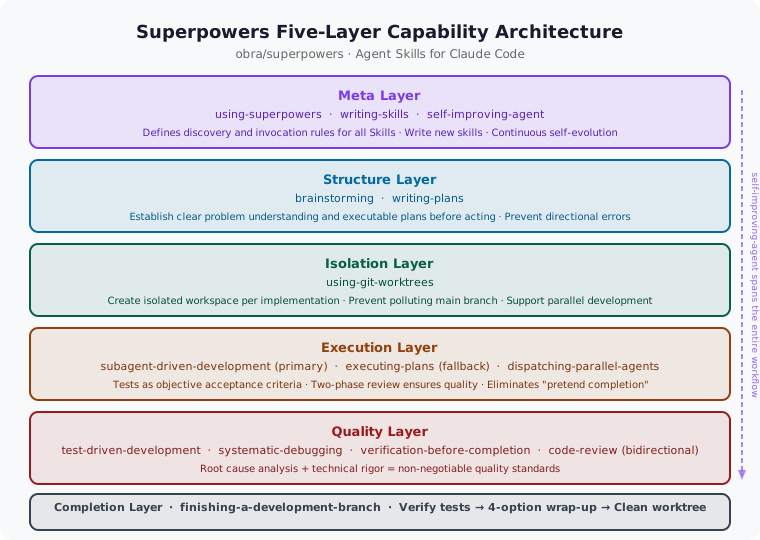
┌──────────────────────────────────────────────────┐
│                  Meta Layer                       │
│   using-superpowers · writing-skills              │
│   · self-improving-agent                          │
│   Define invocation rules · Write new Skills      │
│   · Continuous self-evolution                     │
├──────────────────────────────────────────────────┤
│                  Structure Layer                  │
│   brainstorming → writing-plans                   │
│   Establish clear problem understanding and       │
│   executable plans before starting                │
├──────────────────────────────────────────────────┤
│                  Isolation Layer                  │
│   using-git-worktrees                             │
│   Create independent workspace for each           │
│   implementation, prevent main branch pollution   │
├──────────────────────────────────────────────────┤
│                  Execution Layer                  │
│   subagent-driven-development (preferred)         │
│   executing-plans (alternative)                   │
│   dispatching-parallel-agents (parallel)          │
│   Tests as objective acceptance criteria,         │
│   dual-phase review ensures quality               │
├──────────────────────────────────────────────────┤
│                  Quality Layer                    │
│   TDD · systematic-debugging · verification       │
│   · code-review (bidirectional)                   │
│   Root cause analysis + technical rigor =         │
│   non-negotiable quality standards                │
├──────────────────────────────────────────────────┤
│                  Completion Layer                 │
│   finishing-a-development-branch                  │
│   Verify tests → 4-option completion              │
│   → Clean up Worktree                             │
└──────────────────────────────────────────────────┘
              ↑ self-improving-agent runs throughout ↑
5. Core Skills in Detail
5.1 Structure Layer: Brainstorming + Writing Plans
Brainstorming: Hard Gate
The brainstorming Skill addresses the most common mistake in AI programming: starting to write code without sufficient analysis.
⚠️ HARD-GATE: Never invoke any implementation Skill, write any code, or scaffold anything before presenting a design and getting user approval. This applies to ALL projects, no matter how simple they appear on the surface.
Complete Brainstorming contains 9 sequentially executed steps, each requiring a TodoWrite task to be created for tracking:
- Explore project context: check files, documentation, recent commits
- Provide visual aids (when visual design is involved): send separately, don't merge with questions
- Ask clarifying questions one at a time: ask only one question at a time, understand purpose, constraints, success criteria
- Propose 2-3 options: with trade-off analysis and recommendation rationale
- Present design section by section: ask user to confirm each section
- Write design specification document: save to
docs/superpowers/specs/YYYY-MM-DD-<topic>-design.mdand commit - Specification self-check: scan for TBD/TODO, internal contradictions, ambiguous statements
- Wait for user to review specification: get approval before continuing
- Transition to implementation: invoke
writing-plansSkill
Brainstorming (divergent)              Writing Plans (convergent)
      ↓                                      ↓
Thinking process, option comparison,  →  Executable task list + test plan
design specification
Design principles: ask only one question at a time (multiple choice preferred over open-ended), ruthless YAGNI execution (remove unnecessary features).
Writing Plans: Five Elements of plan.md
writing-plans transforms the design specification output from Brainstorming into a directly executable plan.md:
- Goal: the final deliverable of this implementation
- Tasks: atomic subtasks, each with clear completion criteria
- Test Plan: test cases corresponding to each subtask (mandatory TDD constraint)
- Dependencies: prerequisite dependencies between tasks
- ADR (Architecture Decision Records): key design decisions and their rationale
💡 Key Value: Writing Plans transforms TDD from an "optional discipline" into a "non-bypassable step" — any implementation task must first have corresponding test cases.
5.2 Isolation Layer: Using Git Worktrees
Git Worktrees allow maintaining multiple independent working directories under the same repository simultaneously, without switching branches back and forth.
When it must be used:
- After design approval in
brainstormingPhase 4, before entering implementation - Before
subagent-driven-developmentorexecuting-plansexecutes any task
Creation workflow (5 steps):
# Step 1: Confirm directory (priority: .worktrees/ > worktrees/ > ask user)

# Step 2: Safety verification (directory must be in .gitignore; if not ignored, add and commit first)
git check-ignore -v .worktrees/

# Step 3: Create Worktree
git worktree add .worktrees/<feature-name> -b <branch-name>

# Step 4: Auto-detect and run project initialization
# npm install / cargo build / pip install / go mod download

# Step 5: Verify clean baseline (confirm no pre-existing failures)
npm test  # or other test commands
Key safety rules:
- Never skip
.gitignoreverification (otherwise Worktree contents may be accidentally committed) - Never start development when tests are failing (can't distinguish new bugs from pre-existing issues)
💡 Pairing relationship:
using-git-worktrees(create isolated workspace) andfinishing-a-development-branch(clean up workspace) are a pair of Skills used together — the former opens, the latter closes.
5.3 Execution Layer: Subagent-Driven Development
subagent-driven-development is the most core implementation strategy in Superpowers. Its core idea is:
Dispatch independent subagent for each task + dual-phase review = high quality, fast iteration
Subagents have isolated context — they don't inherit the main session's history; the coordinator precisely constructs the minimum necessary context for them. This ensures both the subagent's focus and prevents the main session's context from being exhausted.
Complete execution workflow:
Read plan, extract all tasks, create TodoWrite
    ↓
(Loop for each task)
    ├─ Dispatch implementation subagent (provide complete task text + context)
    │         ↓
    │     Subagent implements, tests, commits, self-reviews
    │         ↓
    │     ┌─ Dispatch specification review subagent ←────────────────┐
    │     │         ↓                                               │ Issues found, fix and re-review
    │     │     Spec compliant? No → Implementation subagent fixes ──┘
    │     │         ↓ Yes
    │     │     ┌─ Dispatch code quality review subagent ←──────────┐
    │     │     │         ↓                                         │ Issues found, fix and re-review
    │     │     │     Quality pass? No → Fix quality ───────────────┘
    │     │     │         ↓ Yes
    │     │     │     Mark task complete
    │
(All tasks complete)
    ↓
Dispatch final code review subagent
    ↓
Invoke finishing-a-development-branch
Comparison with executing-plans:
| Dimension | subagent-driven-development | executing-plans |
|---|---|---|
| Session | Same session, creates sub-agents | Independent session |
| Context management | Fresh sub-agent per task, precise injection | Continuously accumulates, may degrade |
| Review mechanism | Automatic dual-phase review | No built-in review |
| Applicable conditions | Platform supports sub-agents (e.g., Claude Code) | When no sub-agent support |
| Recommendation | ⭐⭐⭐⭐⭐ Use first | ⭐⭐⭐ Alternative |
Model selection strategy:
| Task Type | Recommended Model |
|---|---|
| Isolated function implementation (1-2 files, clear spec) | Fastest/cheapest model |
| Multi-file coordination, pattern matching, debugging | Standard model |
| Architecture design, code review | Most capable model |
Red Flags (never do):
- Start implementation directly on main/master branch (without explicit consent)
- Skip any review phase
- Let sub-agents self-review instead of real review
- Do code quality review before spec review (wrong order)
- Let sub-agents read the plan file themselves (coordinator should provide complete text)
5.4 Quality Layer
TDD: Test-Driven Development
The red-green-refactor three phases are the cornerstone of Superpowers' quality assurance:
| Phase | Action | Mandatory Constraint |
|---|---|---|
| Red | Write tests describing expected behavior first | Tests MUST fail (implementation doesn't exist yet) |
| Green | Write minimal implementation code | Only make tests pass, not one line more |
| Refactor | Optimize code structure, eliminate duplication | Tests must remain passing |
⚠️ Most common misconception: The "Red" phase requires runnable and failing automated tests, not comments, not pseudocode, not TODOs. Skipping the "Red" phase (writing implementation first, then adding tests) loses TDD's most core value: tests drive design, not just verify implementation.
In AI programming, TDD's value is especially unique:
Traditional programming: TDD is a discipline (relies on engineer's self-discipline)
AI programming: TDD is a constraint mechanism (enforced through Skills)

AI code generation without tests = recursion without a termination condition
——AI can infinitely generate "seemingly reasonable" but actually incorrect code
——Tests are the only objective acceptance criterion
Systematic Debugging: Four-Phase Root Cause Investigation
"NO FIXES WITHOUT ROOT CAUSE INVESTIGATION FIRST."
Random fixes waste time and introduce new bugs. Quick patches mask underlying problems. Must find root cause first, then implement fix. Symptom Fix is failure.
Four non-skippable phases:
- Root cause investigation: collect complete error information, stack traces, reproduction steps; analyze the precise context in which the bug appears
- Pattern analysis: identify which category of known error pattern the bug belongs to (off-by-one? race condition? type error?)
- Hypothesis validation: before making changes, validate hypotheses with minimal experiments (add logging, write targeted test cases)
- Minimal implementation: implement only the minimal fix for the verified root cause; don't make "while I'm at it" other changes
⚠️ Escalation threshold: If debugging the same problem fails 3 or more times, must escalate to architectural level for re-examination — does this bug point to a deeper design flaw? Does the module boundary need to be reconsidered? Should not continue "patching" at the wrong architectural level.
Verification Before Completion
"NO COMPLETION CLAIMS WITHOUT FRESH VERIFICATION EVIDENCE."
Before declaring a task complete, must actually run verification commands and speak based on actual command output — not based on "feelings" about code logic.
This Skill specifically combats AI's tendency to "pretend to complete": AI very easily ends a task with "this implementation should be correct" without actually running the code.
Code Review: Bidirectional Mechanism
Superpowers designs Code Review as a bidirectional skill, targeting both the requesting side and the receiving side:
Requesting side (Requesting Code Review) — Five-dimensional review checklist:
- Code Quality: separation of concerns, error handling, DRY principle, edge case coverage
- Architecture: design decision reasonableness, scalability, security risks
- Testing: tests cover real logic (not just Mocks), boundary coverage
- Requirements: satisfies all requirements in the plan, no scope creep
- Production Readiness: database migration strategy, backward compatibility, documentation completeness
Without context, Code Review can only review code style; Reviewer cannot judge whether the code truly solves the business problem. Standard review context template must include: what was implemented (WHAT_WAS_IMPLEMENTED), original requirements document, Base SHA and Head SHA.
Receiving side (Receiving Code Review) — Performative Agreement anti-pattern:
Code Review is a technical evaluation of objective code, not a social performance to please the Reviewer.
⚠️ Performative Agreement anti-pattern: To appear "cooperative" or "positive," blindly agreeing to and executing Reviewer suggestions without verifying technical feasibility. This is not humility; this is irresponsibility.
Four principles for the receiving side:
- Technical rigor: decisions based on facts, test results, and system status — not authority or social pressure
- Verify before executing: after receiving feedback, strictly forbidden to immediately say "You're absolutely right! Let me fix it..." — first verify in the codebase
- YAGNI principle rebuttal: when Reviewer suggests adding functionality that the current system doesn't call at all, rebut with YAGNI
- Well-reasoned technical rebuttal: when discovering a suggestion would break existing functionality, must rebut with technical reasoning
5.5 Meta-Skills: Writing Skills + Self-Improving Agent
Writing Skills: How to Write SKILL.md
writing-skills is Superpowers' self-extension mechanism — the Skill for writing new Skills.
Three core principles for writing high-quality SKILL.md:
-
Solve problems, don't describe processes: good SKILL.md gives specific, directly executable steps, not narratives of "usually should..."
-
Mandatory constraints, not suggestions:
❌ "You should consider running tests before merging."
✅ "NEVER merge without passing tests. This is FORBIDDEN."
AI doesn't execute suggestions, only rules. Use MUST, NEVER, FORBIDDEN — not should, consider.
-
Reusable Patterns: distill the process of solving problems into reusable patterns, not one-time scripts
The existence of writing-skills gives Superpowers self-extension capability: when a team encounters recurring problem patterns, they can encode the solution as a new SKILL.md, crystallizing it as shared knowledge to be reused by all members and AI Agents.
Self-Improving Agent: Three-Layer Memory Architecture
self-improving-agent is a general self-evolution system, built on 2025 lifelong learning research (SimpleMem, Multi-Memory Survey, Lifelong Learning LLM Agents):
┌──────────────────────────────────────────────────┐
│                Multi-Memory System                │
├──────────────┬───────────────┬───────────────────┤
│  Semantic    │   Episodic    │    Working         │
│  Memory      │   Memory      │    Memory          │
│ (patterns/   │ (specific     │  (current          │
│  rules)      │  experiences) │   session)         │
│ semantic/    │ episodic/     │ working/           │
│ patterns.json│ YYYY-MM-DD-  │ session.json       │
│              │   *.json     │                    │
└──────────────┴───────────────┴───────────────────┘
Automatic trigger mechanisms (Hooks):
| Event | Trigger Timing | Action |
|---|---|---|
before_start | Before any Skill starts | Record session start, load working memory |
after_complete | After any Skill completes | Extract patterns, update Skill files |
on_error | Bash returns non-zero exit code | Capture error context, trigger self-correction |
Four phases of self-evolution:
-
Experience extraction: record what happened, what worked, what failed, what the root cause was
-
Pattern abstraction: transform specific experiences into reusable rules
Specific experience        →    Abstract pattern         →    Update target Skill
"User forgot to save PRD"  →  "Persist thinking process" →    prd-planner
"Missed SQL injection check" → "Add security checklist"  →    code-reviewer
Abstraction rules: same experience repeated 3+ times → mark as key pattern; user rating ≤ 4/10 → add to "avoid" list
-
Skill updates: use evolution markers to track change sources
<!-- Evolution: 2025-01-12 | source: ep-2025-01-12-001 | skill: debugger --> -
Memory consolidation: update semantic memory, manage confidence levels, prune low-confidence patterns (prevent accumulation of incorrect experiences)
Manual trigger: say "self-improve", "self-evolve", or "learn from experience" to trigger manually.
6. Key Connections and Collaborative Relationships
Superpowers' 14 Skills don't exist in isolation — there are 6 key collaborative relationships between them:
| Skill Pair | Collaboration Method | Problem Solved |
|---|---|---|
using-git-worktrees ↔ finishing-a-development-branch | Used in pairs: former creates isolation, latter cleans up | Every development has a clean start and end state |
subagent-driven-dev ↔ dispatching-parallel-agents | Former for serial tasks (with dual-phase review), latter for concurrent independent problem domains | Optimal balance between quality assurance and efficiency |
TDD ↔ code-review | TDD ensures each subtask has objective completion criteria (green tests), Review checks design quality on top of that | Quality double insurance: objectively correct first, then elegantly compliant |
systematic-debugging ↔ verification-before-completion | Former solves "how to fix when something goes wrong," latter solves "how to prove it's done" | Prevent Symptom Fix + prevent pretending to complete |
brainstorming ↔ writing-plans | Former diverges, latter converges, forming a complete "think→execute" preparation phase | Prevent directional errors and missing plans |
writing-skills ↔ self-improving-agent | Former explicitly creates new Skills, latter automatically evolves existing Skills from experience | Self-evolution capability of the Superpowers ecosystem |
7. Getting Started Immediately
# Step 1: Install Superpowers (global, auto-accept all prompts)
npx skills add obra/superpowers -g -y

# Step 2: Complete development pipeline (new feature development)
# In Claude Code, naturally trigger in the following order:

# 2.1 Requirements exploration (hard gate, cannot be skipped)
# → Triggers brainstorming skill
# → Generates docs/superpowers/specs/YYYY-MM-DD-<topic>-design.md

# 2.2 Planning
# → Triggers writing-plans skill
# → Generates plan.md (with TDD constraints)

# 2.3 Create isolated workspace
git worktree add .worktrees/feature-name -b feature/name
# → Or trigger using-git-worktrees skill to execute automatically

# 2.4 Subagent-driven implementation (with dual-phase review)
# → Triggers subagent-driven-development skill

# 2.5 Complete development
# → Triggers finishing-a-development-branch skill
# → Choose: local merge / create PR / keep / discard

# Step 3: Encountering multiple independent bugs (concurrent processing)
# → Triggers dispatching-parallel-agents skill
# → Dispatch dedicated agent for each independent problem domain concurrently

# Step 4: Let the system continuously evolve
# → Say "self-improve" in conversation to trigger manually, or trigger automatically via Hooks
# → self-improving-agent extracts patterns from all Skill usage experiences
💡 Usage Recommendation: You don't need to use all 14 Skills from day one. Recommended onboarding order: start with
brainstorming(experience the value of the hard gate) →writing-plans(develop the habit of planning first) →systematic-debugging(break the habit of Symptom Fix) → gradually introduce other Skills.
Summary
| Dimension | Core Content |
|---|---|
| Project positioning | obra/superpowers, 14 Skills, covering the complete software development lifecycle |
| Design philosophy | SKILL.md loaded on demand, focused context, not placed in main System Prompt |
| Meta-rule | 1% probability must invoke; user instructions > Skills > default system prompt |
| Complete workflow | Brainstorm → Plans → Worktree → Dev → Debug → Verify → Review → Finish |
| Five-layer architecture | Meta / Structure / Isolation / Execution / Quality / Completion layers |
| Most critical Skill | subagent-driven-development (dual-phase review is the quality core) |
| Most easily overlooked Skill | receiving-code-review (Performative Agreement anti-pattern is very common) |
| Self-evolution | self-improving-agent continuously evolves the entire Skills ecosystem through three-layer memory architecture |
⚠️ Open Questions to Consider:
- Are Superpowers' Skills applicable to projects of different scales? Is it worth using all of them for small personal projects?
- As AI capabilities improve, which Skills' rigid constraints will become too strict? How should Skills evolve accordingly?
- How does
self-improving-agent's memory architecture avoid "experience corruption" — accumulation of incorrect patterns — after long-term use?- How do
dispatching-parallel-agentsandsubagent-driven-developmentcollaborate within the same complex task?
Chapter complete. Back to: Chapter 9 Index