9.4 Skill Discovery and Registration
In the previous sections, we learned how to define and learn skills. But in multi-Agent systems, there's another key problem to solve: How does an Agent know what skills other Agents have? How does it find and invoke the right skills?
This is the problem that skill discovery and registration mechanisms solve.
Why Is Skill Discovery Needed?
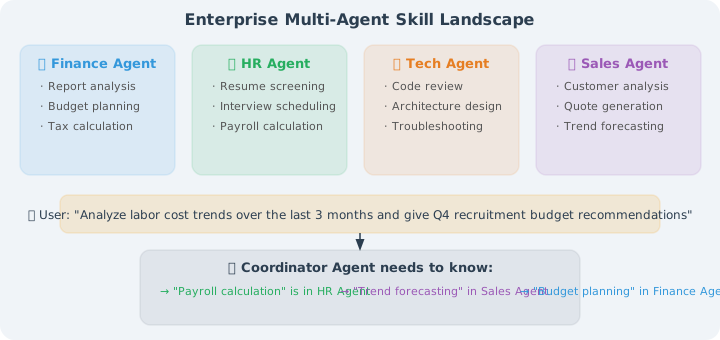
Without a skill discovery mechanism, the coordinating Agent doesn't know who to find or what capabilities they have.
Method 1: Agent Card — Static Skill Declaration
Skill Declaration in the A2A Protocol
In Google's A2A (Agent-to-Agent) protocol, each Agent declares its skills through an Agent Card:
{
  "name": "Data Analysis Agent",
  "description": "Professional data analysis and visualization service",
  "url": "https://data-agent.example.com",
  "version": "2.0",
  "skills": [
    {
      "id": "csv-analysis",
      "name": "CSV Data Analysis",
      "description": "Data cleaning, statistical analysis, and trend identification for CSV files",
      "input_modes": ["text", "file"],
      "output_modes": ["text", "file", "image"],
      "tags": ["data", "analysis", "csv", "statistics"]
    },
    {
      "id": "data-visualization",
      "name": "Data Visualization",
      "description": "Automatically select appropriate chart types based on data and generate visualizations",
      "input_modes": ["text", "file"],
      "output_modes": ["image", "file"],
      "tags": ["visualization", "chart", "plot"]
    },
    {
      "id": "report-generation",
      "name": "Analysis Report Generation",
      "description": "Generate structured Markdown or PDF reports based on analysis results",
      "input_modes": ["text"],
      "output_modes": ["text", "file"],
      "tags": ["report", "document", "summary"]
    }
  ],
  "authentication": {
    "type": "bearer_token"
  }
}
Skill Discovery Workflow
# A2A skill discovery workflow
class AgentRegistry:
    """Agent Registry"""

    def __init__(self):
        self.agents = {}  # agent_url → agent_card

    def register(self, agent_url: str):
        """Register Agent: fetch its Agent Card"""
        card = self._fetch_agent_card(agent_url)
        self.agents[agent_url] = card
        print(f"✅ Registration successful: {card['name']} "
              f"(skills: {[s['name'] for s in card['skills']]})")

    def discover_by_skill(self, skill_query: str) -> list:
        """Discover suitable Agents based on skill description"""
        results = []
        for url, card in self.agents.items():
            for skill in card["skills"]:
                # Match skill description or tags
                if (skill_query.lower() in skill["description"].lower() or
                    any(skill_query.lower() in tag for tag in skill["tags"])):
                    results.append({
                        "agent_name": card["name"],
                        "agent_url": url,
                        "skill": skill
                    })
        return results

    def _fetch_agent_card(self, url: str) -> dict:
        """Fetch Agent Card from Agent's well-known endpoint"""
        import requests
        response = requests.get(f"{url}/.well-known/agent.json")
        return response.json()

# Usage example
registry = AgentRegistry()
registry.register("https://data-agent.example.com")
registry.register("https://finance-agent.example.com")

# Discover Agents that can do "data analysis"
agents = registry.discover_by_skill("data analysis")
# → [{"agent_name": "Data Analysis Agent", "skill": {...}}]
Best Practices for Agent Cards
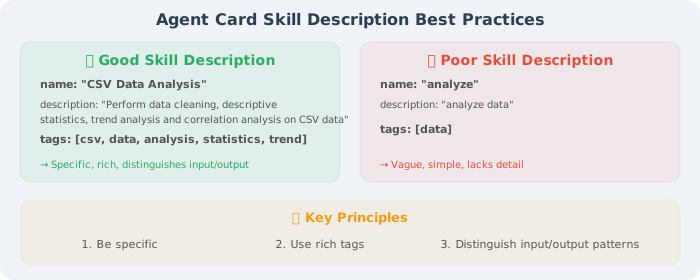
✅ Good skill description:
  {
    "name": "CSV Data Analysis",
    "description": "Perform data cleaning (missing value handling, outlier detection),
                    descriptive statistics (mean, median, standard deviation),
                    trend analysis, and correlation analysis on CSV tabular data",
    "tags": ["csv", "data", "analysis", "statistics", "trend"]
  }

❌ Poor skill description:
  {
    "name": "Analysis",
    "description": "Analyze data",
    "tags": ["data"]
  }

Key principles:
  1. Be specific in description — explain input, processing, output
  2. Use rich tags — cover synonyms and related concepts
  3. Distinguish input/output modes — text, file, image, etc.
Method 2: Semantic Retrieval — Dynamic Skill Discovery
Agent Cards are static and require skills to be predefined. Semantic retrieval enables more flexible dynamic discovery — searching the skill library for semantically matching skills based on task descriptions.
Basic Principle
Static discovery (keyword matching):
  Query: "Analyze customer churn rate"
  Match: tags containing "analysis" → finds 3 Agents
  Problem: not precise enough, may return irrelevant "text analysis" Agents

Dynamic discovery (semantic retrieval):
  Query: "Analyze customer churn rate"
  Embed query vector → calculate similarity with all skill description vectors
  → Precisely matches "customer behavior analysis" skill (similarity 0.92)
  → Rather than "text sentiment analysis" skill (similarity 0.45)
Implementation
from sentence_transformers import SentenceTransformer
import numpy as np

class SemanticSkillDiscovery:
    """Skill discovery based on semantic retrieval"""

    def __init__(self):
        self.model = SentenceTransformer('all-MiniLM-L6-v2')
        self.skills = []
        self.embeddings = []

    def register_skill(self, skill: dict):
        """Register skill and compute embedding"""
        # Concatenate skill name, description, and tags
        text = f"{skill['name']}: {skill['description']}. " \
               f"Tags: {', '.join(skill.get('tags', []))}"
        embedding = self.model.encode(text)

        self.skills.append(skill)
        self.embeddings.append(embedding)

    def discover(self, task: str, top_k: int = 3) -> list:
        """Discover best-matching skills based on task description"""
        task_embedding = self.model.encode(task)

        # Calculate cosine similarity
        similarities = []
        for i, emb in enumerate(self.embeddings):
            sim = np.dot(task_embedding, emb) / (
                np.linalg.norm(task_embedding) * np.linalg.norm(emb)
            )
            similarities.append((i, sim))

        # Sort and return top_k
        similarities.sort(key=lambda x: x[1], reverse=True)

        results = []
        for idx, sim in similarities[:top_k]:
            results.append({
                "skill": self.skills[idx],
                "similarity": float(sim)
            })

        return results

# Usage example
discovery = SemanticSkillDiscovery()

# Register skills
discovery.register_skill({
    "name": "Customer Churn Analysis",
    "description": "Analyze customer behavior data, predict churn risk, provide retention strategies",
    "agent_url": "https://crm-agent.example.com",
    "tags": ["customer", "churn", "prediction", "retention"]
})

discovery.register_skill({
    "name": "Text Sentiment Analysis",
    "description": "Analyze the sentiment tendency of text: positive, negative, neutral",
    "agent_url": "https://nlp-agent.example.com",
    "tags": ["NLP", "sentiment", "text"]
})

# Discover skills
results = discovery.discover("I want to see which customers might be about to churn")
# → [{"skill": {"name": "Customer Churn Analysis", ...}, "similarity": 0.92}]
Method 3: MCP and the Skill Ecosystem
Chapter 17 will cover the MCP protocol in detail. Here we first understand how MCP supports the skill ecosystem:
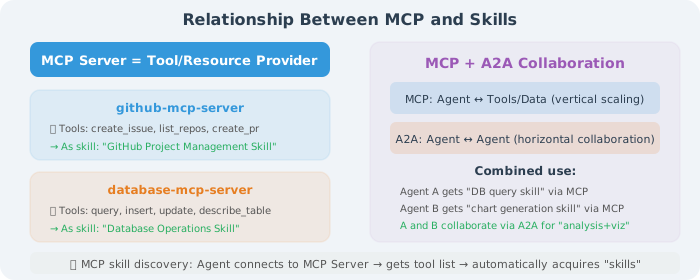
MCP and A2A Collaboration
The collaborative relationship between MCP and A2A is shown in the diagram above: MCP handles vertical expansion between Agents and tools/data, while A2A handles horizontal collaboration between Agents. Together they implement a complete skill ecosystem.
Skill Version Management
In production environments, skills need version management — new versions of skills may change behavior and require compatibility handling:
class VersionedSkillRegistry:
    """Skill registry with version management support"""

    def __init__(self):
        self.skills = {}  # skill_name → {version → skill_definition}

    def register(self, name: str, version: str, definition: dict):
        """Register a specific version of a skill"""
        if name not in self.skills:
            self.skills[name] = {}
        self.skills[name][version] = definition

    def get_skill(self, name: str, version: str = "latest") -> dict:
        """Get skill (supports version specification)"""
        if name not in self.skills:
            raise ValueError(f"Skill not found: {name}")

        if version == "latest":
            versions = sorted(self.skills[name].keys())
            version = versions[-1]

        return self.skills[name][version]

    def list_versions(self, name: str) -> list:
        """List all versions of a skill"""
        return sorted(self.skills[name].keys())

# Usage
registry = VersionedSkillRegistry()
registry.register("data_analysis", "1.0", {
    "description": "Basic data analysis",
    "capabilities": ["descriptive_stats"]
})
registry.register("data_analysis", "2.0", {
    "description": "Advanced data analysis",
    "capabilities": ["descriptive_stats", "predictive_modeling", "anomaly_detection"]
})
Skill Orchestration: From Discovery to Invocation
Putting it all together — a complete skill orchestration workflow:
class SkillOrchestrator:
    """Skill orchestrator: discover → select → invoke → combine"""

    def __init__(self, discovery: SemanticSkillDiscovery, llm):
        self.discovery = discovery
        self.llm = llm

    def execute(self, task: str) -> dict:
        """Execute task: automatically discover and orchestrate skills"""

        # 1. Task decomposition
        subtasks = self._decompose_task(task)

        # 2. Discover skills for each subtask
        skill_plan = []
        for subtask in subtasks:
            candidates = self.discovery.discover(subtask, top_k=3)
            best_skill = self._select_best(subtask, candidates)
            skill_plan.append({
                "subtask": subtask,
                "skill": best_skill
            })

        # 3. Execute in sequence
        results = []
        for step in skill_plan:
            result = self._invoke_skill(
                step["skill"],
                step["subtask"],
                context=results  # Pass results from previous steps
            )
            results.append(result)

        # 4. Integrate results
        return self._combine_results(task, results)

    def _decompose_task(self, task: str) -> list:
        """Use LLM to decompose task"""
        prompt = f"Decompose the following task into 2-5 subtasks:\n{task}"
        return self.llm.generate(prompt)

    def _select_best(self, subtask: str, candidates: list) -> dict:
        """Select the most suitable skill"""
        if not candidates:
            return None
        # Select the one with highest similarity
        return candidates[0]["skill"]
Summary
| Discovery Method | Mechanism | Pros | Cons |
|---|---|---|---|
| Agent Card | Static declaration | Standardized, reliable | Requires predefinition |
| Semantic retrieval | Vector similarity | Flexible, intelligent | Depends on embedding quality |
| MCP ecosystem | Protocol discovery | Tools as skills | Requires MCP Server |
| Hybrid approach | Combination of above | Most comprehensive | Higher complexity |
💡 Industry Trend: In 2025, skill discovery is being standardized. Google's A2A protocol defines the skill declaration format in Agent Cards, Anthropic's SKILL.md defines the skill description format, and the community project add-skill provides cross-platform skill installation tools. In the future, the Agent skill ecosystem may form a standardized discovery, installation, and sharing system similar to today's npm/pip package management.
Next section: 9.5 Practice: Building a Reusable Skill System