A2A (Agent-to-Agent) Protocol
A2A (Agent-to-Agent) is an open protocol launched by Google at Google Cloud Next in April 2025, specifically designed for interoperability between different Agents. The protocol received support from over 50 technology partners at launch.
A2A's Design Goals
Problems A2A solves:
- How can Agents developed by different companies/teams call each other?
- How to standardize the declaration and discovery of Agent capabilities?
- How can Agents across frameworks securely pass tasks?

Analogy:
A2A is to Agents what HTTP is to web services —
making Agents into "microservices" that can connect to each other
MCP vs. A2A: Complementary, Not Competing
MCP and A2A solve problems at different layers:

MCP (Model-Tool layer):
  Agent ←→ Tools/Data
  "Enabling Agents to use various tools"
  Analogy: a person learning to use a hammer or wrench

A2A (Agent-Agent layer):
  Agent ←→ Agent
  "Enabling Agents to collaborate with other Agents"
  Analogy: communication and collaboration between people

Together = a complete Agent interoperability system
Agent Card
Every A2A-compatible Agent needs to publish a capability card at /.well-known/agent.json:
import json
from typing import Optional

class AgentCard:
    """A2A Agent capability declaration"""

    def __init__(
        self,
        name: str,
        description: str,
        url: str,
        version: str = "1.0.0"
    ):
        self.card = {
            "name": name,
            "description": description,
            "url": url,
            "version": version,
            "capabilities": {
                "streaming": True,
                "pushNotifications": False,
                "stateTransitionHistory": True,  # Supports state tracking
            },
            "defaultInputModes": ["text"],
            "defaultOutputModes": ["text"],
            "skills": []
        }

    def add_skill(
        self,
        id: str,
        name: str,
        description: str,
        input_modes: list[str] = None,
        output_modes: list[str] = None
    ):
        """Add a skill description"""
        self.card["skills"].append({
            "id": id,
            "name": name,
            "description": description,
            "inputModes": input_modes or ["text"],
            "outputModes": output_modes or ["text"],
        })

    def to_json(self) -> str:
        return json.dumps(self.card, indent=2)

# Create an example Agent Card
card = AgentCard(
    name="Data Analysis Agent",
    description="A professional data analysis Agent that can process CSV data and generate visualization reports",
    url="https://my-agent.example.com",
    version="2.1.0"
)

card.add_skill(
    id="analyze_csv",
    name="CSV Data Analysis",
    description="Analyze data in CSV files and calculate statistical metrics",
    input_modes=["text", "file"],
    output_modes=["text", "data"]
)

card.add_skill(
    id="generate_chart",
    name="Data Visualization",
    description="Generate data charts (line charts, bar charts, pie charts)",
    input_modes=["data"],
    output_modes=["image", "text"]
)

print(card.to_json())
A2A Task Passing
A2A defines a complete task lifecycle management, including task creation, execution, status tracking, and result return:
from fastapi import FastAPI
from pydantic import BaseModel
import uuid
import datetime

app = FastAPI(title="A2A Agent Server")

# ============================
# A2A Message Format
# ============================

class A2AMessage(BaseModel):
    """A2A standard message format"""
    role: str  # "user" | "agent"
    parts: list[dict]  # Message content blocks (supports text, file, data, etc.)

class A2ATask(BaseModel):
    """A2A task request"""
    id: Optional[str] = None
    message: A2AMessage

class A2ATaskResult(BaseModel):
    """A2A task result"""
    id: str
    status: dict  # state: "completed" | "failed" | "working" | "input-required"
    artifacts: list[dict] = []

# ============================
# A2A Server Endpoints
# ============================

@app.get("/.well-known/agent.json")
async def get_agent_card():
    """Agent capability declaration (all A2A Agents must implement this)"""
    return card.card

@app.post("/tasks/send")
async def send_task(task: A2ATask) -> A2ATaskResult:
    """Receive and process a task (synchronous mode)"""
    task_id = task.id or str(uuid.uuid4())

    # Extract user message
    user_message = ""
    for part in task.message.parts:
        if part.get("type") == "text":
            user_message += part.get("text", "")

    # Process the task (call real Agent logic)
    from openai import OpenAI
    client = OpenAI()

    response = client.chat.completions.create(
        model="gpt-4o-mini",
        messages=[{"role": "user", "content": user_message}]
    )

    result = response.choices[0].message.content

    return A2ATaskResult(
        id=task_id,
        status={
            "state": "completed",
            "timestamp": datetime.datetime.now().isoformat()
        },
        artifacts=[{
            "parts": [{"type": "text", "text": result}],
            "name": "response"
        }]
    )

@app.post("/tasks/sendSubscribe")
async def send_task_streaming(task: A2ATask):
    """Receive and process a task (streaming mode, returns intermediate status via SSE)"""
    # Supports long-running tasks; pushes status updates via SSE
    pass

# ============================
# A2A Client (calling other Agents)
# ============================

import requests

class A2AClient:
    """A2A client: calls other Agents"""

    def __init__(self, agent_url: str):
        self.agent_url = agent_url.rstrip("/")
        self.agent_card = None

    def discover(self) -> dict:
        """Discover Agent capabilities"""
        response = requests.get(
            f"{self.agent_url}/.well-known/agent.json"
        )
        self.agent_card = response.json()
        return self.agent_card

    def send_task(self, message: str) -> str:
        """Send a task to the Agent"""
        payload = {
            "message": {
                "role": "user",
                "parts": [{"type": "text", "text": message}]
            }
        }

        response = requests.post(
            f"{self.agent_url}/tasks/send",
            json=payload
        )

        result = response.json()

        # Extract result
        for artifact in result.get("artifacts", []):
            for part in artifact.get("parts", []):
                if part.get("type") == "text":
                    return part["text"]

        return "Agent returned an empty result"

# Usage example
client = A2AClient("https://my-data-agent.example.com")
card = client.discover()
print(f"Discovered Agent: {card['name']}")
print(f"Available skills: {[s['name'] for s in card.get('skills', [])]}")

result = client.send_task("Analyze this sales data and provide a trend analysis: [100, 120, 95, 140, 160]")
print(result)
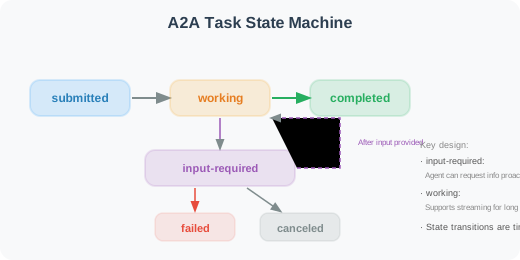
A2A Task State Machine
A2A defines a clear task state transition flow:
Streaming Mode: /tasks/sendSubscribe
For long-running tasks (such as data analysis or document generation), A2A provides a streaming mode based on SSE (Server-Sent Events), allowing clients to receive real-time task progress updates:
from fastapi import FastAPI
from fastapi.responses import StreamingResponse
import json
import asyncio

app = FastAPI()

async def task_stream(task_id: str, user_message: str):
    """Return task progress and results via SSE streaming"""

    # 1. Send task status change: working
    yield f"data: {json.dumps({'id': task_id, 'status': {'state': 'working', 'message': 'Analyzing data...'}})}\n\n"

    await asyncio.sleep(1)  # Simulate processing

    # 2. Send intermediate result (artifact update)
    yield f"data: {json.dumps({'id': task_id, 'artifact': {'parts': [{'type': 'text', 'text': 'Phase 1 complete: data cleaning'}], 'name': 'progress', 'append': True}})}\n\n"

    await asyncio.sleep(1)

    # 3. Send final result
    yield f"data: {json.dumps({'id': task_id, 'status': {'state': 'completed'}, 'artifact': {'parts': [{'type': 'text', 'text': 'Analysis complete: sales grew 23%'}], 'name': 'result', 'lastChunk': True}})}\n\n"

@app.post("/tasks/sendSubscribe")
async def send_task_streaming(task: dict):
    """A2A streaming task endpoint"""
    task_id = task.get("id", str(uuid.uuid4()))
    user_message = task["message"]["parts"][0].get("text", "")

    return StreamingResponse(
        task_stream(task_id, user_message),
        media_type="text/event-stream",
        headers={
            "Cache-Control": "no-cache",
            "Connection": "keep-alive",
        }
    )
Client consuming the SSE stream:
import httpx

async def subscribe_task(agent_url: str, message: str):
    """Subscribe to streaming task results"""
    payload = {
        "message": {
            "role": "user",
            "parts": [{"type": "text", "text": message}]
        }
    }

    async with httpx.AsyncClient() as client:
        async with client.stream(
            "POST", f"{agent_url}/tasks/sendSubscribe", json=payload
        ) as response:
            async for line in response.aiter_lines():
                if line.startswith("data: "):
                    event = json.loads(line[6:])
                    status = event.get("status", {})
                    print(f"Status: {status.get('state', 'unknown')}")

                    if artifact := event.get("artifact"):
                        for part in artifact.get("parts", []):
                            if part.get("type") == "text":
                                print(f"  → {part['text']}")
Push Notifications
For tasks that require even longer processing times, A2A supports asynchronously notifying clients via a Push Notifications mechanism, avoiding clients having to maintain long-lived SSE connections:
class AgentCardWithPush:
    """Agent Card with push notification support"""

    def __init__(self, name: str, url: str):
        self.card = {
            "name": name,
            "url": url,
            "capabilities": {
                "streaming": True,
                "pushNotifications": True,  # Declare push support
                "stateTransitionHistory": True,
            },
            "skills": []
        }

# Push Notification workflow:
# 1. Client calls /tasks/send to submit the task
# 2. Client calls /tasks/{id}/pushNotification/set to register a callback URL
# 3. Agent sends a notification to the callback URL upon completion
# 4. Client calls /tasks/{id} to get the full result

@app.post("/tasks/{task_id}/pushNotification/set")
async def set_push_notification(task_id: str, config: dict):
    """Register a push notification callback"""
    callback_url = config.get("url")
    # Store the callback URL; send a POST request to this URL when the task completes
    push_registry[task_id] = callback_url
    return {"status": "registered"}
Authentication and Security
The A2A protocol declares authentication requirements via the authentication field in the Agent Card, supporting multiple authentication schemes:
# Authentication declaration in Agent Card
agent_card_with_auth = {
    "name": "Enterprise Data Analysis Agent",
    "url": "https://data-agent.corp.example.com",
    "version": "2.0.0",
    "authentication": {
        "schemes": [
            {
                "scheme": "Bearer",
                "description": "Authenticate using OAuth 2.0 Bearer Token",
                "tokenUrl": "https://auth.corp.example.com/oauth/token",
                "scopes": ["agent:read", "agent:execute"]
            },
            {
                "scheme": "ApiKey",
                "description": "Authenticate using API Key",
                "in": "header",
                "name": "X-API-Key"
            }
        ]
    },
    "capabilities": {
        "streaming": True,
        "pushNotifications": True,
        "stateTransitionHistory": True,
    },
    "skills": [...]
}

# Client calling with authentication
class A2ASecureClient:
    """A2A client with authentication"""

    def __init__(self, agent_url: str, auth_token: str):
        self.agent_url = agent_url
        self.headers = {
            "Authorization": f"Bearer {auth_token}",
            "Content-Type": "application/json"
        }

    def send_task(self, message: str) -> dict:
        response = requests.post(
            f"{self.agent_url}/tasks/send",
            json={
                "message": {
                    "role": "user",
                    "parts": [{"type": "text", "text": message}]
                }
            },
            headers=self.headers
        )
        response.raise_for_status()
        return response.json()
Summary
The value of the A2A protocol:
- Interoperability: Agents from different frameworks and teams can call each other
- Service discovery: Declare capabilities via Agent Card (
/.well-known/agent.json) - Standard message format: Unified request/response format supporting multimodal content
- Task state management: Complete task lifecycle tracking
- Complementary to MCP: MCP manages Agent-tool connections; A2A manages Agent-Agent connections
- Industry support: 50+ companies including Google, Salesforce, and SAP are participating
Next section: 17.3 ANP (Agent Network Protocol)