14.1 OpenClaw Panorama: From Clawdbot to OpenClaw
🦞 "How a weekend project became a phenomenon — and why its name changed three times."
Why OpenClaw Matters
Before 2025, Agents were mostly demos (AutoGPT, BabyAGI) stuck in a CLI or a crude web UI. The thing that pushed Agents into daily life was the action-oriented Agent living in chat apps — you @ it in WhatsApp and it searches, edits files, runs commands.
OpenClaw is a leading representative. Its GitHub growth was unprecedented — hundreds of thousands of stars within months. How did it start? What fundamentally separates it from an industrial harness like Claude Code? This section gives the panorama.
A Brief Naming History
The same codebase changed names three times in under two months:
| Time | Name | Event |
|---|---|---|
| Dec 2025 | early prototype | Peter Steinberger's first repo — a "WhatsApp relay" forwarding messages to an LLM and back |
| Jan 2026 (early) | Clawdbot | First "general" version; "claw" from the Claude+claw meme; multi-channel + sandbox + LSP + voice |
| Jan 27, 2026 | Moltbot | Renamed over Anthropic trademark concerns ("Clawd" too close to "Claude") |
| Jan 30, 2026+ | OpenClaw | Dropped the trademark conflict; emphasized open-source / long-term brand |
What this history teaches:
- Naming is engineering — a wrong name brings recurring trademark/SEO/community costs.
- Rewrites flourished — nanobot (Python ~4000 lines), ZeroClaw (Rust), NanoClaw (Go + Apple containers), IronClaw (Rust + WASM sandbox), NullClaw (Zig, 678KB static binary) all use OpenClaw's core architecture as a starting line — itself a "collective quality review."
- OpenClaw chose the community-driven route — the biggest divide from Claude Code (closed source).
OpenClaw's Place in the Harness Spectrum
Action-oriented Agent Harness spectrum (2026)
│
├── Multi-channel · consumer · community-driven (open source)
│   └─ OpenClaw (Ch.14) — put the Agent in chat apps
│
├── Multi-channel · consumer · self-evolving (open source)
│   └─ Hermes Agent (Ch.15) — Agent writes its own skills
│
├── Terminal IDE · industrial · closed (source-available)
│   └─ Claude Code (Ch.16) — the coding IDE
│
└── Terminal IDE · developer workshop · everything-is-a-plugin (open source)
    └─ DeepSeek Harness (Ch.17) — model-agnostic + swappable kernel
The "user key" difference is decisive:
| Harness | Primary interface | User key |
|---|---|---|
| OpenClaw | Chat apps | @bot in WhatsApp/Telegram/Discord/Slack/Signal |
| Hermes | Chat apps + CLI + TUI | Same + hermes command |
| Claude Code | Terminal CLI | claude "fix this bug" |
| DeepSeek Harness | Web UI + CLI + TUI | Browser 127.0.0.1:3080 / dsh |
📌 OpenClaw moved the user key from CLI to chat app — a structural change: inputs become shorter and more colloquial, demanding stronger context summarization and ambiguity tolerance.
Three Fundamental Differences from Claude Code
| Dimension | OpenClaw | Claude Code |
|---|---|---|
| License | MIT open source | source-available |
| Target scene | Personal assistant, life tasks | Software engineering |
| Interaction | Chat apps + CLI + TUI | Terminal CLI |
| Skill system | Skills (Markdown) + plugins (TS) | Skills / MCP / Hooks |
| Extension | Community + ClawHub market | Private + team config |
| Sandbox | Terminal safety + Docker (recommended) | Permission modes |
Key takeaways: scene (not capability) is the dividing line; license ≠ safety; entry point determines design — a chat entry means "messages must fit in ~1.6K chars," driving summarization and task-decomposition submodules that a CLI entry doesn't need.
The 4 Core Subsystems
Gateway (message hub)
Normalizes all channels into IncomingMessage/OutgoingMessage. The flow across the four subsystems is:
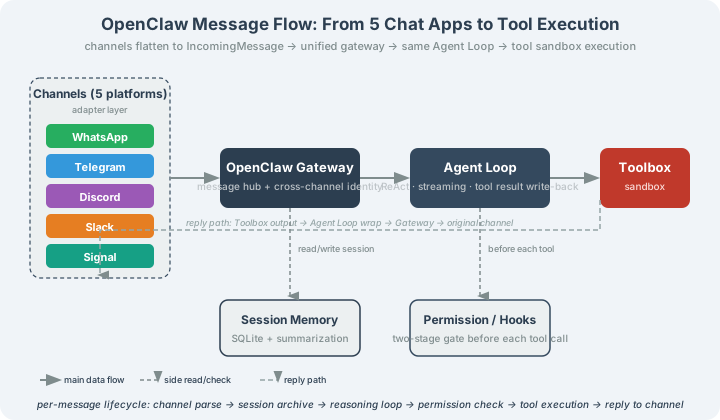
Agent Loop — streaming inference → tool-call parsing → execution → write-back; with compression and permission checks.
Toolbox — file / shell / web / message / calendar / skill / memory tools for daily tasks.
Skills & Plugins — SKILL.md (Markdown + optional script) registers new capabilities; the format is compatible with Claude Code.
💡 These four map directly onto Chapter 8's "six engineering pillars": Gateway ⊂ Channels; Agent Loop ⊂ loop + context; Toolbox ⊂ tools; Skills ⊂ skill system.
Section Summary
| Topic | Key point |
|---|---|
| Positioning | Cross-platform open-source personal assistant in your chat apps |
| Naming | Clawdbot → Moltbot → OpenClaw |
| Spectrum | Multi-channel · consumer · community-driven |
| Core subsystems | Gateway / Agent Loop / Toolbox / Skills |
| vs Claude Code | entry (chat vs CLI), scene (life vs coding), license (MIT vs source-available) |
Next section: 14.2 Installation & 4 Deployment Modes