Multimodal Capabilities Overview
Section Goal: Understand the capability boundaries and typical application scenarios of multimodal large models.
What is Multimodal?
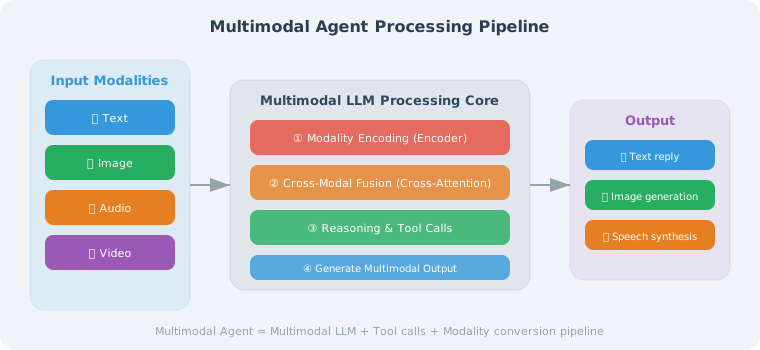
"Multimodal" refers to the ability to simultaneously process and understand multiple types of information (modalities):
| Modality | Input | Output |
|---|---|---|
| Text | Natural language questions | Text answers |
| Image | Photos, screenshots | Image descriptions, generated images |
| Audio | Voice commands | Voice replies |
| Video | Video clips | Video descriptions, keyframe analysis |
GPT-4o is a typical multimodal model — it can simultaneously understand text and image inputs.
Application Scenarios for Multimodal Agents
MULTIMODAL_USE_CASES = {
    "Image Analysis Assistant": {
        "Input": "User uploads a photo",
        "Agent does": "Identify content, extract text, analyze scene",
        "Example": "Auto-translate menu photos, auto-solve math problems from photos"
    },
    "Voice Interaction Assistant": {
        "Input": "User speaks",
        "Agent does": "Speech-to-text → understand intent → execute → voice reply",
        "Example": "Smart speakers, in-car assistants"
    },
    "Document Processing Assistant": {
        "Input": "PDF/PPT with images and text",
        "Agent does": "Understand charts and text, generate summaries and analysis",
        "Example": "Auto-analyze financial reports, summarize research papers"
    },
    "Creative Design Assistant": {
        "Input": "Text description + reference images",
        "Agent does": "Generate design images matching requirements",
        "Example": "Logo design, UI mockup generation"
    }
}
Mainstream Models Supporting Multimodal
| Model | Text Understanding | Image Understanding | Image Generation | Audio |
|---|---|---|---|---|
| GPT-4o | ✅ | ✅ | ✅ (DALL-E) | ✅ |
| Claude 4 | ✅ | ✅ | ❌ | ❌ |
| Gemini 2.5 Pro | ✅ | ✅ | ✅ | ✅ |
| Qwen | ✅ | ✅ | ✅ | ✅ |
⏰ Note: The table above is based on publicly available capability information for each model as of March 2026. Model capabilities are updated frequently; please refer to official documentation.
Using Multimodal in Python
from openai import OpenAI
import base64

client = OpenAI()

def analyze_image(image_path: str, question: str) -> str:
    """Analyze an image with GPT-4o"""

    # Read and encode the image
    with open(image_path, "rb") as f:
        image_data = base64.b64encode(f.read()).decode()

    response = client.chat.completions.create(
        model="gpt-4o",
        messages=[
            {
                "role": "user",
                "content": [
                    {"type": "text", "text": question},
                    {
                        "type": "image_url",
                        "image_url": {
                            "url": f"data:image/png;base64,{image_data}"
                        }
                    }
                ]
            }
        ],
        max_tokens=1000
    )

    return response.choices[0].message.content


# Usage example
result = analyze_image(
    "screenshot.png",
    "What is in this screenshot? Please describe in detail."
)
print(result)
Cross-Modal Fusion Architecture

The core challenge of multimodal Agents is how to fuse information from different modalities into a unified understanding. There are three mainstream fusion approaches:
# Three cross-modal fusion architectures

FUSION_ARCHITECTURES = {
    "early_fusion": {
        "Principle": "Concatenate raw data from all modalities and feed into the model together",
        "Advantages": "Model can learn low-level feature correlations between modalities",
        "Disadvantages": "High computational cost, requires specific model architecture",
        "Representative": "GPT-4o (native multimodal input)"
    },
    "late_fusion": {
        "Principle": "Each modality is processed independently, then results are merged at the decision layer",
        "Advantages": "Modular, flexible, each modality can be optimized independently",
        "Disadvantages": "May lose interaction information between modalities",
        "Representative": "Traditional Pipeline (OCR + NLP processed separately)"
    },
    "hybrid_fusion": {
        "Principle": "Cross-modal interactions at multiple levels simultaneously",
        "Advantages": "Balances low-level features and high-level semantics",
        "Disadvantages": "Complex architecture, high training cost",
        "Representative": "Gemini (multi-level cross-modal attention)"
    }
}
For Agent developers, you usually don't need to implement fusion architectures yourself — just choose the right multimodal model API. But understanding these architectures helps you:
- Determine which tasks are suitable for the current model's capabilities
- Analyze possible causes when the model misunderstands
- Design better multimodal Prompts
Multimodal Agent Design Patterns
In practice, multimodal Agents typically adopt the following design patterns:
Pattern 1: Modality Router
Route to different processing pipelines based on the type of user input:
from openai import OpenAI

client = OpenAI()

class ModalityRouter:
    """Route to the appropriate processing flow based on input modality"""

    def __init__(self):
        self.handlers = {
            "text": self._handle_text,
            "image": self._handle_image,
            "audio": self._handle_audio,
        }

    async def route(self, input_data: dict) -> str:
        modality = input_data.get("type", "text")
        handler = self.handlers.get(modality, self._handle_text)
        return await handler(input_data)

    async def _handle_text(self, data: dict) -> str:
        response = client.chat.completions.create(
            model="gpt-4o-mini",  # Use cheaper model for pure text
            messages=[{"role": "user", "content": data["content"]}]
        )
        return response.choices[0].message.content

    async def _handle_image(self, data: dict) -> str:
        response = client.chat.completions.create(
            model="gpt-4o",  # Image understanding requires multimodal model
            messages=[{
                "role": "user",
                "content": [
                    {"type": "text", "text": data.get("question", "Describe this image")},
                    {"type": "image_url", "image_url": {"url": data["image_url"]}}
                ]
            }]
        )
        return response.choices[0].message.content

    async def _handle_audio(self, data: dict) -> str:
        # Transcribe first, then understand
        transcript = client.audio.transcriptions.create(
            model="whisper-1",
            file=open(data["audio_path"], "rb")
        )
        # Process transcription as text
        return await self._handle_text({"content": transcript.text})
Pattern 2: Multimodal Enhancement Chain
Add multimodal capabilities to a text Agent through tools:
from langchain_core.tools import tool

@tool
def analyze_image_tool(image_url: str, question: str = "Describe the image content") -> str:
    """Analyze image content. Pass in image URL and question, return analysis result."""
    response = client.chat.completions.create(
        model="gpt-4o",
        messages=[{
            "role": "user",
            "content": [
                {"type": "text", "text": question},
                {"type": "image_url", "image_url": {"url": image_url}}
            ]
        }],
        max_tokens=500
    )
    return response.choices[0].message.content

@tool
def generate_image_tool(prompt: str) -> str:
    """Generate an image from a text description. Returns the generated image URL."""
    response = client.images.generate(
        model="dall-e-3",
        prompt=prompt,
        size="1024x1024",
        n=1
    )
    return f"Image generated: {response.data[0].url}"

@tool
def transcribe_audio_tool(audio_path: str) -> str:
    """Convert an audio file to text. Supports mp3, wav, m4a, and other formats."""
    with open(audio_path, "rb") as f:
        transcript = client.audio.transcriptions.create(
            model="whisper-1", file=f
        )
    return transcript.text

# Register these tools with a text Agent to give it multimodal capabilities
multimodal_tools = [analyze_image_tool, generate_image_tool, transcribe_audio_tool]
💡 Design recommendation: Pattern 2 (tool enhancement) is the most recommended approach for beginners — you can progressively add multimodal tools to an existing text Agent without rewriting the entire architecture.
Multimodal Agent vs Pure Text Agent
Key differences between multimodal Agents and pure text Agents:
# Pure text Agent: can only process text
text_agent_response = agent.run("Analyze this data")
# User must manually paste data as text

# Multimodal Agent: can directly process images, files
multimodal_response = agent.run(
    "Analyze the data in this financial report screenshot",
    images=["financial_report.png"]
)
# Agent automatically recognizes table content → extracts data → performs analysis
Three major challenges of multimodal development:
| Challenge | Description | Mitigation Strategy |
|---|---|---|
| Modality understanding bias | LLM may misread image content | Multi-turn confirmation + structured extraction |
| High token consumption | Image encoding uses many tokens | Image compression + on-demand transmission |
| Increased latency | Multimodal inference is slower than pure text | Async processing + streaming output |
Image Token Cost Optimization
In multimodal APIs, the number of tokens consumed by images is directly related to image size. Controlling image size appropriately can significantly reduce costs:
from PIL import Image
import io
import base64

def optimize_image_for_api(
    image_path: str,
    max_size: int = 1024,
    quality: int = 85
) -> str:
    """Optimize image size and quality to reduce API token consumption

    GPT-4o image token calculation rules (2026-03):
    - low detail: fixed 85 tokens
    - high detail: based on 512x512 tiles, 170 tokens per tile + 85 base

    Therefore, reducing images to within 1024px can significantly lower costs.
    """
    img = Image.open(image_path)

    # Proportional scaling
    if max(img.size) > max_size:
        ratio = max_size / max(img.size)
        new_size = (int(img.size[0] * ratio), int(img.size[1] * ratio))
        img = img.resize(new_size, Image.LANCZOS)

    # Convert to JPEG and compress
    buffer = io.BytesIO()
    img.convert("RGB").save(buffer, format="JPEG", quality=quality)

    return base64.b64encode(buffer.getvalue()).decode()


def analyze_with_detail_control(
    image_path: str,
    question: str,
    detail: str = "auto"
) -> str:
    """Control image analysis precision (low/high/auto)

    low: Quick overview, suitable for simple classification, presence detection
    high: Fine-grained analysis, suitable for text recognition, detail extraction
    auto: Let the model decide
    """
    image_b64 = optimize_image_for_api(image_path)

    response = client.chat.completions.create(
        model="gpt-4o",
        messages=[{
            "role": "user",
            "content": [
                {"type": "text", "text": question},
                {
                    "type": "image_url",
                    "image_url": {
                        "url": f"data:image/jpeg;base64,{image_b64}",
                        "detail": detail  # Control precision
                    }
                }
            ]
        }],
        max_tokens=500
    )
    return response.choices[0].message.content
Summary
| Concept | Description |
|---|---|
| Multimodal | Simultaneously process text, images, audio, and other information |
| Mainstream models | GPT-4o, Claude 4, Gemini 2.5 Pro |
| Typical scenarios | Image analysis, voice interaction, document processing, creative design |
| Core process | Input encoding → cross-modal fusion → reasoning → multimodal output |
| Key challenges | Modality understanding bias, token consumption, latency control |
Next Section Preview: We will dive deep into image understanding and generation capabilities.