16.6 Paper Readings: Frontier Research in Multi-Agent Systems
📖 "One person walks fast; a group of people walks far. Multi-Agent systems are the most active direction in Agent research."
This section provides in-depth analysis of core papers in the field of multi-Agent collaboration.
MetaGPT: Multi-Agent Collaboration Constrained by SOPs
Paper: MetaGPT: Meta Programming for A Multi-Agent Collaborative Framework
Authors: Hong et al.
Published: 2023 | ICLR 2024 Oral | arXiv:2308.00352
Core Problem
What problems arise in information transfer when multiple Agents communicate freely in natural language?
- Information loss: Details are omitted when Agent B relays Agent A's requirements to Agent C
- Misunderstanding: Each Agent may interpret the same sentence differently
- Inefficiency: Large amounts of "small talk" between Agents don't produce useful information
Core Insight
Multi-Agent systems need SOPs (Standard Operating Procedures) to constrain collaborative behavior.
MetaGPT simulates a real software company with clearly defined roles and workflows:
Product Manager
  → Output: PRD (Product Requirements Document)
    ↓
Architect
  → Output: System design document + interface definitions
    ↓
Project Manager
  → Output: Task assignments + development plan
    ↓
Engineer
  → Output: Code files
    ↓
QA Engineer
  → Output: Test cases + test report
Key Innovation: Structured Artifact Transfer
MetaGPT's Agents don't pass loose natural language messages — they pass structured artifacts:
❌ Loose chat messages:
  Product Manager: "We need to build a weather query feature, it should be able
                   to check Beijing's weather, make the interface nice, add a chart..."

✅ Structured PRD document:
  {
    "product_name": "Weather Query System",
    "feature_list": [
      {"name": "City weather query", "priority": "P0", "description": "..."},
      {"name": "Weather trend chart", "priority": "P1", "description": "..."}
    ],
    "technical_requirements": ["Python 3.10+", "FastAPI", "..."],
    "api_interfaces": [{...}]
  }
Experimental Results
On the SoftwareDev benchmark:
- MetaGPT code execution success rate: 87%
- ChatDev code execution success rate: 44%
- The large gap in success rates is mainly attributed to structured communication reducing information loss
Lessons for Agent Development
- Structured communication > natural language communication: Passing structured data between Agents is more reliable than natural language
- The value of SOPs: Defining clear workflows prevents chaotic collaboration between Agents
- Role-based prompts: Each Agent's System Prompt should clearly define role responsibilities and output format
ChatDev: Software Development Driven by Chat Chains
Paper: Communicative Agents for Software Development
Authors: Qian et al.
Published: 2023 | arXiv:2307.07924
Core Idea
ChatDev simulates the organizational structure of a software company, but uses a different communication method from MetaGPT — Chat Chains:
The development process is broken into multiple phases:
Design phase → Coding phase → Testing phase → Documentation phase

Each phase involves only two Agents in dialogue:
  Design phase: CEO ↔ CTO
  Coding phase: CTO ↔ Programmer
  Testing phase: Programmer ↔ Tester
  Documentation phase: CEO ↔ Programmer
Inception Prompting
ChatDev uses a technique called "Inception Prompting" to guide the conversation in each phase:
At the start of each chat phase, both Agents receive:
1. Role description: "You are the CTO, responsible for selecting the technical solution..."
2. Phase goal: "The goal of this phase is to determine the programming language and framework to use"
3. Output format: "At the end of the conversation, please summarize the technology selection"
4. Prior information: The output from the previous phase
Comparison with MetaGPT
| Dimension | MetaGPT | ChatDev |
|---|---|---|
| Communication method | Structured artifacts (shared message pool) | Two-person chat chain |
| Collaboration pattern | Publish-subscribe | Pairwise dialogue |
| Advantage | More precise information transfer | Simpler and more intuitive design |
| Code success rate | 87% | 44% |
| Design philosophy | Engineering, process-oriented | Social, conversation-oriented |
Lessons for Agent Development
ChatDev's design of "only two Agents dialogue per phase" reduces the complexity of multi-Agent coordination — the communication complexity of N fully connected Agents is O(N²), while pairwise dialogue reduces it to O(N). In practice, if the number of Agents is small (< 5), pairwise dialogue may be easier to debug than complex shared state.
AutoGen: Conversable Agent Framework
Paper: AutoGen: Enabling Next-Gen LLM Applications via Multi-Agent Conversation
Authors: Wu et al., Microsoft Research
Published: 2023 | arXiv:2308.08155
Core Abstraction: Conversable Agent
AutoGen proposes the abstraction of "Conversable Agent" — each Agent is an independent conversation participant:
# AutoGen's core abstraction (conceptual illustration)
class ConversableAgent:
    """Each Agent can converse with other Agents or humans"""

    def __init__(self, name, system_message, llm_config):
        self.name = name
        self.system_message = system_message

    def generate_reply(self, messages):
        """Generate a reply based on received messages"""
        ...

    def receive(self, message, sender):
        """Receive a message from another Agent or human"""
        ...

    def initiate_chat(self, recipient, message):
        """Initiate a conversation with another Agent"""
        ...
Three Predefined Agent Types
1. AssistantAgent (AI assistant)
   - Driven by LLM
   - Generates replies based on conversation history

2. UserProxyAgent (user proxy)
   - Represents a human user
   - Can execute code, request human input
   - Key to Human-in-the-Loop

3. GroupChatManager (group chat manager)
   - Manages group conversations among multiple Agents
   - Decides which Agent speaks next
Human-in-the-Loop
AutoGen particularly emphasizes human participation — humans can join multi-Agent conversations at any time to provide feedback or correct direction:
Agent A: "I think we should use React to build the frontend..."
Agent B: "Agreed, React's ecosystem is more mature..."
Human:   "Wait, our project requires Vue.js. Please reconsider."
Agent A: "Understood, then let's use Vue 3 + Composition API..."
Lessons for Agent Development
- Flexible conversation patterns: Agents can communicate one-on-one, one-to-many, in group chats, and more
- Code execution capability: UserProxyAgent can execute code locally, which is very important for programming tasks
- The importance of human participation: Fully autonomous multi-Agent systems may go off track; timely human intervention is crucial
AgentVerse: Emergent Behaviors in Multi-Agent Systems
Paper: AgentVerse: Facilitating Multi-Agent Collaboration and Exploring Emergent Behaviors
Authors: Chen et al.
Published: 2023 | arXiv:2308.10848
Core Problem
When multiple Agents interact freely, what emergent behaviors appear? Are these behaviors good or bad?
Discovered Emergent Behaviors
Positive emergence:
✅ Complementary enhancement: different Agents fill each other's knowledge gaps
✅ Quality improvement: solutions after multi-Agent discussion are better than any single Agent's
✅ Creative combination: collision of different perspectives generates new solutions

Negative emergence:
❌ Group polarization: majority opinions are amplified; minority views are ignored
❌ Social loafing: some Agents "free-ride" in groups without contributing valuable content
❌ Information cascade: the first Agent's opinion excessively influences subsequent Agents
Dynamic Role Adjustment
AgentVerse proposes a dynamic role adjustment mechanism: dynamically adding or removing Agent roles during collaboration based on task needs, rather than using a fixed predefined team configuration.
Lessons for Agent Development
- Pay attention to group dynamics: Multi-Agent system design must consider not just individual Agents but also group behavior
- Speaking order matters: The first Agent to speak may excessively influence the outcome — consider introducing randomness
- Independent thinking → discussion → voting: Have each Agent think independently first, then discuss, then vote to decide
Magentic-One: A General-Purpose Multi-Agent System
Paper/Technical Report: Magentic-One: A Generalist Multi-Agent System for Solving Complex Tasks
Authors: Fourney et al., Microsoft Research
Published: November 2024 | arXiv:2411.04468
Core Problem
Previous multi-Agent systems (MetaGPT, ChatDev) mostly focused on the specific domain of software development. Can we build a general-purpose multi-Agent system that handles various complex tasks like a team of human experts?
Architecture Design
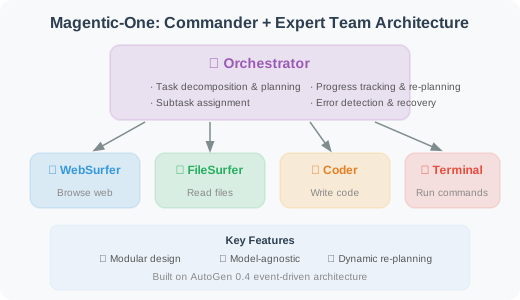
Magentic-One uses a "Commander + Expert Team" architecture:
Experimental Results
| Benchmark | Task Type | Magentic-One Performance |
|---|---|---|
| GAIA | General AI assistant | Near human level |
| AssistantBench | Complex web tasks | State-of-the-art at the time |
| WebArena | Web interaction | Competitive performance |
Lessons for Agent Development
- Effectiveness of the Orchestrator pattern: A dedicated coordinator Agent is more reliable than "Agents discussing freely"
- Error recovery is key: Approximately 30% of Magentic-One's successes come from dynamic re-planning during execution
- Built on AutoGen: Demonstrates the engineering capability of AutoGen 0.4's event-driven architecture
OpenAI Swarm: Lightweight Multi-Agent Orchestration
Project: Swarm: Educational Framework for Ergonomic, Lightweight Multi-Agent Orchestration
Authors: OpenAI Solutions Team
Released: October 2024 | github.com/openai/swarm
Core Philosophy
Unlike heavyweight frameworks like MetaGPT and AutoGen, Swarm pursues minimalism — using only two core concepts:
# Concept 1: Agent = instructions + tools
agent_a = Agent(
    name="Sales Advisor",
    instructions="You are a friendly sales advisor...",
    functions=[check_inventory, get_price]
)

# Concept 2: Handoff = transfer between Agents
def transfer_to_support():
    """When the user needs technical support, hand off to the technical support Agent"""
    return agent_b  # Returning another Agent completes the handoff

agent_a = Agent(
    name="Sales Advisor",
    functions=[check_inventory, transfer_to_support]  # handoff is a regular function
)
Design Philosophy
Heavyweight frameworks (AutoGen, CrewAI):
  - Rich abstractions (roles, tasks, processes)
  - Built-in state management and memory
  - Suitable for complex multi-Agent workflows

Swarm's minimalist philosophy:
  - Agent = instructions + functions
  - Handoff = return another Agent
  - No state management (stateless, each call is independent)
  - Suitable for simple routing and handoff scenarios
Relationship with OpenAI Agents SDK
Swarm is an educational experimental framework (not recommended for production use), but its core concepts — Handoff (Agent transfer) and Routines — were inherited by the OpenAI Agents SDK released in 2025, which is the official framework for production environments.
Lessons for Agent Development
- Simple is better than complex: Not every scenario needs AutoGen or CrewAI; simple routing and handoffs can be handled with the Swarm pattern
- Handoff is the primitive of multi-Agent collaboration: Transfers between Agents can be implemented with regular function calls
- OpenAI's Agent direction: From Swarm to Agents SDK, reflecting the design philosophy of "minimal + composable"
Multi-Agent Collaboration Survey (2025)
Paper: Multi-Agent Collaboration Mechanisms: A Survey of LLMs
Authors: Nguyen et al., University College Cork & Pusan National University
Published: January 2025 | arXiv:2501.06322
Core Contribution
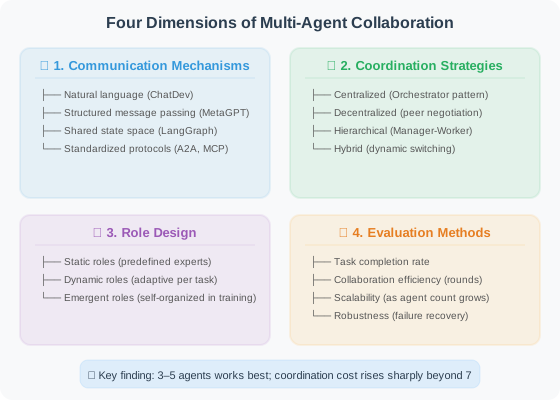
This is the most comprehensive survey of multi-Agent collaboration mechanisms as of early 2025, systematically organizing four dimensions of collaboration:
Key Findings
- Structured communication significantly outperforms natural language communication: MetaGPT's success validates this
- Orchestrator mode is most reliable in most scenarios: But for creative tasks, decentralized discussion may produce better results
- There is a "sweet spot" for Agent count: Usually 3–5 Agents works best; coordination costs rise sharply beyond 7
- Standardized protocols are the trend: A2A and MCP are changing how Agents interoperate
Comprehensive Survey
Paper: A Survey on Large Language Model based Autonomous Agents
Authors: Wang et al., Gaoling School of Artificial Intelligence, Renmin University of China
Published: 2023 | arXiv:2308.11432
This is currently the most comprehensive survey paper on LLM Agents, systematically organizing the four major components of Agents:
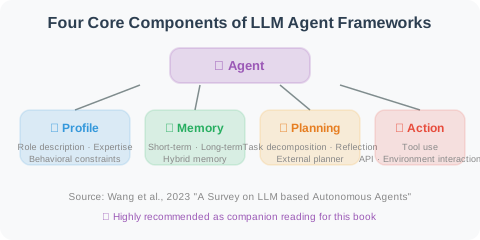
💡 Strongly recommended as companion reading for this book, especially when reading chapters related to multi-Agent systems.
Paper Comparison and Development Timeline
| Paper | Year | Communication Mode | Agent Count | Core Contribution |
|---|---|---|---|---|
| MetaGPT | 2023 | Structured artifacts | 5 | SOP + structured communication |
| ChatDev | 2023 | Two-person chat chain | 4–6 | Chat chain phased collaboration |
| AutoGen | 2023 | Free conversation | 2+ | Conversable Agent abstraction |
| AgentVerse | 2023 | Group discussion | 3+ | Emergent behavior research |
| Swarm | 2024 | Handoff transfer | 2+ | Minimal multi-Agent orchestration |
| Magentic-One | 2024 | Orchestrator command | 5 | General-purpose multi-Agent system |
| Collaboration Survey | 2025 | Systematic classification | — | Four-dimension collaboration mechanism analysis |
Development timeline:
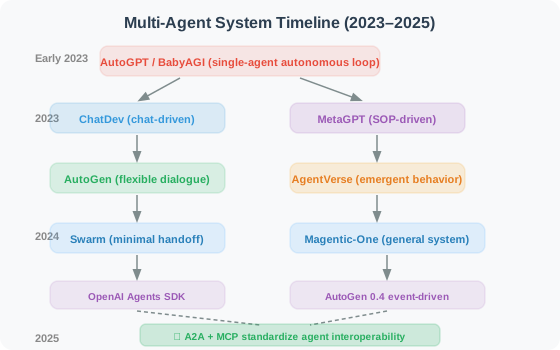
💡 Frontier trends (2025–2026): Multi-Agent systems are shifting from "framework competition" to "protocol standardization." Three major trends: ① Orchestrator mode dominates: Both Magentic-One and OpenAI Agents SDK adopt the "one coordinator + multiple experts" architecture; ② Interoperability standardization: Google's A2A and Anthropic's MCP protocols allow Agents built with different frameworks to collaborate with each other (see Chapter 17); ③ Expanding from software development to general scenarios: Broader multi-Agent applications in scientific research, business analysis, educational simulation, and more are emerging.