Supervisor Mode vs. Decentralized Mode
Multi-Agent systems face a fundamental architectural decision: who coordinates? Should you set up a "project manager" to centrally schedule all Agents (Supervisor mode), or let Agents negotiate freely with each other (decentralized mode)?
Both modes have their pros and cons. Most real-world projects choose Supervisor mode because it's easier to control and debug. This section compares the two approaches with complete code examples.
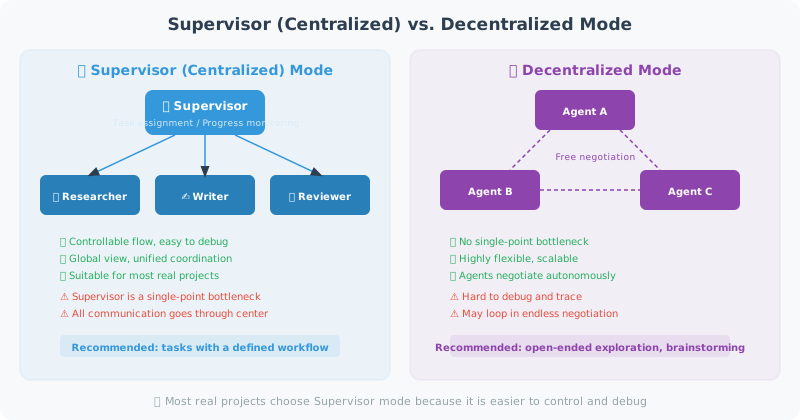
Supervisor (Centralized) Mode
The Supervisor mode works like project management: a Supervisor Agent is responsible for analyzing tasks, assigning subtasks, monitoring progress, and aggregating results. All decisions are coordinated through the Supervisor.
The following example builds a "content creation team" — the Supervisor coordinates three sub-Agents: a researcher, a writer, and a reviewer:
from langgraph.graph import StateGraph, END, START
from langgraph.prebuilt import create_react_agent
from langchain_openai import ChatOpenAI
from langchain_core.tools import tool
from typing import TypedDict, Annotated, Literal
import operator

llm = ChatOpenAI(model="gpt-4o")

# ============================
# Define tools for each sub-Agent
# ============================

@tool
def do_research(topic: str) -> str:
    """Research specialist: in-depth research on a specified topic"""
    from openai import OpenAI
    client = OpenAI()
    response = client.chat.completions.create(
        model="gpt-4o-mini",
        messages=[{"role": "user", "content": f"Research {topic} and provide 3 core insights"}],
        max_tokens=200
    )
    return response.choices[0].message.content

@tool
def write_content(outline: str) -> str:
    """Writing specialist: write content based on an outline"""
    from openai import OpenAI
    client = OpenAI()
    response = client.chat.completions.create(
        model="gpt-4o-mini",
        messages=[{"role": "user", "content": f"Write a 300-word article based on this outline: {outline}"}],
        max_tokens=400
    )
    return response.choices[0].message.content

@tool
def review_content(content: str) -> str:
    """Review specialist: check content quality"""
    from openai import OpenAI
    client = OpenAI()
    response = client.chat.completions.create(
        model="gpt-4o-mini",
        messages=[{"role": "user", "content": f"Review the following content (score + suggestions): {content[:200]}"}],
        max_tokens=150
    )
    return response.choices[0].message.content

# Supervisor Agent has access to all tools
supervisor_tools = [do_research, write_content, review_content]
supervisor_agent = create_react_agent(llm, supervisor_tools)

# ============================
# Supervisor decision logic
# ============================

class SupervisorState(TypedDict):
    messages: Annotated[list, operator.add]
    task: str
    research_done: bool
    content_written: bool
    review_done: bool

def supervisor(state: SupervisorState) -> dict:
    """Supervisor: centrally coordinates all subtasks"""
    from langchain_core.messages import HumanMessage, SystemMessage

    context = f"""
You are a task coordinator managing a content creation team.
Available tools: do_research, write_content, review_content

Task: {state['task']}
Research complete: {state.get('research_done', False)}
Writing complete: {state.get('content_written', False)}
Review complete: {state.get('review_done', False)}

Analyze the current progress and decide the next step:
1. If research is not done → use do_research
2. If research is done but writing is not → use write_content
3. If writing is done but review is not → use review_content
4. If everything is done → summarize and finish

Current message history (to get previous outputs):
{[m.content if hasattr(m, 'content') else str(m) for m in state.get('messages', [])[-3:]]}
"""

    result = supervisor_agent.invoke({
        "messages": [HumanMessage(content=context)]
    })

    last_msg = result["messages"][-1]
    content = last_msg.content if hasattr(last_msg, 'content') else ""

    # Update state
    updates = {"messages": [last_msg]}
    if "research" in content.lower():
        updates["research_done"] = True
    if "write" in content.lower() or "article" in content.lower():
        updates["content_written"] = True
    if "review" in content.lower():
        updates["review_done"] = True

    return updates

def should_continue(state: SupervisorState) -> str:
    if state.get("review_done"):
        return "end"
    return "continue"

# Build Supervisor graph
graph = StateGraph(SupervisorState)
graph.add_node("supervisor", supervisor)
graph.add_edge(START, "supervisor")
graph.add_conditional_edges(
    "supervisor",
    should_continue,
    {"end": END, "continue": "supervisor"}
)

supervisor_app = graph.compile()

# Run
result = supervisor_app.invoke({
    "messages": [],
    "task": "Write a technical article about Python asynchronous programming",
    "research_done": False,
    "content_written": False,
    "review_done": False
})

print("Final state:")
print(f"  Research complete: {result['research_done']}")
print(f"  Writing complete: {result['content_written']}")
print(f"  Review complete: {result['review_done']}")
Decentralized Mode
Unlike Supervisor mode, decentralized mode has no central coordinator. Each Agent has its own inbox and communicates directly with other Agents via broadcast or point-to-point messages. This mode is more like a self-organizing team — members discuss freely and decide among themselves who does what.
The advantage is no single point of failure and high flexibility; the disadvantage is high coordination costs and the potential for conflicts or deadlocks.
# Decentralized: Agents negotiate directly with each other, no central coordinator

class PeerToPeerNetwork:
    """Peer-to-peer Agent network"""

    def __init__(self):
        self.agents = {}
        self.message_board = {}  # Shared message board

    def add_agent(self, name: str, specialization: str):
        self.agents[name] = {
            "name": name,
            "specialization": specialization,
            "inbox": [],
        }

    def broadcast(self, sender: str, message: str, target: str = "all"):
        """Broadcast a message"""
        if target == "all":
            for name, agent in self.agents.items():
                if name != sender:
                    agent["inbox"].append({
                        "from": sender,
                        "message": message
                    })
        else:
            if target in self.agents:
                self.agents[target]["inbox"].append({
                    "from": sender,
                    "message": message
                })

    def process_inbox(self, agent_name: str) -> list[str]:
        """Process inbox"""
        agent = self.agents[agent_name]
        messages = agent["inbox"].copy()
        agent["inbox"].clear()
        return [m["message"] for m in messages]

# Usage example
network = PeerToPeerNetwork()
network.add_agent("research", "Information research")
network.add_agent("writing", "Content writing")
network.add_agent("editing", "Article editing")

# Agents communicate directly with each other, self-organizing to complete tasks
# This mode is more flexible but also harder to control
Comparison of the Two Modes
Supervisor (Centralized):
✅ Easy to coordinate and control
✅ Global view, avoids duplicate work
✅ Easy to debug and monitor
❌ Supervisor becomes a bottleneck
❌ If Supervisor fails, everything fails

Decentralized:
✅ No single point of failure
✅ Highly flexible, adaptive
✅ Closer to real team collaboration
❌ High coordination costs
❌ May produce conflicts or deadlocks
❌ Difficult to debug

Recommendations:
- Most production scenarios → Supervisor mode
- High fault tolerance required → Decentralized
- Clear task boundaries → Supervisor is more suitable
Summary
This section compared the two major architectural paradigms for multi-Agent systems:
- Supervisor (Centralized) Mode: A coordinator Agent centrally schedules all sub-Agents, providing a global view that is easy to coordinate and monitor. The code example shows how to build a Supervisor loop with LangGraph, tracking task progress via state flags. Suitable for scenarios with clear task boundaries and strict process control requirements.
- Decentralized Mode: Agents communicate directly via a peer-to-peer network, with no single point of failure and high flexibility. But coordination costs and debugging difficulty are also higher.
Practical recommendation: Most production projects should prioritize Supervisor mode; its controllability and debuggability far outweigh decentralized solutions. Only consider decentralized architecture when high fault tolerance is required or the number of Agents is very large.
Next section: 16.5 Practice: Multi-Agent Software Development Team