4.1 Why Do Agents Need Memory?
Imagine an assistant who completely forgets you every time you come to them — who you are, what your job is, what tasks you assigned last time. Such an assistant cannot provide any real help.
An Agent Without Memory: The Pain of Constant Repetition
# Example conversation with an Agent that has no memory
user: "My name is Alex, and I'm a Python developer"
agent: "Hello! How can I help you?"

user: "Help me write a function"
agent: "Sure, what functionality do you need the function to have?"

# The next day...
user: "That function from yesterday has a bug"
agent: "Sorry, I don't have access to our previous conversation.
       Could you tell me which function you need help fixing?"  # Completely forgotten!
This experience frustrates users and limits the complexity of tasks an Agent can handle.
The Three Levels of Memory Systems
An Agent's memory system is analogous to human memory and consists of three levels:
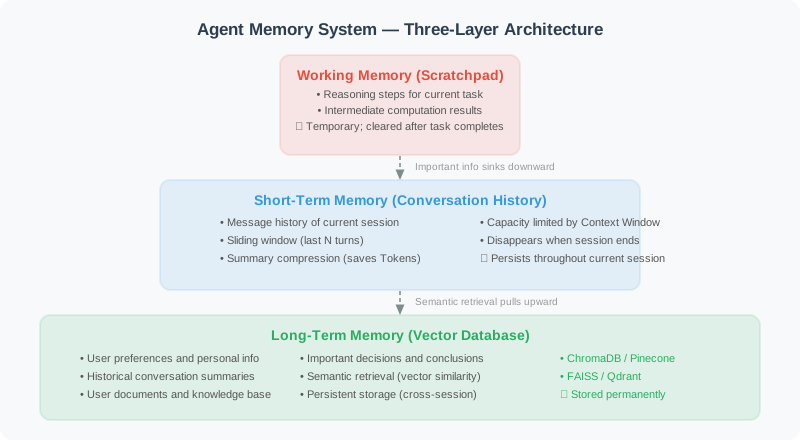
Short-Term Memory
- Analogy: Documents on your desk while working
- Content: Message history of the current conversation
- Characteristics: Limited capacity (constrained by Context Window), disappears when the session ends
- Use: Maintaining coherence across multi-turn conversations
Long-Term Memory
- Analogy: Files stored in a filing cabinet
- Content: User preferences, important information, historical conversation summaries
- Characteristics: Persistent storage, cross-session access, large capacity
- Use: Personalized service, knowledge accumulation
Working Memory (Scratchpad)
- Analogy: Scratch paper
- Content: Intermediate reasoning steps for the current task
- Characteristics: Exists while the task is in progress, can be cleared after completion
- Use: Complex multi-step reasoning, avoiding "repeated reasoning"
Typical Scenarios Where Memory Failure Causes Problems
Understanding when "lack of memory causes problems" helps decide where to add memory systems:
# Scenario 1: Preference amnesia
# The user said "I prefer concise code without comments"
# But in the next conversation the Agent starts writing lots of comments again

# Scenario 2: Context fragmentation
# The user is discussing a complex problem; the conversation grows too long
# and exceeds the Context Window
# The Agent starts forgetting what was said at the beginning of the conversation

# Scenario 3: Repeated onboarding
# The user has to introduce themselves and their background every time
# The Agent cannot accumulate knowledge about the user

# Scenario 4: Task continuity
# The user asks to "continue the plan we discussed last time"
# The Agent has no idea what was discussed last time
Core Challenges in Memory System Design
1. Token Limits
# Context Window limits the size of short-term memory
# GPT-4o has a 128K token context
# But long conversations consume tokens quickly and are costly

# Solutions:
# - Sliding window: only keep the most recent N turns of conversation
# - Summary compression: compress old conversations into summaries
# - Vector retrieval: retrieve relevant snippets from long-term memory
2. What Is Worth Remembering
# Not all information is worth storing
# Worth remembering:
keep_memory = [
    "User name, profession, preferences",
    "Important decisions and conclusions",
    "User-defined rules (e.g., code style)",
    "Ongoing project information",
]

# Not worth remembering:
skip_memory = [
    "Casual small talk",
    "Repeated greetings",
    "Temporary queries",
    "Outdated information",
]
3. Memory Accuracy
# Information stored in memory may be incorrect
# The Agent needs:
# - The ability to update memory (user corrects preferences)
# - Distinguishing facts from inferences
# - Memory source traceability
Summary
Memory systems are the core of Agent practicality:
- Short-term memory: maintains coherence within the current conversation
- Long-term memory: accumulates knowledge across sessions
- Working memory: supports complex reasoning tasks
- Core challenges: token limits, selective memory, accuracy
📖 Want to dive deeper into the academic frontier of memory systems? Read 4.6 Paper Readings: Frontier Advances in Memory Systems, covering in-depth analysis of four core papers: Generative Agents, MemGPT, MemoryBank, and CoALA.
Next section: 4.2 Short-Term Memory: Conversation History Management