Chapter 1: What is an Agent?
🎯 "An Agent is not just a chatbot — it is an intelligent entity capable of autonomously perceiving its environment, making decisions, and taking action."
Chapter Overview
Welcome to the world of Agent development! In this chapter, we start from the most fundamental concepts to help you build a comprehensive understanding of AI Agents.
If you've used conversational AI like ChatGPT or Claude, you might wonder: "Aren't these Agents?" In fact, there is a fundamental difference. A true Agent doesn't just "talk" — it can "do things." It can use tools, access databases, call APIs, execute code, and even formulate plans and self-correct.
This chapter will help you understand these core differences and lay a solid conceptual foundation for the hands-on development ahead.
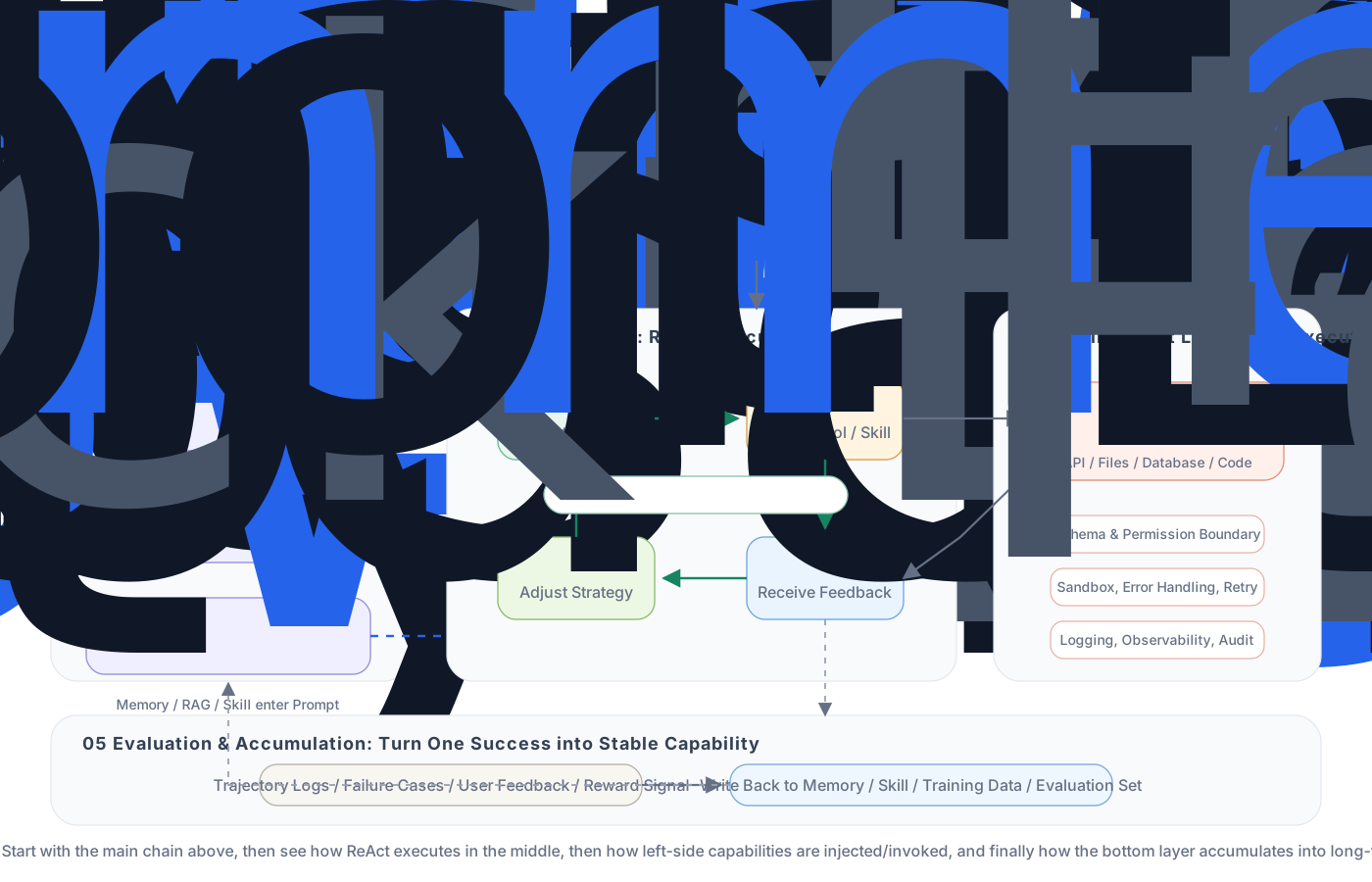
The diagram above helps you build a complete Agent intuition: after the user proposes a goal, the system organizes the task, context, memory, knowledge base, and available skills together into a Prompt, which is then fed to the LLM for reasoning and decision-making. The model does not generate a single answer — instead, it advances the task through a Reason → Action → Observe → Update loop: first think about the next step, then invoke tools or access files and APIs, then adjust the plan based on external feedback, and iterate until a final result is produced.
Within this loop, Memory is responsible for storing long-term preferences, historical decisions, and reusable experiences; RAG retrieves reliable materials from documents or knowledge bases; the Skill Library captures common task workflows and tool usage patterns. After understanding this diagram, you will more easily see the difference between an Agent and a regular chatbot: a chatbot mainly answers questions, while an Agent continuously completes tasks with goals, tools, and a feedback loop.
🎓 Learning Objectives
After completing this chapter, you will be able to:
- ✅ Clearly define what an AI Agent is
- ✅ Understand the evolution of Agents from simple chatbots to complex intelligent entities
- ✅ Master the core architecture of Agents: the Perception-Thinking-Action loop
- ✅ Distinguish the essential differences between Agents, traditional programs, and chatbots
- ✅ Understand typical application scenarios of Agents across various industries
- ✅ Understand the history of intelligent agents, from symbolic AI to the evolution driven by large models
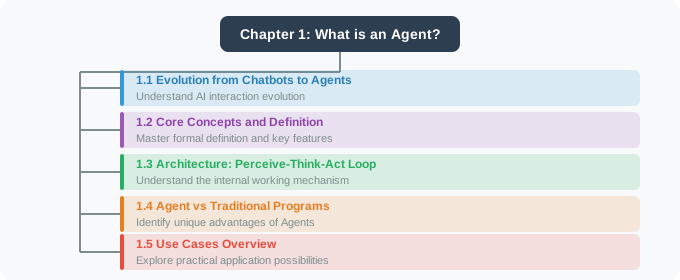
📑 Chapter Structure
⏱️ Estimated Study Time
Approximately 45–60 minutes (including thinking exercises)
💡 Prerequisites
- No background knowledge in AI or Agents required
- Basic understanding of programming concepts is helpful (but not required)
🔗 Learning Path
This book has 23 chapters across 6 parts, with clear dependencies between chapters. The overview diagram below shows the structural backbone of the book and three recommended routes — the color strip on the left border of each node marks which route(s) it belongs to (a chapter can belong to multiple routes simultaneously).
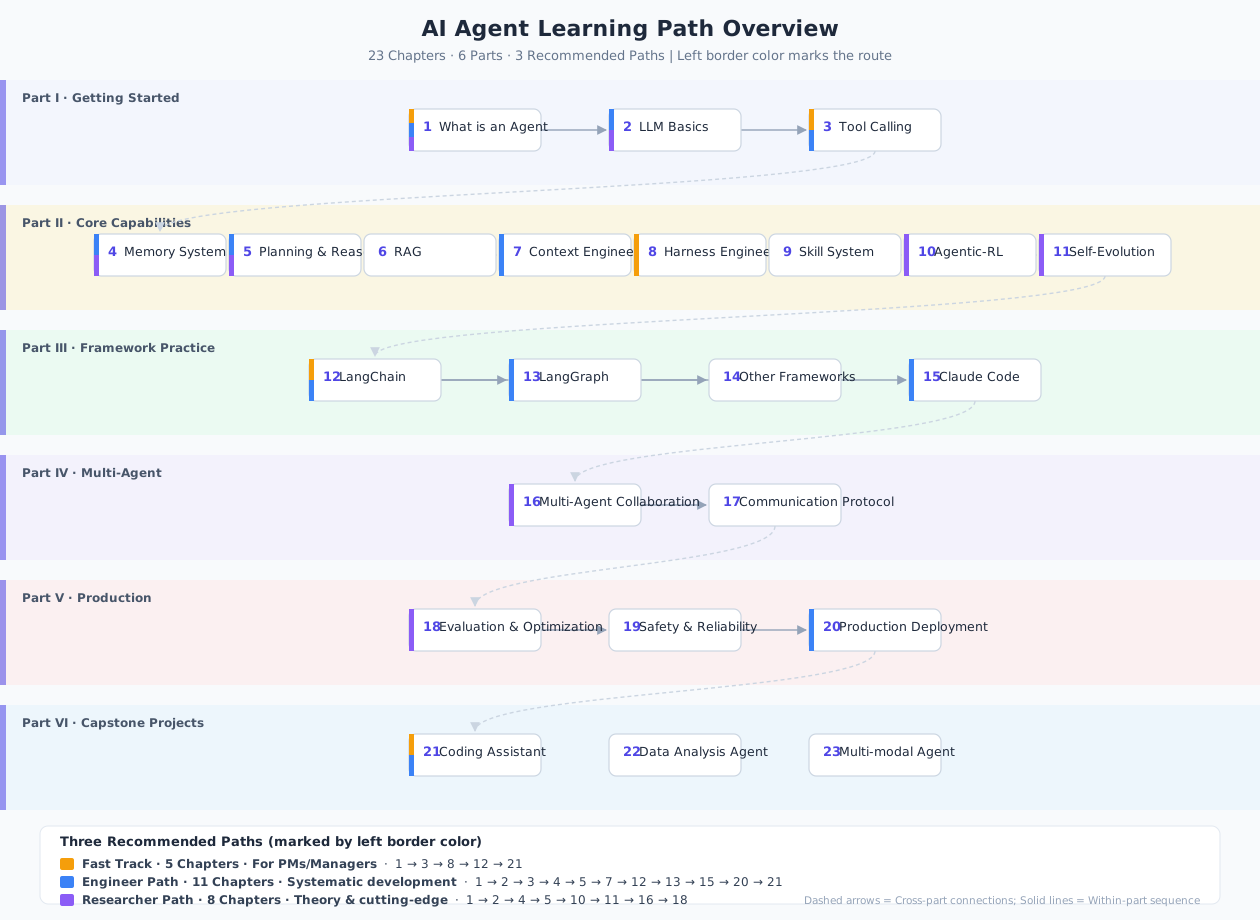
Three Recommended Routes
Readers from different backgrounds can "skip around" the book along different routes — no need to read linearly from start to finish:
-
🟠 Fast Track (5 chapters, for product managers / managers):
1 → 3 → 8 → 12 → 21Build Agent intuition first (Chapter 1), understand tool calling (Chapter 3), master Harness engineering standards (Chapter 8), use a mainstream framework (Chapter 12 LangChain) to build your first programming assistant project (Chapter 21). Skip deep theory and see results fastest. -
🔵 Engineer Track (11 chapters, for developers wanting systematic mastery):
1 → 2 → 3 → 4 → 5 → 7 → 12 → 13 → 15 → 20 → 21On top of the Fast Track, add LLM fundamentals (Chapter 2), memory and planning (Chapters 4, 5), context engineering (Chapter 7), then learn LangChain + LangGraph + Claude Code three frameworks, and finally land on deployment (Chapter 20) and a practical project (Chapter 21). -
🟣 Researcher Track (8 chapters, for those diving deep into theory and frontiers):
1 → 2 → 4 → 5 → 10 → 11 → 16 → 18Focus on principles and frontiers: LLM fundamentals (Chapter 2), memory and planning theory (Chapters 4, 5), deep dive into Agentic-RL training (Chapter 10) and self-evolution (Chapter 11), then expand to multi-Agent systems (Chapter 16) and evaluation methods (Chapter 18).
💡 Reading suggestion: Solid arrows indicate "in-part sequential order," dashed arrows indicate "cross-part backbone connections." Regardless of which route you take, it is recommended to read Chapter 1 first to build a holistic view; the comprehensive project chapters (Chapters 21–23) are best left for last as an integration test of everything you've learned.
Recommended Next Steps
- 👉 Chapter 2: LLM Fundamentals — Understand the Agent's "brain"
- 👉 Appendix F: Development Environment Setup — Set up tools and start building
Ready? Let's start with the history and origins of Agents…