8.6 Structured Output: Engineering Practices for JSON Reliability
🔩 "An Agent outputs an unparseable JSON, and the entire downstream pipeline crashes. This isn't a model problem — it means your Harness isn't doing its job."
Why Is JSON Reliability a Harness Problem?
In Agent systems, JSON is the universal language for inter-module communication: tool call parameters, structured analysis results, multi-Agent message passing... it's everywhere.
But models don't "naturally" guarantee valid JSON output. Even if you write please output JSON in your Prompt, you'll still encounter these in production:
# Various "surprises" in actual model output

✗ Wrapped in Markdown:  ```json { "key": "value" } ```
✗ Trailing extra text:  {"key": "value"} The above is the analysis result
✗ Single quotes instead of double: {'key': 'value'}
✗ Comments (not supported in JSON): {"key": "value" // this is a comment}
✗ Numeric field output as string: {"count": "3"} instead of {"count": 3}
✗ Hallucinated fields: model added fields not in the Schema
✗ Truncated output: context insufficient, output cut off, JSON unclosed
Every one of these will cause json.loads() to throw an exception, triggering downstream cascading failures.
From a Harness perspective, this is a core application scenario for Pillar 2 (Architectural Constraints): you can't rely on "the model will self-discipline to output correct JSON" — you need engineering mechanisms to enforce output format.
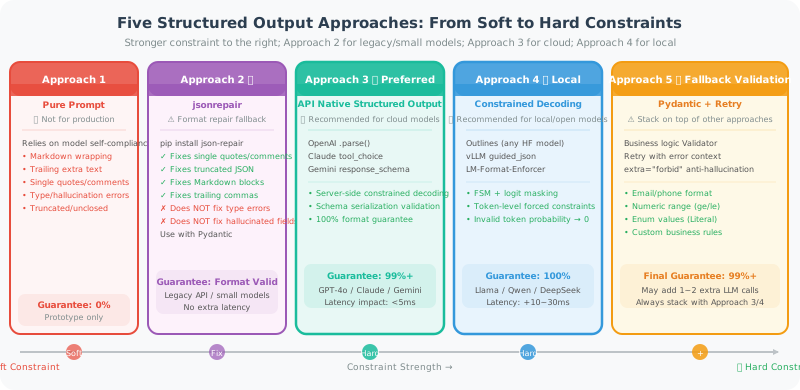
The Evolution Path of Five Approaches
Soft constraints (not recommended)    Post-processing fix    Hard constraints (recommended)
──────────────────────────────────────────────────────────────────────────────────────────
Prompt says "please output JSON"  →  jsonrepair  →  API structured output  →  Constrained decoding
                                     (fallback)      (server-side enforced)    (token-level enforced)
The diagram below shows the technical paths and applicable scenarios for the five approaches:
Approach 1: Pure Prompt Constraints (Soft Constraints — Not Recommended)
# ❌ Anti-pattern: relying only on Prompt constraints
system_prompt = """
You are a data extraction assistant. Please parse user input into the following JSON format:
{
  "name": "name",
  "age": age (number),
  "email": "email"
}
Please ensure the output is valid JSON with no other content.
"""

# Problems:
# 1. Model may add explanatory text outside the JSON
# 2. High field type error rate with complex Schemas
# 3. Cannot handle hallucinated fields in nested structures
# 4. Inconsistent behavior across model versions/temperatures

# If you must use this, at least add post-processing:
import json, re

def extract_json_from_text(text: str) -> dict:
    """
    Best-effort JSON extraction from model output (last resort — don't rely on this)
    Tries multiple parsing strategies in priority order
    """
    # Strategy 1: direct parse
    try:
        return json.loads(text.strip())
    except json.JSONDecodeError:
        pass

    # Strategy 2: extract ```json ... ``` code block
    md_match = re.search(r'```(?:json)?\s*(\{.*?\})\s*```', text, re.DOTALL)
    if md_match:
        try:
            return json.loads(md_match.group(1))
        except json.JSONDecodeError:
            pass

    # Strategy 3: extract first { ... } block
    brace_match = re.search(r'\{[^{}]*(?:\{[^{}]*\}[^{}]*)?\}', text, re.DOTALL)
    if brace_match:
        try:
            return json.loads(brace_match.group())
        except json.JSONDecodeError:
            pass

    raise ValueError(f"Cannot extract valid JSON from output: {text[:200]}")
⚠️ When soft constraints are acceptable: simple single-field output, prototype validation phase.
Unacceptable scenarios: production environments, complex Schemas, downstream processing requiring type precision.
Approach 1.5: jsonrepair — A JSON Repair Library Designed for LLM Output
When hard constraints are unavailable (older API, local small models, high migration cost for existing code), json-repair is a far more robust fallback than hand-written regex.
What Can It Fix?
json-repair is specifically designed for typical LLM output issues and handles all the scenarios that hand-written regex struggles with:
| Issue Type | Raw Output Example | After Repair |
|---|---|---|
| Markdown code block | ```json {"k": 1}``` | {"k": 1} |
| Trailing extra text | {"k": 1} This is the result | {"k": 1} |
| Single-quote keys/values | {'key': 'value'} | {"key": "value"} |
| Inline comments | {"k": 1 // comment} | {"k": 1} |
| Truncated JSON | {"name": "Alice", "age": | {"name": "Alice", "age": null} |
| Missing quotes | {name: "Alice"} | {"name": "Alice"} |
| Trailing comma | {"k": 1,} | {"k": 1} |
| Truncated array | ["a", "b", | ["a", "b"] |
| Mixed Python literals | {"flag": True, "val": None} | {"flag": true, "val": null} |
Installation and Basic Usage
# pip install json-repair
from json_repair import repair_json
import json

# ── Basic usage: direct replacement for json.loads ──
broken_json = """```json
{
  "name": "Alice",
  'age': 28,   // age
  "email": "alice@example.com",
"""

# repair_json returns the repaired JSON string
fixed_str = repair_json(broken_json)
data = json.loads(fixed_str)
# {"name": "Alice", "age": 28, "email": "alice@example.com"}

# ── Or directly return a Python object ──
data = repair_json(broken_json, return_objects=True)
print(type(data))  # <class 'dict'>
print(data["name"])  # "Alice"
Combining with Pydantic Validation
The best use of jsonrepair is as a "repair layer" between json.loads() and Pydantic validation:
from json_repair import repair_json
from pydantic import BaseModel, ValidationError
import json

class OrderInfo(BaseModel):
    order_id: str
    amount: float
    status: str
    items: list[str]

def safe_parse(raw_text: str, model_class: type[BaseModel]) -> BaseModel:
    """
    Robust parsing process with jsonrepair:

    Raw text
      ↓ repair_json (fix format errors)
      ↓ json.loads (parse to Python dict)
      ↓ Pydantic.model_validate (type validation + business rules)
      ↓ Structured object
    """
    # Step 1: jsonrepair fixes format
    try:
        fixed = repair_json(raw_text)
    except Exception as e:
        raise ValueError(f"jsonrepair cannot handle this input: {e}")

    # Step 2: parse to Python object
    try:
        data = json.loads(fixed)
    except json.JSONDecodeError as e:
        raise ValueError(f"Still cannot parse after repair: {fixed[:100]}\nError: {e}")

    # Step 3: Pydantic type validation (including business rules)
    try:
        return model_class.model_validate(data)
    except ValidationError as e:
        raise ValueError(
            f"Structure validation failed (JSON format correct but fields don't match Schema):\n{e}"
        )

# Usage: handle various malformed JSON from model output
raw_outputs = [
    "```json\n{'order_id': 'ORD-001', 'amount': 99.9, 'status': 'paid', 'items': ['Item A']}\n```",
    '{"order_id": "ORD-002", "amount": 150, "status": "pending", "items": ["Item B", "Item C"],}',
    '{"order_id": "ORD-003", "amount": 200.0, "status": "shipped", "items": ["Item D"]  // tracking number generated',
]

for raw in raw_outputs:
    order = safe_parse(raw, OrderInfo)
    print(f"✅ Parsed successfully: {order.order_id}, ${order.amount}")
Handling Truncated Output (Context Overflow Scenario)
This is one of jsonrepair's biggest advantages — when model output is truncated due to context limits, it intelligently completes the missing structure:
from json_repair import repair_json

# Simulate: model output truncated (context tokens exhausted)
truncated_outputs = [
    # Object truncated
    '{"name": "Alice", "age": 28, "address": {"city": "New York", "district": "Manhattan',
    # Array truncated
    '["apple", "banana", "orange", "grape',
    # Nested truncated
    '{"users": [{"id": 1, "name": "Alice"}, {"id": 2, "name": "Bob"}, {"id": 3',
]

for truncated in truncated_outputs:
    repaired = repair_json(truncated, return_objects=True)
    print(f"Original (truncated): {truncated[:50]}...")
    print(f"Repaired:             {repaired}")
    print()

# Output:
# Original (truncated): {"name": "Alice", "age": 28, "address": {"city": "New York", "district": "Manhattan...
# Repaired:             {'name': 'Alice', 'age': 28, 'address': {'city': 'New York', 'district': 'Manhattan'}}
#
# Original (truncated): ["apple", "banana", "orange", "grape...
# Repaired:             ['apple', 'banana', 'orange', 'grape']
#
# Original (truncated): {"users": [{"id": 1, "name": "Alice"}, {"id": 2, "name": "Bob"}, {"id": 3...
# Repaired:             {'users': [{'id': 1, 'name': 'Alice'}, {'id': 2, 'name': 'Bob'}, {'id': 3}]}
Limitations of jsonrepair
jsonrepair is not a silver bullet — understanding its boundaries is important:
from json_repair import repair_json

# ❌ Problems jsonrepair cannot solve: type errors
wrong_types = '{"age": "twenty-eight", "score": "excellent"}'  # strings instead of numbers
result = repair_json(wrong_types, return_objects=True)
# → {'age': 'twenty-eight', 'score': 'excellent'}  ← types still wrong, needs Pydantic validation

# ❌ Problems jsonrepair cannot solve: hallucinated fields
hallucinated = '{"name": "Alice", "age": 28, "non_schema_field": "hallucinated value"}'
result = repair_json(hallucinated, return_objects=True)
# → hallucinated field still present, needs extra="forbid" to intercept

# ❌ Problems jsonrepair cannot solve: semantic errors
semantic_error = '{"status": "completed-not-completed"}'  # semantic contradiction
# → jsonrepair will preserve it, needs business logic validator to handle

# ✅ Correct approach: jsonrepair + Pydantic double defense
from pydantic import BaseModel, ConfigDict

class StrictUser(BaseModel):
    model_config = ConfigDict(extra="forbid")  # block hallucinated fields
    name: str
    age: int       # Pydantic will fail on "twenty-eight", triggering an error

# jsonrepair fixes format → Pydantic validates types + business rules = complete defense
💡 jsonrepair's role: it is a format repair layer, not a semantic validation layer. The correct division of labor is:
jsonrepair: fix JSON syntax errors (brackets, quotes, commas, truncation)Pydantic: validate field types, value ranges, business rules- Both are indispensable.
Position in the Collaboration with Other Approaches
┌─────────────────────────────────────────────────────────────┐
│     Complete JSON parsing defense (recommended stacking)     │
│                                                             │
│  Raw model output text                                      │
│       ↓                                                     │
│  ① jsonrepair.repair_json()   ← fix format errors, truncation│
│       ↓                                                     │
│  ② json.loads()               ← convert to Python object    │
│       ↓                                                     │
│  ③ Pydantic.model_validate()  ← type validation + business  │
│       ↓ (on failure)                                        │
│  ④ Retry with error context   ← max 2~3 times               │
│       ↓                                                     │
│  Structured object (type-safe)                              │
└─────────────────────────────────────────────────────────────┘
Approach 2: API Native Structured Output (Recommended — First Choice)
From 2024–2026, mainstream model APIs all natively support structured output — this is the simplest and most reliable approach.
Principle: Why Can the API Guarantee JSON Format?
The underlying mechanism of API native structured output is server-side constrained decoding: when the model generates each token, the API server builds a finite state machine (FSM) based on the JSON Schema you provide, then in real time masks tokens that don't conform to the current state.
An intuitive example: when the model has already generated {"age":, and the JSON Schema requires age to be an integer, the candidate range for the next token is only 0-9, - (minus sign), and spaces — the probabilities of all letter, quote, and boolean tokens are forced to 0. This means the model physically cannot output a type-incorrect value.
The essential difference from pure Prompt approach:
- Prompt constraints tell the model at the input side "what you should do" — the model can choose to comply or not
- Constrained decoding controls at the output side "what you can only do" — the model doesn't even have the option to violate the rules
The three major vendors implement this slightly differently:
| Vendor | Mechanism | Call Method | Schema Source | Release Date |
|---|---|---|---|---|
| OpenAI | Native constrained decoding | response_format=PydanticModel | Auto-converted from Pydantic | 2024.08 |
| Anthropic | Tool call semantic equivalent | tool_choice forced tool | Pydantic → JSON Schema → Tool | 2024.04 |
| Native constrained decoding | response_schema=PydanticModel | Auto-converted from Pydantic | 2024.10 |
Selection recommendation:
- If using OpenAI or Gemini, passing a Pydantic class directly is the simplest
- If using Claude, implement structured output indirectly by "defining a tool + forcing that tool to be called"
- All three provide the same guarantee strength (all can 100% guarantee valid JSON format), but Claude's approach consumes an extra tool call's worth of tokens
Below are code examples for all three platforms.
OpenAI Structured Outputs (2024.08+)
OpenAI's implementation is the most direct — just pass the Pydantic class to the response_format parameter, and the return value is directly a Pydantic object:
from openai import OpenAI
from pydantic import BaseModel, Field
from typing import Optional, Literal

client = OpenAI()

# ── Define Schema with Pydantic ──
class PersonInfo(BaseModel):
    name: str = Field(description="Full name")
    age: int = Field(description="Age, must be a positive integer", ge=0, le=150)
    email: Optional[str] = Field(default=None, description="Email address")
    gender: Literal["male", "female", "unknown"] = Field(
        default="unknown", description="Gender"
    )

class ExtractionResult(BaseModel):
    persons: list[PersonInfo] = Field(description="All extracted person information")
    confidence: float = Field(description="Extraction confidence 0~1", ge=0, le=1)
    notes: Optional[str] = Field(default=None, description="Notes")

# ── Call API, use parse() method to get Pydantic object directly ──
response = client.beta.chat.completions.parse(
    model="gpt-4o-2024-08-06",   # Version supporting Structured Outputs
    messages=[
        {"role": "system", "content": "You are an information extraction assistant that extracts person information from text."},
        {"role": "user", "content": "Alice, female, 28 years old, email alice@example.com. Bob, 35 years old."},
    ],
    response_format=ExtractionResult,  # Pass Pydantic class directly!
)

# Returns a Pydantic object directly — type-safe, no manual parsing needed
result: ExtractionResult = response.choices[0].message.parsed
print(result.persons[0].name)    # "Alice"
print(result.confidence)         # 0.95 (example)
print(type(result.persons[0].age))  # <class 'int'>, type guaranteed
💡 Underlying guarantee of OpenAI Structured Outputs:
Uses constrained decoding (see Approach 3), forcibly masking all tokens that don't conform to the Schema at the model logit layer.
This means even if the model "wants" to output an illegal format, it will be intercepted — not post-hoc repair, but never generating illegal output in the first place.
Anthropic Claude Structured Output
Claude's implementation differs from OpenAI — it doesn't have a dedicated response_format parameter, but instead reuses the Tool Use mechanism. The core idea is: define a "fake tool" whose input Schema is the JSON format you want, then force the model to call that tool via tool_choice.
The advantage of this approach is seamless integration with Claude's Agent tool call system; the disadvantage is that it requires extra tool definitions, and the returned result is nested in a tool_use block requiring one extraction step:
import anthropic
import json
from pydantic import BaseModel

client = anthropic.Anthropic()

class ProductReview(BaseModel):
    sentiment: str        # "positive" | "negative" | "neutral"
    score: int            # 1-5
    key_points: list[str]
    summary: str

def extract_with_claude(text: str) -> ProductReview:
    """Use Claude's tool calls to implement structured output"""

    # Convert Pydantic Schema to Claude tool definition
    tool_schema = ProductReview.model_json_schema()

    response = client.messages.create(
        model="claude-sonnet-4-6",
        max_tokens=1024,
        tools=[{
            "name": "extract_review",
            "description": "Extract structured information from a product review",
            "input_schema": tool_schema,
        }],
        tool_choice={"type": "tool", "name": "extract_review"},  # Force tool use
        messages=[
            {"role": "user", "content": f"Analyze the following review: {text}"}
        ],
    )

    # Extract tool call result
    for block in response.content:
        if block.type == "tool_use":
            return ProductReview(**block.input)

    raise ValueError("Claude did not return a tool call result")

# Usage
review = extract_with_claude("The battery life on this phone is terrible — it died after two days. Very disappointed.")
print(review.sentiment)    # "negative"
print(review.score)        # 1
print(review.key_points)   # ["poor battery life", "short usage time"]
Google Gemini Structured Output
Gemini's approach is most similar to OpenAI — pass the Pydantic class directly via the response_schema parameter. But there's one key difference: you also need to set response_mime_type="application/json" to tell the model to return in JSON format:
import google.generativeai as genai
from pydantic import BaseModel

genai.configure(api_key="YOUR_API_KEY")

class RecipeInfo(BaseModel):
    name: str
    ingredients: list[str]
    cook_time_minutes: int
    difficulty: str  # "easy" | "medium" | "hard"

model = genai.GenerativeModel("gemini-2.5-pro")

response = model.generate_content(
    "Give me a simple scrambled eggs with tomatoes recipe",
    generation_config=genai.GenerationConfig(
        response_mime_type="application/json",
        response_schema=RecipeInfo,  # Pass Pydantic class directly
    ),
)

recipe = RecipeInfo.model_validate_json(response.text)
print(recipe.name)              # "Scrambled Eggs with Tomatoes"
print(recipe.cook_time_minutes) # 15
Limitations of API Native Structured Output
Although the API native approach is the most recommended, you need to understand its boundaries:
-
Schema complexity has an upper limit: OpenAI has limits on nesting depth and field count (typically no more than 5 levels of nesting, no more than 100 fields). Oversized Schemas should be split into multiple calls.
-
Cannot constrain semantic correctness: The API guarantees format legality (JSON parses without error, types match Schema), but doesn't guarantee value business reasonableness. For example,
"age": -5is a legally valid integer in format, but unreasonable in business — this requires Pydantic'svalidatorto handle. -
First call has cache latency: OpenAI pre-compiles the Schema (builds FSM), which may add ~100ms latency on the first call; subsequent calls have almost no additional overhead.
-
Not suitable for streaming output: Most Structured Outputs implementations don't support streaming returns (because the complete JSON needs to be generated before its integrity can be verified). If you need to display intermediate results in a stream, use normal mode + post-processing.
Approach 3: Constrained Decoding
For locally deployed open-source models (Llama, Qwen, DeepSeek, etc.), you can't use cloud API native structured output. This is where constrained decoding technology is needed.
Principle: Enforcing Constraints at the Token Generation Layer
To understand constrained decoding, first review the LLM generation process (see Chapter 3): at each step, the model outputs a probability distribution over the vocabulary (logits), then selects the next token through a sampling strategy (top-p, temperature, etc.).
The core idea of constrained decoding is: before sampling, based on the currently generated text and JSON Schema rules, force all illegal tokens' probabilities to −∞ (i.e., probability 0 after softmax). The model still does normal forward inference, but only legal tokens can be sampled.
This process can be understood in three steps:
Step 1: Compile JSON Schema into a Finite State Machine (FSM)
JSON Schema defines all possible shapes of valid JSON. For example, {"age": int, "name": str} can be expanded into a series of states:
State 0: expecting "{"
State 1: expecting key ("age" or "name")
State 2: expecting ":"
State 3 (age value): expecting integer token (0-9, minus sign)
State 4 (name value): expecting string token (starts with quote)
State 5: expecting "," or "}"
...
Each state corresponds to a legal token subset in the vocabulary. This FSM is compiled before inference begins — the overhead is one-time only.
Step 2: Query FSM at each generation step, build logit mask
Normal generation:
  Model logits [vocab_size] → softmax → sampling → any token

Constrained generation:
  Model logits [vocab_size]
       ↓
  logit_mask[i] = −∞  (if token i is not in the legal set for FSM's current state)
       ↓
  softmax → sampling → guaranteed legal token
Step 3: FSM state transition
After selecting a token, the FSM transitions to the next state based on that token, and the above process repeats.
Key property: constrained decoding does not change the model's weights or inference logic — it only adds a filter layer before sampling. The model still selects the highest-probability token within the legal token range, so output quality doesn't decrease; it's just constrained to the legal space.
Here's a concrete example of how the state machine works:
Target Schema: {"age": {"type": "integer"}}
Currently generated: {"age":

FSM current state: expecting integer value
Allowed next tokens: 0-9 (start of number)
Masked tokens: letters, quotes, true/false/null, etc.

→ Model can only generate numbers, physically preventing type errors
💡 Essential difference between constrained decoding and jsonrepair:
jsonrepair is post-hoc repair — the model has already generated incorrect JSON, then tries to patch it.
Constrained decoding is preventive — incorrect JSON can never be generated.
In terms of reliability: constrained decoding > jsonrepair, but constrained decoding requires control of the inference engine and can only be used for locally deployed models.
Using the Outlines Library
Outlines is the most mainstream constrained decoding library:
import outlines
from pydantic import BaseModel
from typing import Optional

# ── 1. Load local model ──
model = outlines.models.transformers(
    "Qwen/Qwen2.5-7B-Instruct",
    device="cuda",
)

# ── 2. Define Schema ──
class CodeReview(BaseModel):
    has_bugs: bool
    bug_description: Optional[str] = None
    severity: str          # "low" | "medium" | "high" | "critical"
    suggested_fix: str
    estimated_fix_time_hours: float

# ── 3. Create structured generator ──
generator = outlines.generate.json(model, CodeReview)

# ── 4. Generate — guaranteed 100% Schema compliance ──
code_sample = """
def divide(a, b):
    return a / b   # division by zero not handled
"""

result: CodeReview = generator(
    f"Review this code:\n{code_sample}"
)

# result is directly a Pydantic object, type-safe
print(result.has_bugs)                    # True
print(result.severity)                    # "high"
print(result.estimated_fix_time_hours)    # 0.5 (example)
Using vLLM's Native Structured Output (Recommended for Production)
If you need high-concurrency service (multiple users requesting simultaneously), using Outlines' transformers backend alone isn't efficient enough — it processes requests synchronously one by one. vLLM is a better choice: it has built-in constrained decoding support in a high-performance inference engine, capable of serving multiple structured output requests simultaneously in continuous batching, with each request potentially having a different Schema.
vLLM supports two constrained decoding backends — outlines (default) and lm-format-enforcer — switchable via parameters:
from vllm import LLM, SamplingParams
from pydantic import BaseModel
import json

llm = LLM(model="Qwen/Qwen2.5-72B-Instruct", tensor_parallel_size=4)

class AnalysisResult(BaseModel):
    category: str
    subcategories: list[str]
    confidence: float
    reasoning: str

# Specify constrained decoding via guided_decoding_backend
params = SamplingParams(
    max_tokens=512,
    guided_decoding_backend="outlines",   # or "lm-format-enforcer"
    guided_json=AnalysisResult.model_json_schema(),
)

outputs = llm.generate(
    ["Classify the following text: 'Stock market surged today, tech sector led gains'"],
    sampling_params=params,
)

result = AnalysisResult.model_validate_json(outputs[0].outputs[0].text)
print(result.category)      # "Finance"
print(result.confidence)    # 0.92
Approach 4: Pydantic + Retry Validation (Defensive Fallback Layer)
Why Aren't Hard Constraints Enough?
Even with API native structured output or constrained decoding, JSON format being legal doesn't mean values are business-reasonable. For example:
- Format legal but value unreasonable:
{"age": -5, "email": "not-an-email"} - Format legal but semantically contradictory:
{"status": "shipped", "shipped_date": null} - Format legal but value out of range:
{"score": 999}(should be 0~100) - Format legal but fields conflict:
{"is_active": true, "deactivated_at": "2025-01-01"}
These issues are all outside the "jurisdiction" of JSON Schema and require business logic layer validation. Pydantic's validator mechanism specifically addresses these issues: it allows you to define arbitrarily complex inter-field constraints and business rules using Python code.
Design Thinking for Retry Strategy
When validation fails, simply "trying again" isn't enough — the model will likely make the same mistake. An effective retry strategy needs:
- Carry error context: feed back the previous output and specific validation error information to the model, so it knows what went wrong
- Exponential backoff: increasing intervals between retries (0.5s → 1s → 2s), avoiding rate limiting from frequent calls
- Limited attempts: usually no more than 3 times — if 3 attempts all fail, the Schema design is likely ambiguous or the task itself is too vague; continuing to retry only wastes cost
- Explicit failure: after exceeding the retry limit, throw an error with complete context for easy debugging
Here's a complete retry validation implementation:
from pydantic import BaseModel, ValidationError, validator
from openai import OpenAI
from typing import Optional
import json
import time

client = OpenAI()

class UserProfile(BaseModel):
    username: str
    email: str
    age: int
    role: str  # "admin" | "user" | "guest"

    @validator("email")
    def email_must_be_valid(cls, v):
        if "@" not in v or "." not in v.split("@")[-1]:
            raise ValueError(f"Invalid email format: {v}")
        return v.lower()

    @validator("age")
    def age_must_be_positive(cls, v):
        if not (0 < v < 150):
            raise ValueError(f"Age out of reasonable range: {v}")
        return v

    @validator("role")
    def role_must_be_valid(cls, v):
        allowed = {"admin", "user", "guest"}
        if v not in allowed:
            raise ValueError(f"Role '{v}' not in allowed list {allowed}")
        return v


def extract_with_retry(
    text: str,
    schema_class: type[BaseModel],
    max_retries: int = 3,
    model: str = "gpt-4o-mini",
) -> BaseModel:
    """
    Structured extraction with retry

    First round: normal extraction
    Subsequent rounds: feed back the previous round's error information to guide correction
    """
    last_error = None
    last_output = None

    for attempt in range(max_retries):
        # Build Prompt
        if attempt == 0:
            user_content = f"Extract user information from the following text:\n\n{text}"
        else:
            user_content = f"""
The previous extraction result had errors, please correct:

Previous output:
{last_output}

Validation errors:
{last_error}

Original text:
{text}

Please re-extract, ensuring all field types and formats are correct.
"""

        try:
            # Use OpenAI Structured Outputs
            response = client.beta.chat.completions.parse(
                model=model,
                messages=[
                    {"role": "system", "content": "You are a user information extraction assistant. Output strictly in the required format."},
                    {"role": "user", "content": user_content},
                ],
                response_format=schema_class,
            )

            parsed = response.choices[0].message.parsed

            # Even if the API returned a result, do a full Pydantic validation
            # (including business logic checks like email format, age range, etc.)
            validated = schema_class.model_validate(parsed.model_dump())

            if attempt > 0:
                print(f"✅ Retry {attempt + 1} succeeded")

            return validated

        except ValidationError as e:
            last_error = str(e)
            last_output = str(parsed) if 'parsed' in locals() else "Parse failed"
            print(f"⚠️ Validation failed on attempt {attempt + 1}: {last_error[:100]}")

            if attempt < max_retries - 1:
                time.sleep(0.5 * (attempt + 1))  # Exponential backoff

        except Exception as e:
            print(f"❌ API call failed: {e}")
            raise

    raise ValueError(f"Unable to extract valid result after {max_retries} retries. Last error: {last_error}")


# Usage example
profile = extract_with_retry(
    text="User: Alice, email alice@company.com, age 30, regular user",
    schema_class=UserProfile,
)
print(profile.model_dump())
# {'username': 'Alice', 'email': 'alice@company.com', 'age': 30, 'role': 'user'}
Production-Grade JSON Harness: Comprehensive Implementation
The four approaches above each have their focus — Approach 2 guarantees format, Approach 3 controls tokens, Approach 4 validates semantics. In real production systems, they're not "pick one to use" — they're layered on top of each other to form a defense in depth:
┌────────────────────────────────────────────────────┐
│  Layer 1: Hard Constraints (API Structured Outputs / Constrained Decoding) │
│  → Guarantees JSON format 100% legal, types match Schema                   │
├────────────────────────────────────────────────────┤
│  Layer 2: Business Validation (Pydantic Validator)                          │
│  → Guarantees value ranges reasonable, inter-field logic consistent, no hallucinated fields │
├────────────────────────────────────────────────────┤
│  Layer 3: Smart Retry (with error context)                                  │
│  → When business validation fails, let model correct output based on specific error info │
└────────────────────────────────────────────────────┘
The StructuredOutputHarness class below encapsulates these three layers as a generic component supporting multiple backend (OpenAI / Claude / vLLM) switching. Its design follows three core principles of Harness Engineering Pillar 2 (Architectural Constraints):
- Don't trust model output: every output goes through complete Pydantic validation, even when using native structured output
- Errors don't fail silently: all exceptions have clear logs and error messages for easy debugging
- Auto-recovery: automatically retries with error context when validation fails, no manual intervention needed
from __future__ import annotations
import json
import time
import logging
from enum import Enum
from typing import TypeVar, Generic, Type, Optional, Any
from pydantic import BaseModel, ValidationError

T = TypeVar("T", bound=BaseModel)
logger = logging.getLogger(__name__)


class OutputBackend(Enum):
    """Supported backends"""
    OPENAI = "openai"        # OpenAI API (native Structured Outputs)
    ANTHROPIC = "anthropic"  # Claude API (tool calls)
    VLLM = "vllm"           # Local vLLM (constrained decoding)
    FALLBACK = "fallback"    # Soft constraints + regex extraction (fallback)


class StructuredOutputHarness(Generic[T]):
    """
    Structured output Harness

    Design principles (from "Architectural Constraints" in Harness Engineering's six pillars):
    - Use engineering mechanisms to guarantee, not rely on model self-discipline
    - From hard constraints (API) to soft constraints (retry), layer by layer defense
    - All errors have explicit handling, no silent failures

    Usage example:
        harness = StructuredOutputHarness(MySchema, backend=OutputBackend.OPENAI)
        result = harness.extract("Extract information from this text: ...")
    """

    def __init__(
        self,
        schema_class: Type[T],
        backend: OutputBackend = OutputBackend.OPENAI,
        model: str = "gpt-4o",
        max_retries: int = 3,
        retry_delay: float = 0.5,
    ):
        self.schema_class = schema_class
        self.backend = backend
        self.model = model
        self.max_retries = max_retries
        self.retry_delay = retry_delay
        self._client = self._init_client()

    def _init_client(self):
        if self.backend == OutputBackend.OPENAI:
            from openai import OpenAI
            return OpenAI()
        elif self.backend == OutputBackend.ANTHROPIC:
            import anthropic
            return anthropic.Anthropic()
        return None  # vLLM and fallback don't need a client

    def extract(self, prompt: str, system: str = "") -> T:
        """
        Core extraction method: layer-by-layer defense

        Execution order:
        1. Try hard-constraint extraction (API native / constrained decoding)
        2. If failed, retry with error context (up to max_retries times)
        3. Every result goes through complete Pydantic validation (including business logic)
        4. After all retries fail, throw a clear error
        """
        last_error: Optional[str] = None
        last_raw: Optional[str] = None

        for attempt in range(self.max_retries):
            try:
                # ── Build Prompt (carry error context on retry) ──
                full_prompt = self._build_prompt(prompt, last_error, last_raw, attempt)

                # ── Execute extraction ──
                raw_result = self._call_backend(full_prompt, system)
                last_raw = str(raw_result)

                # ── Complete Pydantic validation ──
                if isinstance(raw_result, self.schema_class):
                    validated = raw_result  # Native structured output, already a Pydantic object
                else:
                    validated = self.schema_class.model_validate(raw_result)

                logger.info(
                    "Structured output succeeded",
                    extra={"attempt": attempt + 1, "schema": self.schema_class.__name__}
                )
                return validated

            except ValidationError as e:
                last_error = self._format_validation_error(e)
                logger.warning(f"Validation failed on attempt {attempt + 1}: {last_error[:100]}")

            except json.JSONDecodeError as e:
                last_error = f"JSON parse failed: {e}"
                logger.warning(f"JSON parse failed on attempt {attempt + 1}: {e}")

            if attempt < self.max_retries - 1:
                time.sleep(self.retry_delay * (2 ** attempt))  # Exponential backoff

        raise RuntimeError(
            f"Structured output failed after {self.max_retries} retries.\n"
            f"Schema: {self.schema_class.__name__}\n"
            f"Last error: {last_error}"
        )

    def _build_prompt(
        self, original: str, last_error: Optional[str],
        last_raw: Optional[str], attempt: int
    ) -> str:
        if attempt == 0 or not last_error:
            return original
        return f"""
[Retry {attempt}/{self.max_retries - 1}] The previous output had the following issues, please correct:

Issue: {last_error}
Previous output: {last_raw}

Original request:
{original}

Please regenerate, ensuring full compliance with the required format and type constraints.
"""

    def _call_backend(self, prompt: str, system: str) -> Any:
        """Call the corresponding API based on backend"""
        if self.backend == OutputBackend.OPENAI:
            return self._call_openai(prompt, system)
        elif self.backend == OutputBackend.ANTHROPIC:
            return self._call_anthropic(prompt, system)
        elif self.backend == OutputBackend.FALLBACK:
            return self._call_fallback(prompt, system)
        raise NotImplementedError(f"Backend {self.backend} not implemented")

    def _call_openai(self, prompt: str, system: str) -> T:
        system_msg = system or "You are an assistant that strictly outputs structured data in the specified format."
        response = self._client.beta.chat.completions.parse(
            model=self.model,
            messages=[
                {"role": "system", "content": system_msg},
                {"role": "user", "content": prompt},
            ],
            response_format=self.schema_class,
        )
        return response.choices[0].message.parsed

    def _call_anthropic(self, prompt: str, system: str) -> T:
        response = self._client.messages.create(
            model=self.model,
            max_tokens=2048,
            system=system or "You are an assistant that strictly outputs structured data in the specified format.",
            tools=[{
                "name": "structured_output",
                "description": "Output structured data",
                "input_schema": self.schema_class.model_json_schema(),
            }],
            tool_choice={"type": "tool", "name": "structured_output"},
            messages=[{"role": "user", "content": prompt}],
        )
        for block in response.content:
            if block.type == "tool_use":
                return self.schema_class(**block.input)
        raise ValueError("Anthropic did not return a tool call")

    def _call_fallback(self, prompt: str, system: str) -> dict:
        """Fallback: soft constraints + regex extraction"""
        import re
        # Simplified example here; in practice should call a local model
        raise NotImplementedError("Fallback mode requires configuring a local model")

    def _format_validation_error(self, e: ValidationError) -> str:
        """Format Pydantic validation error into readable information"""
        errors = e.errors()
        lines = []
        for err in errors:
            field = " → ".join(str(loc) for loc in err["loc"])
            lines.append(f"Field [{field}]: {err['msg']} (input value: {err.get('input', '?')})")
        return "\n".join(lines)


# ── Usage example ──

class SentimentAnalysis(BaseModel):
    """Sentiment analysis result"""
    text_summary: str
    sentiment: str           # "positive" | "negative" | "neutral" | "mixed"
    confidence: float        # 0.0 ~ 1.0
    key_phrases: list[str]
    emotion_tags: list[str]  # e.g. ["joy", "anticipation"]

# One-line initialization
harness = StructuredOutputHarness(
    SentimentAnalysis,
    backend=OutputBackend.OPENAI,
    model="gpt-4o-mini",
    max_retries=3,
)

result = harness.extract(
    prompt="Analyze the sentiment of the following review: 'The food at this restaurant is absolutely amazing, the service is excellent too, definitely coming back!'"
)

print(result.sentiment)     # "positive"
print(result.confidence)    # 0.98
print(result.key_phrases)   # ["amazing food", "excellent service", "coming back"]
Key Technical Comparison
| Approach | Guarantee Strength | Applicable Scenarios | Latency Impact | Implementation Complexity |
|---|---|---|---|---|
| Pure Prompt | ❌ No guarantee | Prototype phase only | None | Very low |
| jsonrepair | ⚠️ Format repair (not type guarantee) | Old API/local small model fallback | Minimal (pure CPU) | Very low |
| OpenAI Structured Outputs | ✅ Schema enforced | GPT-4o/mini production | Minimal (<5ms) | Low |
| Claude Tool Call | ✅ Schema enforced | Claude production | Minimal | Low |
| Constrained Decoding (Outlines) | ✅ Token-level enforced | Local open-source models | Small (+10~30ms) | Medium |
| vLLM guided_json | ✅ Token-level enforced | High-concurrency local service | Small | Medium |
| Pydantic + Retry | ⚠️ Final guarantee (multi-round) | Fallback validation layer for all scenarios | May add 1~2 calls | Low |
💡 Production best practices:
- First choice: API native structured output (OpenAI/Claude/Gemini)
- Local models: vLLM guided_json or Outlines
- Old API / unable to upgrade:
jsonrepair+ Pydantic combination fallback- Always layer: Pydantic business logic validation + limited retry (as last line of defense)
- Never: bare
json.loads()without any error handling
Common Pitfalls and Solutions
The following three pitfalls are the most commonly encountered in structured output. Their common characteristic is: JSON format is legal, json.loads() doesn't error, but downstream logic goes wrong. This is precisely why format guarantees (Approaches 2/3) must be combined with semantic validation (Approach 4).
Pitfall 1: Hallucinated Fields in Nested Schemas
Root cause: when LLMs generate JSON, they may "spontaneously" add fields not defined in the Schema to nested objects — this is called "hallucination" in machine learning. Pydantic's default configuration allows extra fields (extra="allow"), meaning hallucinated fields silently pass validation and lurk in downstream code causing unpredictable behavior.
Example: model outputs {"name": "Alice", "address": {"street": "...", "city": "...", "country": "US"}}, but your Address Schema doesn't have a country field. Neither json.loads() nor default Pydantic validation will error, but if downstream code tries to serialize or compare this object, the extra field may cause unexpected behavior.
class Address(BaseModel):
    street: str
    city: str
    # Note: no country field defined

class User(BaseModel):
    name: str
    address: Address

# Model may output: {"name": "Alice", "address": {"street": "...", "city": "...", "country": "US"}}
# json.loads() won't error, but Pydantic by default allows extra fields!

# Solution: use model_config to forbid extra fields
from pydantic import ConfigDict

class Address(BaseModel):
    model_config = ConfigDict(extra="forbid")  # Block hallucinated fields!
    street: str
    city: str
Pitfall 2: Null Value Confusion for Optional Fields
Root cause: Python's None and empty string "" are completely different values, but LLMs often confuse them. When you define Optional[str] = None, you expect null when "this information is absent," but the model may return "" (empty string). This can cause serious differences in downstream logic — for example, if description: evaluates differently for None and "", but semantically they should be equivalent.
More subtle variants include: returning "N/A", "none", "unknown" — text that is semantically equivalent to null.
from typing import Optional

class Item(BaseModel):
    name: str
    description: Optional[str] = None
    # Model may output "description": "" (empty string) instead of null
    # Downstream logic may handle "" and None differently

# Solution: use validator to handle uniformly
from pydantic import validator

class Item(BaseModel):
    name: str
    description: Optional[str] = None

    @validator("description", pre=True)
    def empty_str_to_none(cls, v):
        if isinstance(v, str) and v.strip() == "":
            return None
        return v
Pitfall 3: Large Schemas Causing Token Consumption to Skyrocket
Root cause: OpenAI Structured Outputs works by serializing the JSON Schema and appending it to the model's system prompt. A complex Schema with 50+ fields and multiple levels of nesting may occupy 500~2000 tokens when serialized — these tokens are consumed repeatedly in every API call, increasing both latency and cost.
A deeper impact is that the Schema itself consumes a large amount of context attention budget (see Chapter 8), potentially reducing the model's attention to user input content and actually degrading extraction quality.
Solution principle: split large Schemas into multiple smaller extractions, each focusing on one subset — similar to "query primary key first, then JOIN details" in database queries:
# ❌ Define an overly complex Schema all at once (Schema itself is hundreds of tokens)
class MegaSchema(BaseModel):
    field_1: str
    field_2: int
    field_3: list[SubSchema1]  # SubSchema1 has another 10 fields
    field_4: dict[str, SubSchema2]
    # ... 50 fields

# ✅ Step-by-step extraction, simplify complexity
class BasicInfo(BaseModel):
    name: str
    category: str
    priority: int

class DetailInfo(BaseModel):
    description: str
    tags: list[str]
    metadata: dict[str, str]

# Step 1: extract basic info
basic = harness_basic.extract(text)
# Step 2: extract details based on basic info
detail = harness_detail.extract(f"{text}\n\nConfirmed category: {basic.category}")
Summary
| Technology | Key Points |
|---|---|
| Pure Prompt constraints | Only for prototypes; unreliable in production |
| jsonrepair | pip install json-repair; fixes syntax/format errors and truncation; doesn't solve type/semantic issues |
| OpenAI Structured Outputs | client.beta.chat.completions.parse() + Pydantic, first choice |
| Claude tool calls | tool_choice forced, equivalent effect to native structured output |
| Constrained decoding (Outlines/vLLM) | Strong guarantee for local models, token-level hard constraint |
| Pydantic business validation | extra="forbid" prevents hallucinations, @validator handles business rules |
| Retry mechanism | Retry with error context, exponential backoff, no more than 3 times |
Recommended complete defense (from loose to strict):
Old/small models:  jsonrepair  →  Pydantic validation  →  retry
Cloud API:         Structured Outputs  →  Pydantic validation  →  retry
Local models:      Constrained decoding (Outlines/vLLM)  →  Pydantic validation
💡 Harness perspective summary:
The essence of ensuring JSON reliability is upgrading "the model should output correct JSON" from a soft constraint to "the model cannot output incorrect JSON" as a hard constraint. This is precisely the core concept of Harness Engineering Pillar 2 (Architectural Constraints) — using engineering mechanisms to replace trust in the model's "self-discipline."
Previous section: 8.5 Practice: Building Your First Harness System
Next chapter: Chapter 9 Skill System