Low-Code Agent Platforms: Dify, Coze, and More
Low-code platforms allow non-programmers to build Agent applications, lowering the barrier to AI application development. In 2024–2025, a large number of platforms emerged in this space, with competition intensifying.
Major Low-Code Platforms
Dify
Dify is currently the most popular open-source LLM application development platform, with 90K+ GitHub stars as of early 2026:
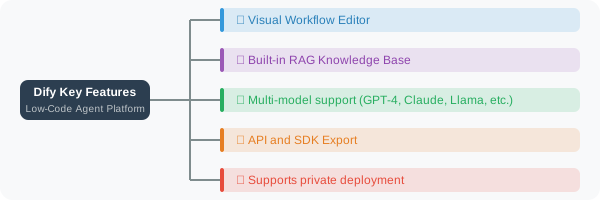
Dify integrates with existing applications via API:
import requests

# Dify application API call example
def call_dify_app(app_token: str, user_message: str) -> str:
    """Call a Dify application"""
    url = "https://api.dify.ai/v1/chat-messages"

    response = requests.post(
        url,
        headers={
            "Authorization": f"Bearer {app_token}",
            "Content-Type": "application/json"
        },
        json={
            "inputs": {},
            "query": user_message,
            "response_mode": "blocking",
            "user": "user_001"
        }
    )

    result = response.json()
    return result.get("answer", "")

# Usage example
answer = call_dify_app("your-app-token", "How do I apply for reimbursement?")
print(answer)
Coze
An Agent-building platform launched by ByteDance, one of the most feature-rich low-code Agent platforms:
Key features:
- Graphical Agent building with drag-and-drop workflow orchestration (supports conditional branching and loops)
- Rich built-in plugins (weather, search, code execution, database, etc.)
- Multi-platform publishing: WeChat, Feishu, Douyin, Discord, Telegram, and more
- Bot marketplace (share and reuse bots)
- Knowledge base management (supports RAG retrieval augmentation)
Coze also provides an API for calling bots built on Coze via code:
import requests
import json

def call_coze_bot(
    bot_id: str,
    user_message: str,
    access_token: str,
    user_id: str = "user_001",
) -> str:
    """Call the Coze Bot API"""
    url = "https://api.coze.com/v3/chat"

    response = requests.post(
        url,
        headers={
            "Authorization": f"Bearer {access_token}",
            "Content-Type": "application/json",
        },
        json={
            "bot_id": bot_id,
            "user_id": user_id,
            "stream": False,
            "auto_save_history": True,
            "additional_messages": [
                {
                    "role": "user",
                    "content": user_message,
                    "content_type": "text",
                }
            ],
        },
    )

    result = response.json()
    # Coze API returns messages in data.messages
    if result.get("code") == 0:
        messages = result.get("data", {}).get("messages", [])
        # Find the assistant's reply
        for msg in messages:
            if msg.get("role") == "assistant" and msg.get("type") == "answer":
                return msg.get("content", "")
    return f"API call failed: {result.get('msg', 'Unknown error')}"


# Usage example
answer = call_coze_bot(
    bot_id="your-bot-id",
    user_message="Help me analyze recent sales data trends",
    access_token="your-access-token",
)
print(answer)
💡 Coze vs Dify selection: Coze is better suited for scenarios that need quick distribution to multiple instant messaging platforms (WeChat, Feishu, Douyin); Dify is better for enterprise scenarios requiring private deployment and custom workflows.
Dify Workflow API
Beyond the basic conversation API, Dify also supports calling Workflows via API, which is very useful for embedding Dify-orchestrated complex logic into your own systems:
import requests

def run_dify_workflow(
    api_key: str,
    inputs: dict,
    user: str = "user_001",
) -> dict:
    """Call the Dify Workflow API"""
    url = "https://api.dify.ai/v1/workflows/run"

    response = requests.post(
        url,
        headers={
            "Authorization": f"Bearer {api_key}",
            "Content-Type": "application/json",
        },
        json={
            "inputs": inputs,
            "response_mode": "blocking",
            "user": user,
        },
    )

    result = response.json()
    return result.get("data", {}).get("outputs", {})


# Example: call a "document summary + translation" workflow
outputs = run_dify_workflow(
    api_key="app-your-workflow-key",
    inputs={
        "document_url": "https://example.com/report.pdf",
        "target_language": "Chinese",
    },
)
print(outputs)
# Output: {"summary": "...", "translation": "..."}
n8n: Workflow Automation Platform
n8n is an open-source workflow automation platform with built-in AI Agent nodes, enabling complex LLM workflows through drag-and-drop configuration. Its core advantage is connecting everything — supporting 400+ app integrations.
n8n integrates bidirectionally with external systems via Webhooks:
import requests

# Call an n8n Webhook to trigger an AI workflow
# Configure in n8n: Webhook → AI Agent → Slack notification
def trigger_n8n_workflow(
    webhook_url: str,
    payload: dict,
) -> dict:
    """Trigger an n8n workflow"""
    response = requests.post(webhook_url, json=payload)
    return response.json()


# Example: trigger a "daily task intelligent prioritization" workflow
result = trigger_n8n_workflow(
    webhook_url="https://your-n8n.example.com/webhook/daily-tasks",
    payload={
        "tasks": [
            "Complete project proposal",
            "Fix production bug",
            "Write weekly report",
            "Team code review",
        ],
        "context": "There's an important client demo this afternoon",
    },
)
# n8n workflow: read tasks → call GPT-4o to analyze priorities → return sorted results
print(result)  # {"prioritized_tasks": [...], "reasoning": "..."}
Other Noteworthy Platforms
| Platform | Key Features | Best For |
|---|---|---|
| FastGPT | Open-source, excellent knowledge base RAG | Enterprise knowledge base Q&A |
| Langflow | LangChain visual orchestration | Developer rapid prototyping |
| Flowise | Low-code LangChain orchestration | Simple Agent building |
| Baidu AppBuilder | Baidu ecosystem, ERNIE model | Domestic enterprise applications |
| Alibaba Tongyi | Alibaba Cloud ecosystem, Qwen model | Domestic enterprise applications |
Low-Code vs Code Development
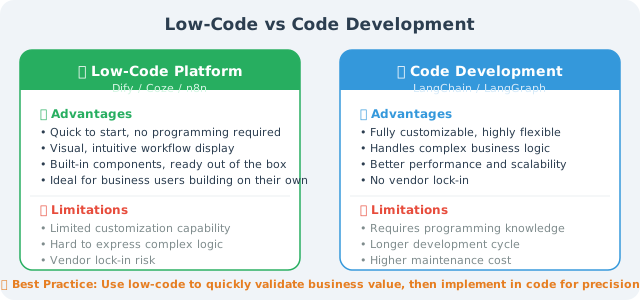
How to Choose?
decision_guide = {
    "Choose low-code platform": [
        "Quickly validate MVP (prototype within 1–3 days)",
        "Projects led by non-technical teams",
        "Standardized customer service/Q&A/document processing scenarios",
        "Internal tools with low customization requirements",
    ],
    "Choose code development": [
        "Need deep customization of Agent behavior logic",
        "Strict requirements on latency/cost/security",
        "Need deep integration with existing systems",
        "Complex architectures like multi-Agent collaboration",
    ],
    "Hybrid approach": [
        "Use Dify to quickly build a prototype and validate product direction",
        "After validation, rewrite core logic with LangChain/LangGraph",
        "Keep Dify as an orchestration tool for non-core modules",
    ],
}
Summary
Low-code platforms lower the barrier to Agent development, but code development provides greater flexibility. The best practice is: use low-code to quickly validate ideas, then use code for fine-tuned implementation and production deployment. As platforms like Dify and Coze continue to iterate, the capability boundaries of low-code platforms are constantly expanding.
Next section: 14.5 How to Choose the Right Framework?