Observability: Logging, Tracing, and Monitoring
Section Goal: Learn how to build a comprehensive observability system for Agents, so that "problems can be detected when they occur, and located once detected."
What Is Observability?
Observability refers to the ability to understand the internal state of a system through its external outputs, without modifying the system's code. For Agents, this means being able to answer the following questions:
- What decisions did the Agent make? Why?
- Which tools were called? How long did each tool take?
- What intermediate steps occurred between the user's question and the final answer?
- When an error occurred, at which step did it happen?
The three pillars of observability: Logs, Traces, and Metrics.
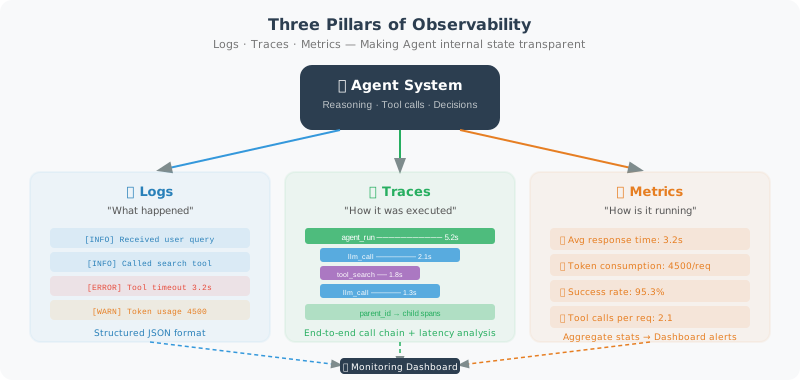
Pillar 1: Structured Logging
import logging
import json
from datetime import datetime

class AgentLogger:
    """Structured logger dedicated to Agents"""

    def __init__(self, agent_name: str, log_file: str = None):
        self.agent_name = agent_name
        self.logger = logging.getLogger(agent_name)
        self.logger.setLevel(logging.DEBUG)

        # Console output
        console_handler = logging.StreamHandler()
        console_handler.setFormatter(
            logging.Formatter("%(asctime)s [%(levelname)s] %(message)s")
        )
        self.logger.addHandler(console_handler)

        # File output (JSON format)
        if log_file:
            file_handler = logging.FileHandler(log_file)
            file_handler.setFormatter(logging.Formatter("%(message)s"))
            self.logger.addHandler(file_handler)

    def log_event(self, event_type: str, **kwargs):
        """Log a structured event"""
        event = {
            "timestamp": datetime.now().isoformat(),
            "agent": self.agent_name,
            "event": event_type,
            **kwargs
        }
        self.logger.info(json.dumps(event))

    def log_llm_call(
        self,
        model: str,
        prompt: str,
        response: str,
        tokens: dict,
        latency: float
    ):
        """Log an LLM call"""
        self.log_event(
            "llm_call",
            model=model,
            prompt_preview=prompt[:200] + "..." if len(prompt) > 200 else prompt,
            response_preview=response[:200] + "..." if len(response) > 200 else response,
            input_tokens=tokens.get("input", 0),
            output_tokens=tokens.get("output", 0),
            latency_ms=round(latency * 1000)
        )

    def log_tool_call(
        self,
        tool_name: str,
        args: dict,
        result: str,
        success: bool,
        latency: float
    ):
        """Log a tool call"""
        self.log_event(
            "tool_call",
            tool=tool_name,
            arguments=args,
            result_preview=str(result)[:200],
            success=success,
            latency_ms=round(latency * 1000)
        )

    def log_error(self, error: Exception, context: dict = None):
        """Log an error"""
        self.log_event(
            "error",
            error_type=type(error).__name__,
            error_message=str(error),
            context=context or {}
        )

# Usage example
logger = AgentLogger("customer_service", log_file="agent.log")

logger.log_llm_call(
    model="gpt-4o",
    prompt="User asked: Where is my order?",
    response="Let me check your order status...",
    tokens={"input": 150, "output": 80},
    latency=1.2
)
Pillar 2: Distributed Tracing
Trace all steps a request goes through from start to finish:
import uuid
import time
from dataclasses import dataclass, field

@dataclass
class Span:
    """A single node in a trace chain"""
    name: str
    trace_id: str
    span_id: str = field(default_factory=lambda: str(uuid.uuid4())[:8])
    parent_id: str = None
    start_time: float = 0.0
    end_time: float = 0.0
    attributes: dict = field(default_factory=dict)
    events: list = field(default_factory=list)
    status: str = "ok"

    @property
    def duration_ms(self) -> float:
        return (self.end_time - self.start_time) * 1000


class AgentTracer:
    """Agent distributed tracer"""

    def __init__(self):
        self.traces = {}  # trace_id -> list[Span]

    def start_trace(self, name: str) -> Span:
        """Start a new trace chain"""
        trace_id = str(uuid.uuid4())[:12]
        span = Span(name=name, trace_id=trace_id)
        span.start_time = time.time()
        self.traces[trace_id] = [span]
        return span

    def start_span(self, name: str, parent: Span) -> Span:
        """Create a child node in an existing trace chain"""
        span = Span(
            name=name,
            trace_id=parent.trace_id,
            parent_id=parent.span_id
        )
        span.start_time = time.time()
        self.traces[parent.trace_id].append(span)
        return span

    def end_span(self, span: Span, status: str = "ok", **attributes):
        """End a node"""
        span.end_time = time.time()
        span.status = status
        span.attributes.update(attributes)

    def print_trace(self, trace_id: str):
        """Visually print a complete trace chain"""
        spans = self.traces.get(trace_id, [])
        if not spans:
            print("Trace not found")
            return

        print(f"\n{'='*60}")
        print(f"🔍 Trace: {trace_id}")
        print(f"{'='*60}")

        # Build tree structure
        root_spans = [s for s in spans if s.parent_id is None]

        for root in root_spans:
            self._print_span_tree(root, spans, indent=0)

    def _print_span_tree(self, span: Span, all_spans: list, indent: int):
        """Recursively print the Span tree"""
        prefix = "  " * indent
        status_icon = "✅" if span.status == "ok" else "❌"

        print(f"{prefix}{status_icon} {span.name} "
              f"({span.duration_ms:.0f}ms)")

        for key, value in span.attributes.items():
            print(f"{prefix}   {key}: {value}")

        # Print child nodes
        children = [s for s in all_spans if s.parent_id == span.span_id]
        for child in children:
            self._print_span_tree(child, all_spans, indent + 1)


# Usage example
tracer = AgentTracer()

# Simulate a complete Agent request trace
root = tracer.start_trace("handle_user_query")

# Step 1: Understand user intent
intent_span = tracer.start_span("classify_intent", root)
# ... execute intent classification ...
tracer.end_span(intent_span, intent="order_query")

# Step 2: Call a tool
tool_span = tracer.start_span("call_tool:query_order", root)
# ... query the order ...
tracer.end_span(tool_span, order_id="12345", status="shipped")

# Step 3: Generate a reply
reply_span = tracer.start_span("generate_reply", root)
# ... generate the final reply ...
tracer.end_span(reply_span, tokens=150)

tracer.end_span(root)
tracer.print_trace(root.trace_id)
Example output:
============================================================
🔍 Trace: a1b2c3d4e5f6
============================================================
✅ handle_user_query (1523ms)
  ✅ classify_intent (245ms)
     intent: order_query
  ✅ call_tool:query_order (1050ms)
     order_id: 12345
     status: shipped
  ✅ generate_reply (228ms)
     tokens: 150
Pillar 3: Monitoring Metrics
import time
from collections import defaultdict, deque
from dataclasses import dataclass

class AgentMonitor:
    """Agent runtime monitor"""

    def __init__(self, window_size: int = 100):
        self.window_size = window_size
        self.latencies = deque(maxlen=window_size)
        self.error_count = 0
        self.total_count = 0
        self.tool_stats = defaultdict(
            lambda: {"calls": 0, "errors": 0, "total_ms": 0}
        )

    def record_request(self, latency: float, success: bool):
        """Record a request"""
        self.total_count += 1
        self.latencies.append(latency)
        if not success:
            self.error_count += 1

    def record_tool_usage(
        self,
        tool_name: str,
        latency: float,
        success: bool
    ):
        """Record tool usage"""
        stats = self.tool_stats[tool_name]
        stats["calls"] += 1
        stats["total_ms"] += latency * 1000
        if not success:
            stats["errors"] += 1

    def get_dashboard(self) -> str:
        """Get monitoring dashboard data"""
        avg_latency = (
            sum(self.latencies) / len(self.latencies)
            if self.latencies else 0
        )
        error_rate = (
            self.error_count / self.total_count
            if self.total_count else 0
        )
        p95_latency = (
            sorted(self.latencies)[int(len(self.latencies) * 0.95)]
            if len(self.latencies) > 20 else avg_latency
        )

        dashboard = f"""
┌──────────────────────────────────────┐
│        🖥️  Agent Monitor Dashboard    │
├──────────────────────────────────────┤
│ Total requests: {self.total_count:<20} │
│ Error rate:     {error_rate:<20.2%} │
│ Avg latency:    {avg_latency:<18.0f}ms │
│ P95 latency:    {p95_latency:<18.0f}ms │
├──────────────────────────────────────┤
│ 🔧 Tool Usage Statistics              │
"""
        for name, stats in self.tool_stats.items():
            avg_tool_ms = (
                stats["total_ms"] / stats["calls"]
                if stats["calls"] else 0
            )
            dashboard += (
                f"│ {name:<15} "
                f"calls:{stats['calls']:<5} "
                f"avg:{avg_tool_ms:.0f}ms │\n"
            )

        dashboard += "└──────────────────────────────────────┘"
        return dashboard
Using LangSmith for Tracing (Recommended)
LangSmith is LangChain's official observability platform that can automatically trace every step of LangChain/LangGraph applications:
import os

# Just set environment variables to enable LangSmith tracing
os.environ["LANGCHAIN_TRACING_V2"] = "true"
os.environ["LANGCHAIN_API_KEY"] = os.getenv("LANGSMITH_API_KEY")
os.environ["LANGCHAIN_PROJECT"] = "my-agent-project"

# All subsequent LangChain calls will be automatically traced
from langchain_openai import ChatOpenAI

llm = ChatOpenAI(model="gpt-4o")
response = llm.invoke("Hello")
# Detailed information about this call (input, output, latency, tokens)
# will automatically appear in the LangSmith web interface
Core features provided by LangSmith:
| Feature | Description |
|---|---|
| Automatic tracing | Complete chain for every LLM/tool call |
| Visualization | View input/output of each step in the web interface |
| Dataset management | Create test datasets for batch evaluation |
| Run comparison | Compare performance differences between versions |
| Alerting | Set alert rules for error rate, latency, etc. |
Summary
| Pillar | Problem Solved | Tools |
|---|---|---|
| Logs | "What happened?" | Structured logging, JSON format |
| Traces | "What steps were taken?" | Span chains, LangSmith |
| Metrics | "How is overall performance?" | Counters, histograms, monitoring dashboards |
🎓 Chapter Summary: Evaluation and optimization is a continuous iterative process. First establish an evaluation system, then continuously improve the Agent through prompt tuning, cost control, and observability.