Code Generation and Modification
Section Goal: Implement code generation and modification capabilities for the Agent, ensuring controllable code quality.
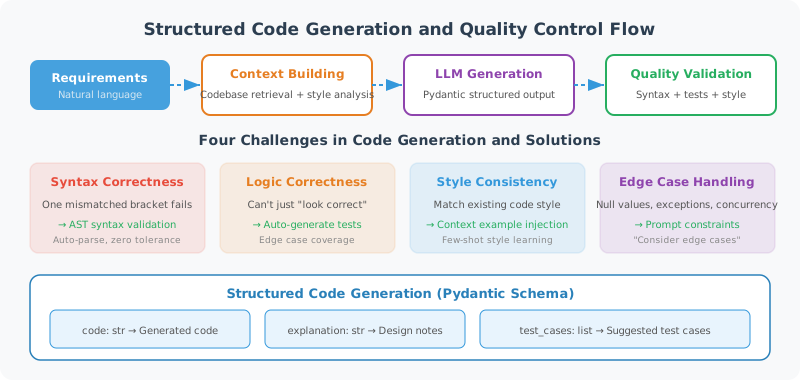
Challenges of Code Generation
Generating code is much harder than generating regular text:
- Must be syntactically correct (one mismatched bracket causes an error)
- Must be logically correct (can't just "look right")
- Must be consistent with existing code style
- Must consider edge cases
Structured Code Generation
from pydantic import BaseModel, Field
from langchain_openai import ChatOpenAI
from langchain_core.prompts import ChatPromptTemplate

class GeneratedCode(BaseModel):
    """Structured code generation result"""
    code: str = Field(description="Generated code")
    language: str = Field(description="Programming language")
    explanation: str = Field(description="Code explanation")
    dependencies: list[str] = Field(
        default_factory=list, description="Dependencies to install"
    )
    usage_example: str = Field(
        default="", description="Usage example"
    )

class CodeGenerator:
    """Code generator"""

    def __init__(self, llm: ChatOpenAI):
        self.llm = llm.with_structured_output(GeneratedCode)

    async def generate(
        self,
        requirement: str,
        language: str = "python",
        style_guide: str = None
    ) -> GeneratedCode:
        """Generate code based on requirements"""

        style_section = ""
        if style_guide:
            style_section = f"\nCode style requirements:\n{style_guide}\n"

        prompt = ChatPromptTemplate.from_messages([
            ("system", f"""You are a professional {language} developer.
Please generate high-quality code based on the requirements.

Requirements:
1. Code must be complete and runnable
2. Include necessary error handling
3. Add clear comments and docstrings
4. Follow {language} best practices
{style_section}"""),
            ("human", "{requirement}")
        ])

        chain = prompt | self.llm
        result = await chain.ainvoke({"requirement": requirement})

        return result

# Usage example
async def demo():
    llm = ChatOpenAI(model="gpt-4o", temperature=0)
    generator = CodeGenerator(llm)

    result = await generator.generate(
        requirement="Implement an LRU cache with expiration time",
        language="python"
    )

    print(result.code)
    print(f"\nDependencies: {result.dependencies}")
    print(f"\nExplanation: {result.explanation}")
Code Modification (Diff Mode)
Modifying existing code is more complex than generating from scratch — it requires understanding context and making precise changes:
class CodeModifier:
    """Code modifier — precise modification based on diff"""

    def __init__(self, llm):
        self.llm = llm

    async def modify(
        self,
        original_code: str,
        modification_request: str,
        file_path: str
    ) -> dict:
        """Modify code"""

        prompt = f"""Please modify the following code according to the modification request.

File: {file_path}

Original code:
{original_code}
Modification request: {modification_request}

Please return in the following format (JSON):
{{
    "modified_code": "Complete modified code",
    "changes": [
        {{
            "description": "Change description",
            "line_range": "Lines X-Y"
        }}
    ],
    "explanation": "Overall modification explanation"
}}

Notes:
1. Only modify what is necessary, keep other code unchanged
2. Maintain the original code style
3. Ensure the modified code runs correctly
"""

        response = await self.llm.ainvoke(prompt)
        import json
        return json.loads(response.content)

    async def add_feature(
        self,
        existing_code: str,
        feature_description: str
    ) -> str:
        """Add a new feature to existing code"""

        prompt = f"""Add a new feature to the following existing code, maintaining consistency with the existing code style.

Existing code:
```python
{existing_code}
New feature requirements: {feature_description}
Requirements:
- New code integrates naturally into the existing code structure
- Do not modify the logic of existing functionality
- Add necessary import statements
- Add docstrings and comments
Please return the complete modified code directly. """ response = await self.llm.ainvoke(prompt) return response.content
---

## Code Quality Validation

After generating code, automatically validate quality:

```python
import ast
import subprocess
import tempfile

class CodeValidator:
    """Code quality validator"""

    def validate(self, code: str, language: str = "python") -> dict:
        """Validate code quality"""
        results = {
            "syntax_valid": False,
            "style_issues": [],
            "security_issues": [],
            "overall_pass": False
        }

        if language == "python":
            results["syntax_valid"] = self._check_python_syntax(code)
            results["style_issues"] = self._check_style(code)
            results["security_issues"] = self._check_security(code)

        results["overall_pass"] = (
            results["syntax_valid"]
            and len(results["security_issues"]) == 0
        )

        return results

    def _check_python_syntax(self, code: str) -> bool:
        """Check Python syntax"""
        try:
            ast.parse(code)
            return True
        except SyntaxError:
            return False

    def _check_style(self, code: str) -> list[str]:
        """Check code style"""
        issues = []
        lines = code.split('\n')

        for i, line in enumerate(lines, 1):
            if len(line) > 120:
                issues.append(f"Line {i} exceeds 120 characters")
            if line.rstrip() != line:
                issues.append(f"Line {i} has trailing whitespace")

        return issues

    def _check_security(self, code: str) -> list[str]:
        """Check security issues"""
        issues = []

        dangerous = {
            "eval(": "Uses eval(), potential code injection risk",
            "exec(": "Uses exec(), potential code injection risk",
            "os.system(": "Uses os.system(), recommend using subprocess",
            "pickle.loads(": "Uses pickle.loads(), potential deserialization attack risk",
        }

        for pattern, warning in dangerous.items():
            if pattern in code:
                issues.append(warning)

        return issues
Summary
| Component | Function |
|---|---|
| CodeGenerator | Generate complete code based on requirements |
| CodeModifier | Precisely modify existing code |
| CodeValidator | Automatic syntax/style/security validation |
Next Section Preview: Code is written, now it needs testing. Let the Agent automatically generate tests and fix bugs.