10.3 PPO: Proximal Policy Optimization
In 10.1 What Is Agentic-RL, we introduced the two-phase training paradigm of Agentic-RL (SFT → RL). The core question in the RL phase is: how do we update model parameters based on reward signals? This is exactly the problem that policy optimization algorithms solve.
This section systematically explains the PPO (Proximal Policy Optimization) algorithm from scratch — it is the core training algorithm behind InstructGPT and ChatGPT, and the foundation for understanding the DPO and GRPO algorithms that follow. We will start from the most basic intuition, derive the mathematical formulas step by step, and use plenty of diagrams to aid understanding.
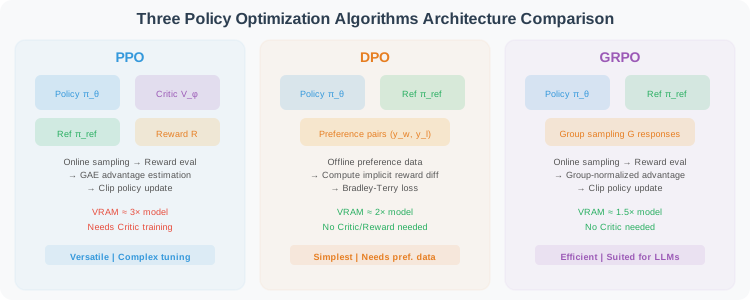
Prerequisites: The Basic Idea of Policy Gradients
Before diving into the three algorithms, we need to understand a common starting point — Policy Gradient [1].
Core Intuition
Imagine you're practicing basketball free throws. After each shot, you get feedback: made it (reward +1) or missed (reward 0). The idea behind policy gradients is extremely simple:
If an action received a high reward, increase the probability of that action; if it received a low reward, decrease the probability of that action.
Formally, the policy gradient theorem gives the gradient direction as:
Let's break down this formula term by term, using a concrete language model example to aid understanding.
① — "Which direction should I adjust the parameters?"
- is our overall objective: the expected cumulative reward of the model across all possible inputs. The larger , the better the model's overall performance
- is the gradient with respect to model parameters (i.e., the billions of weight values in the model)
- is a vector with the same dimension as , telling us: if we nudge each parameter slightly in which direction, will increase fastest
- During training, we do: ( is the learning rate), i.e., "climbing uphill" along the gradient direction
Analogy: You're standing blindfolded on a hillside; the gradient is "the steepest uphill direction under your feet." Each step (one parameter update) brings you a little closer to the summit (maximum reward).
② — "How should I adjust parameters to make this action more likely?"
This is the most central and hardest-to-understand part of the formula; let's explain it in layers:
Layer 1: What is ?
is our language model. Given the current state (conversation history + already-generated tokens), it outputs a probability distribution representing "what is the probability of the next token." For example:
| Next token () | Probability |
|---|---|
| "search" | 0.35 |
| "answer" | 0.25 |
| "calculate" | 0.20 |
| "I" | 0.10 |
| ... | ... |
means: in the current context, the model thinks the probability of outputting "search" next is 35%.
Layer 2: Why take the logarithm of ?
Taking the logarithm has two benefits:
- Numerical stability: probability values are between 0 and 1; multiplying many token probabilities together becomes extremely small (e.g., ); taking the log converts it to addition (), avoiding numerical underflow
- Clean gradient form: ; this ratio form is exactly what we need
Layer 3: What exactly is ?
This is called the score function. It is a vector with the same dimension as model parameters , indicating:
"If we want the probability of action in state to increase, which direction should each model parameter be adjusted?"
- It doesn't directly change the probability; it gives a direction
- Adjusting parameters in this direction → increases (this action becomes more likely)
- Adjusting parameters in the opposite direction → decreases (this action becomes less likely)
Analogy: The score function is like the "steering wheel" for action — turning it can increase or decrease the probability of this action being selected. But having a steering wheel alone isn't enough; you also need to know how much to turn — that's the role of below.
③ — "How much should I turn the steering wheel?"
is the cumulative reward of the entire trajectory (the complete interaction from start to finish), serving as a weight:
-
(positive reward): the trajectory performed well overall
- Gradient = positive weight × score function → update in the score function direction → increase the probability of each action in the trajectory
- Intuition: this performance was good; do more of the same next time
-
(negative reward): the trajectory performed poorly overall
- Gradient = negative weight × score function → update in the opposite direction of the score function → decrease the probability of each action in the trajectory
- Intuition: this performance was bad; avoid doing the same next time
-
(zero reward): this trajectory contributes nothing to the gradient
-
Larger : larger weight; this trajectory has more influence on parameter updates. More extreme rewards/penalties → deeper model "memory"
Analogy: is like a coach's score. The score function points the steering wheel; determines how far to turn. Coach gives a high score () → turn hard toward "increase this action's probability"; coach gives a low score () → turn hard toward "decrease this action's probability."
④ — "Calculate for every step in the trajectory"
A trajectory contains time steps (from to ), each with a pair. The summation means: every step's score function is weighted by the same .
In language models, one step = generating one token. If the model generates a 50-token response, , and the generation probability of each of these 50 tokens will be updated weighted by the same total reward.
Note: This is actually a rough approach — using the total reward of the entire trajectory to weight each step. If the first 30 tokens of a trajectory are correct reasoning and the last 20 tokens are wrong conclusions, they're all treated equally by the total reward. This is the "credit assignment problem" — PPO's advantage function is specifically designed to solve this (see §1.3).
⑤ — "Average over many attempts"
is the expectation operator; means trajectory is randomly sampled according to policy .
- Because language model generation is stochastic (via temperature sampling), the same input may produce different outputs
- Each sample gives a trajectory , corresponding to an value
- Expectation is the weighted average over all possible trajectories — higher-probability trajectories have larger weights
In practice: we can't enumerate all possible trajectories (the output space of language models is astronomically large), so we use Monte Carlo approximation — sample trajectories and take the average as an estimate of the expectation:
Larger gives more accurate estimates but higher computational cost. This is the essence of batch size in training.
Complete Example: One Policy Gradient Update for a Language Model Agent
Suppose we're training an Agent that can call a search tool, and the user asks "What's the weather in Beijing today?"
Sampling two trajectories:
| Trajectory A (good response) | Trajectory B (bad response) | |
|---|---|---|
| User: "What's the weather in Beijing today?" | User: "What's the weather in Beijing today?" | |
<think> | <think> | |
| Need to query real-time weather | I'll just answer directly | |
</think> | </think> | |
<tool_call>search("Beijing weather")</tool_call> | Beijing is sunny today, 25°C | |
| ... | (gives accurate answer after getting results) | (made up, possibly completely wrong) |
| +0.8 (called tool, answer accurate) | -0.2 (didn't call tool, answer wrong) |
Gradient update effects:
- Trajectory A (): the model will increase the probability of the action sequence "encounter real-time info question → call search tool"
- Trajectory B (): the model will decrease the probability of the action sequence "encounter real-time info question → make up an answer directly"
After thousands of such updates, the model gradually learns: when encountering questions requiring real-time information, it should call a tool first rather than fabricating an answer.
Deficiencies of Raw Policy Gradients
Although the intuition is clear, raw policy gradients have two serious problems:
| Problem | Manifestation | Consequence |
|---|---|---|
| High variance | may vary enormously across different trajectories | Gradient estimates are unstable; training converges extremely slowly |
| Uncontrolled step size | No constraint on the size of single-step updates | One "big jump" can destroy the entire policy |
PPO, DPO, and GRPO each solve these two problems in different ways. This section explains PPO in detail; DPO and GRPO will be introduced in 10.4 DPO: Direct Preference Optimization and 10.5 GRPO/GSPO: Group Relative Policy Optimization and Reward Function Design respectively.
1.1 What Problem Does PPO Solve?
Before understanding PPO, we should look at the two pieces of historical baggage it has to pick up.
The first comes from the most naive policy gradient (REINFORCE): every update depends on the batch of trajectories just sampled, so sample efficiency is very low. In the large language model setting, a single trajectory may be a long response and sampling is extremely expensive; if the model has to generate a large batch of new responses every few update steps, training cost quickly spirals out of control.
The second is the stability of policy updates. Policy gradients only tell us "in which direction to adjust the probabilities," but they don't automatically tell us "how far we may move in one step." If a single update pushes the probability of one token or action too hard, the model can jump from "slightly preferring good responses" to "the whole output distribution shifting," destroying capabilities it had already learned. This is what reinforcement learning calls policy collapse.
Before PPO, TRPO (Trust Region Policy Optimization) had already tried to solve this: it uses KL divergence to constrain the distance between the new and old policies, requiring the new policy not to stray too far from the old one. The idea is right, but it is complex to implement, computationally expensive, and requires second-order optimization — not convenient for large model training.
PPO [2] is a policy optimization algorithm proposed by OpenAI in 2017, and is the core training algorithm of InstructGPT [3] and ChatGPT. Its core goal can be summed up in one sentence:
Approximate TRPO's "trust region" in a simpler, cheaper way, and reuse the same batch of sampled data for repeated updates without letting the policy jump too far.
So PPO is not a trick that appeared out of nowhere; it was designed to resolve two concrete tensions:
| Problem with the old approach | Why it's painful | PPO's solution |
|---|---|---|
| Low sample efficiency of policy gradients | Resampling for every update, and generating LLM trajectories is expensive | Reuse data generated by the old policy via importance sampling |
| Uncontrolled policy update step size | One large update can cause policy collapse | Limit the new/old policy probability ratio with Clip |
| TRPO is too heavy | KL constraints and second-order optimization are complex to implement and costly to train | Approximate the trust region with first-order optimization + a clipped objective |
PPO achieves this goal through two key mechanisms:
- Importance sampling: allows using data collected by the "old policy" to train the "current policy" (data reuse)
- Clip: limits the step size of policy updates to prevent policy collapse
Is PPO On-Policy or Off-Policy?
Strictly speaking, PPO is still an on-policy algorithm. The criterion is simple: is the data used to update the network produced by the latest policy of this round?
Purely on-policy algorithms, such as REINFORCE or A2C, typically run a batch of trajectories in the environment with the current policy, update the parameters once with that data, and then throw the batch away. Once the parameters change, the policy changes; the next update must resample. This is stable but sample-inefficient.
Purely off-policy algorithms, such as DQN, SAC, and TD3, maintain a large replay buffer. Data collected days, weeks, or even longer ago can be pulled out repeatedly to train the current network. They do not require training data to come from the latest policy.
PPO sits in between. It lets us perform multiple update passes over the same batch of data sampled by the old policy — for example, 4 to 10 epochs of training — which looks like a bit of off-policy capability. But this data can only be reused within a very short window. Once this round of PPO updates finishes, the batch is still discarded, and the next round must resample with the latest policy.
So from a macro data-flow perspective, PPO still relies on fresh data "near the current policy" rather than a long-lived experience pool. Importance sampling only gives PPO short-range data reuse; it does not turn PPO into a truly off-policy algorithm.
| Algorithm type | Where data comes from | How long old data lasts | Typical algorithms |
|---|---|---|---|
| Pure on-policy | Data just sampled by the current policy | Usually used only once | REINFORCE, A2C |
| PPO | Data sampled by the most recent old policy | Briefly reused within a few epochs | PPO |
| Pure off-policy | Historical data in a replay buffer | Can be reused repeatedly for a long time | DQN, SAC, TD3 |
In one sentence: PPO's identity is on-policy, but importance sampling gives it a limited, short-window ability to reuse off-policy data.
1.2 Importance Sampling Ratio : The Core of Off-Policy Training
In policy gradients, we need to sample trajectories from the current policy to compute gradients. But if we resample after every parameter update, efficiency is extremely low. Importance sampling allows us to use samples from the old policy to estimate the gradient of the new policy .
The core is introducing the importance sampling ratio:
Term-by-term interpretation:
- Numerator : probability of the current policy choosing action in state
- Denominator : probability of the old policy (at sampling time) choosing that action
- : current and old policies have identical preference for this action
- : current policy favors this action more than the old policy ("current policy thinks this action got better")
- : current policy favors this action less than the old policy ("current policy thinks this action got worse")
- : current policy's probability of choosing this action is 2× the old policy's
Intuition for importance sampling: suppose the old policy sampled an action with probability 10% (), while the current policy thinks that action's probability should be 30% (), so . This means if we use the old policy's data to estimate the new policy's expectation, each such data point should be given 3× weight — because the new policy "should have" sampled it more frequently.
1.3 Advantage Function : Judging Whether an Action Is "Good or Bad"
In policy gradients, using cumulative reward as a weight leads to high variance. The Advantage Function solves this by introducing a baseline:
- : expected cumulative reward after executing action in state (action value)
- : expected cumulative reward from following the current policy in state (state value, i.e., the "baseline")
- : action is better than "average" → should be reinforced
- : action is worse than "average" → should be suppressed
- : action is at the average level → no adjustment needed
Why does subtracting a baseline reduce variance? A vivid analogy: suppose you scored 85 on an exam. If the class average is 60, you'd feel "did well" (); if the class average is 90, you'd feel "underperformed" (). Converting absolute scores to relative scores eliminates the interference of score scale, making the signal more stable.
1.4 GAE: Generalized Advantage Estimation
Don't rush to the formula. GAE solves a very concrete problem: at a given time step , how much better than expected was the action the model just took?
As the previous section said, the advantage function is:
Intuitively, it asks: "How much better is taking action in the current state than the average performance in that state?" The problem is that in real training, neither nor is precisely known. All we can do is train a Critic model to estimate "roughly how much return we can still get if we continue from a given state."
So GAE's idea can be split into two steps:
- First, use the TD error to measure the "degree of surprise" at each step;
- Then add up the "surprises" of the current step and the next few steps, weighted by distance, to obtain the advantage estimate for the current action.
Step 1: The TD Error Measures Whether "This Small Step Beat Expectations"
The TD error (Temporal Difference Error) is defined as:
This formula can be read in plain language as:
TD error = what we actually observe after taking one step - what the Critic originally expected for the current state.
Term by term:
- : the Critic's original prediction of roughly how much total future value we get from the current state onward.
- : after actually taking the action, we immediately receive reward and arrive at the next state ; the Critic then estimates the future value of the next state, multiplied by the discount factor .
- Subtracting the two gives "how much better reality was than expected."
Therefore:
- : the actual result is better than the Critic expected — a positive surprise, suggesting the action just taken may deserve reinforcement.
- : the actual result is worse than the Critic expected — a negative surprise, suggesting the action just taken should probably be suppressed.
- : the result basically matches expectations, meaning this step provides little new learning signal.
Here's a small example. Suppose the Critic originally thought the current state's value was 5.0. The model takes a step and immediately receives a reward of 1.0; the next state's value is estimated at 5.5, with discount factor :
This means: what actually happened was 0.95 better than originally expected. For PPO, this action should receive positive reinforcement.
Step 2: GAE Combines Multi-Step "Surprises" into the Current Advantage
Looking at only one step's TD error has a problem: it is too short-sighted. Whether the current action is good may not show up immediately; it may only become visible several steps later.
For example, an Agent decides to call a search tool first. The current step may not immediately produce the final answer, but the following steps see a big jump in answer quality because the search results are now available. If we only look at the current step's reward, we would underestimate the value of the "call the tool" action.
GAE's approach: don't just look at the current step's TD error ; also look at the TD errors of the following steps , with smaller weights the further away they are:
Written as a summation:
The key here is :
- : the current step, weight 1.
- : the next step, weight .
- : the step after that, weight .
- The further out, the more the weight decays exponentially, and the less influence it has on the current action.
You can think of GAE as a "decaying ledger of surprises":
| Time step | TD error | Contribution to the current action |
|---|---|---|
| Current step | Most important; counted in full | |
| Next step | Relevant, but discounted once | |
| Step after | Possibly relevant; discounted again | |
| Further future | Influence keeps shrinking |
Controls "How Far Ahead We Look"
is the GAE trade-off parameter. It decides whether we trust "the nearby single-step TD estimate" more, or prefer to look at the full trajectory.
| value | GAE degenerates to | Bias | Variance | Intuition |
|---|---|---|---|---|
| Single-step TD: | High (fully depends on Critic accuracy) | Low | Only looks at one step's "surprise" — very stable but short-sighted | |
| Monte Carlo: | Low (uses the complete trajectory) | High | Looks at the complete trajectory — full information but noisy | |
| Common value in PPO | Moderate | Moderate | Looks at the near term while retaining some long-term influence |
So the core of GAE is not "inventing yet another complex formula," but a compromise strategy:
Use the Critic's short-term prediction error as the basic signal, then add back the errors of the next few steps with distance-based decay, yielding a more stable advantage estimate.
📌 Key issue: GAE requires a Critic model to estimate state values. For large language models (e.g., 7B parameters), this means needing to load an additional Critic model of equivalent scale — this is PPO's biggest resource bottleneck in large model training.
1.5 PPO Clip Mechanism: The "Safety Rope" for Policy Updates
With advantage and ratio , PPO's loss function is:
This formula looks complex, but the core idea is simple. Let's understand it in two cases:
Case ①: (good action, should be reinforced)
- Without Clip: the larger (i.e., the more we increase this action's probability), the smaller the loss → gradient pushes the policy to keep increasing this action's probability
- With Clip: once exceeds , no longer increases → takes the clipped value → gradient becomes zero
- Effect: even if an action is good, its probability is not allowed to increase too much (prevents "overconfidence")
Case ②: (bad action, should be suppressed)
- Without Clip: the smaller (i.e., the more we decrease this action's probability), the smaller the loss → gradient pushes the policy to greatly decrease this action's probability
- With Clip: once falls below , gradient becomes zero
- Effect: even if an action is bad, its probability is not allowed to decrease too much (prevents "overcorrection")
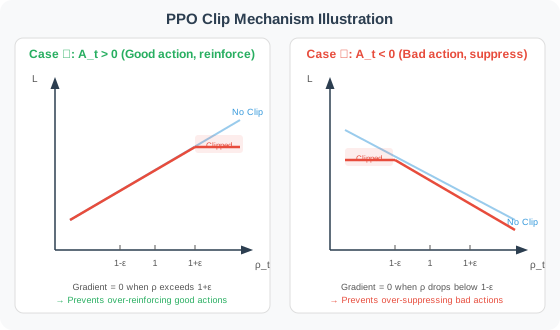
Meaning of Clip parameter : (typically 0.1–0.3) defines the size of the "trust region" — in each policy update, the probability change of each action must not exceed times the old policy. Smaller is more conservative; larger is more aggressive.
1.6 KL Divergence Penalty: Another Safety Net Against Policy "Drift"
The Clip mechanism limits the magnitude of probability change for individual actions, but it cannot constrain the drift of the policy's overall distribution. In RLHF scenarios, if the model "forgets" the general language capabilities learned during SFT (such as grammar and coherence) in pursuit of high rewards, language degeneration or reward hacking occurs — the model finds some "clever" output pattern to trick its way to high rewards, but the result is a mess to read for humans.
For this reason, PPO in RLHF typically adds an additional KL divergence penalty term; the complete optimization objective becomes:
Where KL divergence is defined as:
Term-by-term interpretation:
- : Reference Policy — see the dedicated explanation below
- : measures the distributional divergence of the current policy relative to the reference policy . means they're completely identical; larger means more severe divergence
- : KL penalty coefficient — controls the balance between "exploring new strategies" and "maintaining existing capabilities"
For the mathematical definition and intuitive explanation of KL divergence, see Appendix E: KL Divergence Explained
What Is the Reference Model ()?
The reference model is a very important concept in RLHF and GRPO; beginners often confuse it with the "old policy" (). Let's use a table to completely clarify:
| Reference Model | Old Policy | |
|---|---|---|
| What it is | Snapshot of the SFT model before RL training starts | Snapshot of the policy model at the start of the current RL iteration |
| When created | When RL training starts, copy a snapshot of the SFT model | Before sampling new data each time, copy the current Policy model |
| Whether updated | ❌ Never updated (frozen parameters) | ✅ Updated once per iteration (synchronized to current policy) |
| Purpose | Serves as an "anchor" to prevent policy from drifting too far from SFT | Provides the denominator for importance sampling (data reuse) |
| Scope | Entire RL training process | Only valid within the current iteration |
| Used in | KL divergence penalty | Importance sampling ratio |
Vivid analogy:
Imagine you're learning to drive (RL training). The driving instructor taught you the basics (SFT); now you're practicing on the road.
- Reference model = the standard operating procedures in the instructor's manual. No matter how long you practice, the manual never changes. Its role: if your driving habits deviate too far from the standard (e.g., you start "speeding"), it pulls you back.
- Old policy = your driving skill level at the end of your last practice session. After each practice, your skill improves a little. Its role: evaluate what changed in this practice session compared to last time.
Why is the Reference Model needed?
During RL training, the model continuously iterates and updates. Without a Reference model as an anchor, the following problems may occur:
- Reward Hacking: the model discovers some "clever" output pattern that earns high rewards (e.g., repeatedly outputting a high-reward phrase), but actual output quality is terrible
- Language Degeneration: the model loses the grammar ability, coherence, and general knowledge learned during SFT in pursuit of rewards
- Mode Collapse: the model generates similar "safe" answers for all inputs, losing diversity
KL divergence is like an "elastic rope" — the further drifts from , the larger the penalty, pulling the policy back.
Timeline of the three models during training:
| Model | Role | How it changes |
|---|---|---|
| Reference model (KL anchor) | Never changes; always the SFT model | |
| Sampling policy | Copied as a snapshot from at the start of each iteration, used to sample trajectories | |
| Training policy | Continuously updated; gradient descent on every mini-batch |
Iteration 1: = SFT → sample → updated to
Iteration 2: = → sample → updated to
Iteration 3: = → sample → updated to
- Row 1: is always the SFT model, unchanged from start to finish
- Row 2: copies a snapshot from at the start of each iteration
- Row 3: is the Policy model that is continuously trained and updated
📌 Implementation detail: The Reference model needs to occupy separate GPU memory. For a 7B parameter model (bf16), the Reference model takes ~14GB of GPU memory. To save memory, some implementations use LoRA adapters — in this case, the Reference model doesn't need to be loaded separately; just disable the LoRA adapter during inference to get 's output.
Role and adjustment of :
| value | Effect | Applicable scenario |
|---|---|---|
| too small (e.g., 0.001) | KL constraint almost ineffective; policy can deviate greatly | Strong exploration, but prone to reward hacking and language degeneration |
| moderate (e.g., 0.01–0.1) | Balances exploration and constraint; recommended starting value | Most RLHF scenarios |
| too large (e.g., 1.0) | Policy can barely deviate from the SFT model | RL training is essentially useless |
Adaptive KL control: InstructGPT [3] proposed a method for dynamically adjusting — set a target KL value ; if the actual exceeds the target, increase (tighten the constraint); otherwise decrease (relax the constraint):
Where is the adjustment step size (typically 0.1–0.2). This adaptive mechanism makes training more robust — no need to manually fine-tune .
Synergistic effect of Clip + KL:
| Constraint mechanism | Constrains | Granularity | Intuition |
|---|---|---|---|
| Clip | Probability ratio of individual actions | Local (per-token level) | "Each step can't go too far" |
| KL | Overall output distribution vs | Global (policy level) | "The overall route can't deviate too far" |
The two are complementary: Clip prevents single-step updates from being too large; KL prevents cumulative drift from being too large. In practice, both are typically used simultaneously.
1.7 PPO Complete Training Process
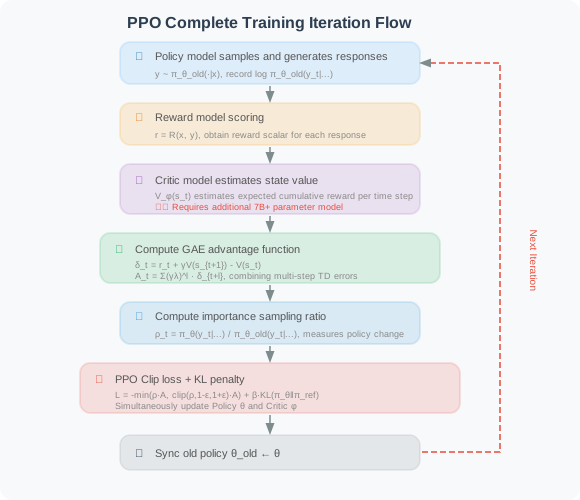
PPO training requires maintaining the following models simultaneously:
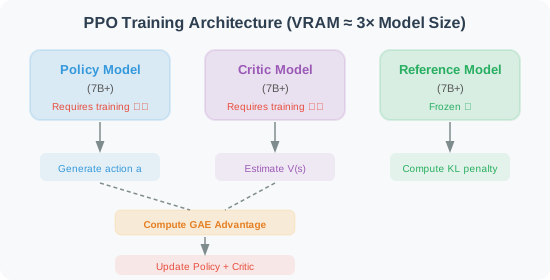
1.8 PPO Core Code Implementation
Below is a complete PyTorch implementation of PPO's core components, helping to understand the meaning of each formula at the code level.
1.8.1 GAE Advantage Estimation
import torch
import torch.nn.functional as F

def compute_gae(
    rewards: torch.Tensor,       # [T] immediate reward at each step
    values: torch.Tensor,        # [T+1] state values estimated by Critic (including terminal state)
    gamma: float = 1.0,          # discount factor (usually 1.0 for language model tasks)
    lam: float = 0.95,           # GAE λ parameter
) -> torch.Tensor:
    """
    Compute GAE (Generalized Advantage Estimation)

    Formula: A_t = Σ (γλ)^l · δ_{t+l}
    where δ_t = r_t + γ·V(s_{t+1}) - V(s_t)

    Args:
        rewards:  immediate reward at each step, shape [T]
        values:   Critic's value estimate for each state, shape [T+1]
                  (the last one is the terminal state value, usually 0)
        gamma:    discount factor, controls the decay of future rewards
        lam:      GAE λ parameter, controls the bias-variance trade-off
                  λ=0 → single-step TD (low variance, high bias)
                  λ=1 → Monte Carlo (high variance, low bias)

    Returns:
        advantages: GAE advantage estimates, shape [T]
    """
    T = len(rewards)
    advantages = torch.zeros(T)
    gae = 0.0  # accumulate backwards from the last step

    for t in reversed(range(T)):
        # TD error: δ_t = r_t + γ·V(s_{t+1}) - V(s_t)
        # "what actually happened" - "what the Critic expected"
        delta = rewards[t] + gamma * values[t + 1] - values[t]

        # GAE recurrence: A_t = δ_t + γλ·A_{t+1}
        # equivalent to A_t = Σ (γλ)^l · δ_{t+l}
        gae = delta + gamma * lam * gae
        advantages[t] = gae

    return advantages
1.8.2 PPO Clip Loss
def ppo_clip_loss(
    log_probs: torch.Tensor,         # [B, T] log π_θ(a_t|s_t) of the current policy
    old_log_probs: torch.Tensor,     # [B, T] log π_θ_old(a_t|s_t) of the old policy
    advantages: torch.Tensor,         # [B, T] GAE advantage estimates
    clip_epsilon: float = 0.2,        # Clip range ε
) -> tuple[torch.Tensor, dict]:
    """
    Compute the PPO Clip policy loss

    Formula: L = -E[min(ρ_t·A_t, clip(ρ_t, 1-ε, 1+ε)·A_t)]

    Args:
        log_probs:     log probability of each token under the current policy [batch, seq_len]
        old_log_probs: log probability of each token under the old policy [batch, seq_len]
        advantages:    advantage value for each token [batch, seq_len]
        clip_epsilon:  clipping range, typically 0.1-0.3

    Returns:
        loss: policy loss scalar
        metrics: monitoring metrics
    """
    # ── Compute the importance sampling ratio ────────────────────
    # ρ_t = π_θ(a_t|s_t) / π_θ_old(a_t|s_t)
    # Division in log space = subtraction, then exp back
    ratio = torch.exp(log_probs - old_log_probs)  # [B, T]

    # ── Unclipped objective ──────────────────────────────────────
    # ρ_t · A_t
    surr1 = ratio * advantages  # [B, T]

    # ── Clipped objective ────────────────────────────────────────
    # clip(ρ_t, 1-ε, 1+ε) · A_t
    clipped_ratio = torch.clamp(ratio, 1.0 - clip_epsilon, 1.0 + clip_epsilon)
    surr2 = clipped_ratio * advantages  # [B, T]

    # ── PPO loss = -min(surr1, surr2) ────────────────────────────
    # Taking min ensures:
    #   When A>0: don't let ρ exceed 1+ε (prevent over-reinforcement)
    #   When A<0: don't let ρ fall below 1-ε (prevent over-suppression)
    loss = -torch.min(surr1, surr2).mean()

    # ── Monitoring metrics ───────────────────────────────────────
    with torch.no_grad():
        # Clip fraction: proportion of clipped tokens (healthy range 0.1-0.3)
        clip_fraction = ((ratio - 1.0).abs() > clip_epsilon).float().mean().item()
        # Approximate KL divergence (for monitoring policy drift)
        approx_kl = (old_log_probs - log_probs).mean().item()

    metrics = {
        "policy_loss": loss.item(),
        "clip_fraction": clip_fraction,       # > 0.5 indicates the update step is too large
        "approx_kl": approx_kl,               # > 0.02 may require reducing the learning rate
        "mean_ratio": ratio.mean().item(),     # should be close to 1.0
    }

    return loss, metrics
1.8.3 Critic (Value Function) Loss
def critic_loss(
    values: torch.Tensor,        # [B, T] V(s_t) predicted by the Critic
    returns: torch.Tensor,       # [B, T] actual returns = advantages + old_values
) -> torch.Tensor:
    """
    Compute the Critic loss (mean squared error)

    The Critic's goal: make V_ϕ(s_t) as close as possible to the actual returns

    Args:
        values:  Critic's value prediction for each state [batch, seq_len]
        returns: actual returns (GAE advantage + old value estimate) [batch, seq_len]

    Returns:
        loss: Critic loss scalar
    """
    return F.mse_loss(values, returns)
1.8.4 KL Divergence Penalty
def kl_penalty(
    log_probs: torch.Tensor,     # [B, T] log π_θ of the current policy
    ref_log_probs: torch.Tensor, # [B, T] log π_ref of the reference policy (SFT model)
) -> torch.Tensor:
    """
    Compute the KL divergence between the current policy and the reference policy

    Formula: D_KL(π_θ ‖ π_ref) = E[log(π_θ/π_ref)]

    Args:
        log_probs:     log probabilities of the current policy
        ref_log_probs: log probabilities of the reference policy (SFT model, frozen parameters)

    Returns:
        kl: KL divergence scalar
    """
    # KL = E[log π_θ - log π_ref]
    kl = (log_probs - ref_log_probs).mean()
    return kl
1.8.5 PPO Complete Training Step
def ppo_training_step(
    policy_model,          # Policy model π_θ (trainable)
    critic_model,          # Critic model V_ϕ (trainable)
    ref_model,             # Reference model π_ref (frozen, not trained)
    input_ids,             # Input token ids
    response_ids,          # Generated response token ids
    old_log_probs,         # Log probabilities of the old policy
    rewards,               # Reward signals
    old_values,            # Value estimates from the old Critic
    clip_epsilon=0.2,      # PPO Clip ε
    kl_coef=0.01,          # KL penalty coefficient β
    critic_coef=0.5,       # Critic loss weight
    gamma=1.0,             # Discount factor
    lam=0.95,              # GAE λ
):
    """
    The complete process of a single PPO training step

    Total loss = policy loss + β·KL penalty + c·Critic loss
    """
    # ── Step 1: Compute log probabilities of the current policy ──
    # Forward pass to get log probabilities of each token under the current policy
    logits = policy_model(input_ids=input_ids, response_ids=response_ids)
    log_probs = compute_token_log_probs(logits, response_ids)  # [B, T]

    # ── Step 2: Compute the Critic's value estimates ─────────────
    values = critic_model(input_ids=input_ids, response_ids=response_ids)  # [B, T]

    # ── Step 3: Compute GAE advantages ───────────────────────────
    # Compute GAE separately for each sample in the batch
    advantages_list = []
    for b in range(rewards.shape[0]):
        adv = compute_gae(rewards[b], old_values[b], gamma=gamma, lam=lam)
        advantages_list.append(adv)
    advantages = torch.stack(advantages_list)  # [B, T]

    # Normalize advantages (reduce variance, stabilize training)
    advantages = (advantages - advantages.mean()) / (advantages.std() + 1e-8)

    # Actual returns = advantages + old value estimates (used to train the Critic)
    returns = advantages + old_values[:, :-1]

    # ── Step 4: Compute the PPO Clip policy loss ─────────────────
    policy_loss, policy_metrics = ppo_clip_loss(
        log_probs, old_log_probs, advantages, clip_epsilon
    )

    # ── Step 5: Compute the KL divergence penalty ────────────────
    with torch.no_grad():
        ref_logits = ref_model(input_ids=input_ids, response_ids=response_ids)
        ref_log_probs = compute_token_log_probs(ref_logits, response_ids)
    kl = kl_penalty(log_probs, ref_log_probs)

    # ── Step 6: Compute the Critic loss ──────────────────────────
    c_loss = critic_loss(values[:, :-1], returns)

    # ── Step 7: Total loss ───────────────────────────────────────
    # Policy loss (make the model do the right thing) + KL penalty (don't forget language ability) + Critic loss (learn to judge good from bad)
    total_loss = policy_loss + kl_coef * kl + critic_coef * c_loss

    return total_loss, {
        **policy_metrics,
        "kl_divergence": kl.item(),
        "critic_loss": c_loss.item(),
        "total_loss": total_loss.item(),
    }
📌 Key differences from the GRPO code:
- PPO needs to additionally maintain a Critic model (
critic_model) of equivalent scale to the Policy model- Advantage estimation uses the GAE recurrence (depends on the Critic), not GRPO's within-group normalization
- The total loss has three parts: policy loss + KL penalty + Critic loss, while GRPO has no Critic loss
- This also explains why PPO's memory requirement is ≈ 3× model size (Policy + Critic + Reference)
1.9 Summary of PPO's Advantages and Disadvantages
| Dimension | Assessment |
|---|---|
| ✅ Generality | Applicable to almost all RL scenarios, not limited to language models |
| ✅ Stability | The Clip mechanism provides reliable training stability guarantees |
| ✅ Theoretical foundation | Backed by mature theory (a simplification of trust region methods) |
| ❌ Memory requirements | Requires a Critic model; memory usage ≈ 3× model size |
| ❌ Training complexity | Critic and Policy are mutually dependent; joint training is unstable |
| ❌ Many hyperparameters | GAE λ, Critic learning rate, clip ε, KL β, etc. all need careful tuning |
PPO is a powerful but resource-intensive algorithm — it requires a Critic model, a reward model, and online sampling. The next section introduces DPO, which through elegant mathematical derivation directly bypasses both the reward model and the Critic, turning the RL problem into simple supervised learning.
References
[1] WILLIAMS R J. Simple statistical gradient-following algorithms for connectionist reinforcement learning[J]. Machine Learning, 1992, 8(3): 229-256.
[2] SCHULMAN J, WOLSKI F, DHARIWAL P, et al. Proximal policy optimization algorithms[R]. arXiv preprint arXiv:1707.06347, 2017.
[3] OUYANG L, WU J, JIANG X, et al. Training language models to follow instructions with human feedback[C]//Advances in Neural Information Processing Systems (NeurIPS). 2022.
[4] SCHULMAN J, MORITZ P, LEVINE S, et al. High-dimensional continuous control using generalized advantage estimation[C]//International Conference on Learning Representations (ICLR). 2016.