Preface
🤖 "The future belongs not to those who write code, but to those who can direct AI to write code. And Agent is the bridge connecting human intent with AI capability."
Why This Book?
Since 2023, Large Language Models (LLMs) have sparked a technological revolution. But many people have found that simple "conversation" is far from enough — we need AI that can make autonomous decisions, use tools, and complete complex tasks. This is the purpose of Agents (Intelligent Agents).
However, learning resources for Agent development are scattered across various papers, blogs, and framework documentation, lacking a systematic, beginner-friendly, and practice-oriented learning path. This book is written to fill that gap.
Who Is This Book For?
- 🐍 Developers with Python basics who want to enter the AI Agent field
- 🎓 Students or researchers interested in LLMs who want to understand the principles and implementation of Agents
- 💼 Product managers or tech leads who want to understand the capability boundaries and application scenarios of Agents
- 🔧 People already using ChatGPT and similar tools who want to understand and customize AI capabilities more deeply
Features of This Book
| Feature | Description |
|---|---|
| 📖 Progressive Learning | Starting from "What is an Agent?", gradually deepening into multi-agent systems, reinforcement learning training, and production deployment |
| 🐍 Python in Practice | Every chapter includes runnable Python code examples — learn by doing |
| 🎨 Rich Visuals | Extensive architecture diagrams, flowcharts, and sequence diagrams to help understand concepts intuitively |
| 🔨 Project-Driven | 3 complete comprehensive projects, covering the full workflow from requirements to deployment |
| 🌐 Cutting-Edge | Covers LangChain, LangGraph, MCP/A2A/ANP protocols, Context Engineering, Agentic-RL, and other latest technologies |
| 📚 Academic Tracing | Each chapter includes authoritative paper citations and references, covering the complete academic spectrum from symbolic AI to LLM-driven approaches |
| 📊 Evaluation System | In-depth breakdown of mainstream benchmarks including BFCL, GAIA, AgentBench, and SWE-bench |
How to Use This Book?
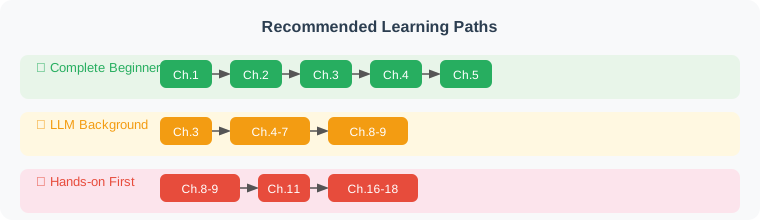
Chapter Structure:
- Concept Explanation — Core concepts explained in plain language with analogies
- Architecture Diagrams — Clear diagrams showing system design
- Code Practice — Complete, runnable Python code
- Exercise Challenges — Hands-on exercises to reinforce learning
- Further Reading — Recommended papers and resources
Technology Stack Overview
This book primarily uses the following technology stack:
- Programming Language: Python 3.11+
- Core Frameworks: LangChain, LangGraph, OpenAI Agents SDK
- LLM Services: OpenAI API (GPT-4o/GPT-5), Anthropic (Claude 4), Open-source models (Llama 4, Qwen 3)
- Agent Protocols: MCP (Model Context Protocol), A2A (Agent-to-Agent), ANP (Agent Network Protocol)
- Vector Databases: ChromaDB, FAISS
- Web Framework: FastAPI
- Other Tools: Docker, Pydantic, asyncio, uv
Ready? Let's embark on the Agent development journey together! 🚀